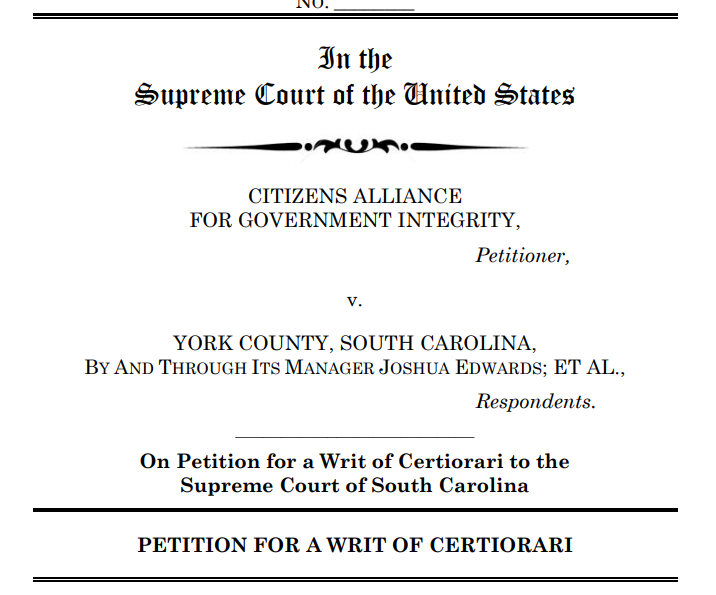

A Fort Mill area nonprofit representing more than 8,000 York County residents has asked the U.S. Supreme Court to review York County’s permitting of the Silfab Solar manufacturing facility on Logistics Lane, arguing that county officials kept issuing permits for a use the county’s own zoning appeals board had ruled prohibited.
The petition for a writ of certiorari was filed May 14 by Citizens Alliance for Government Integrity, the nonprofit that has spent more than two years challenging the conversion of a warehouse of about 840,000 square feet at 7149 Logistics Lane into a solar panel and photovoltaic cell manufacturing plant. The filing names York County as respondent, by and through County Manager Joshua Edwards, along with York County Development Services Manager Josh Reinhardt and Director of Planning and Development Jonathan Buono.
The Question Before the Court
The petition asks the justices to decide a single federal constitutional question. Stated in the filing, that question is whether local executive officials’ issuance of land use permits after a local board of zoning appeals has ruled the proposed use prohibited may support a claim of arbitrary executive action under the Fourteenth Amendment.
Lauren Joseph Wolongevicz of Appellate Counsel, PC, in Boston is listed as counsel of record for the nonprofit.
The petition frames the dispute as turning on a basic question of executive authority. After the York County Board of Zoning Appeals ruled in May 2024 that solar panel manufacturing was not a listed use in the property’s Light Industrial district and was therefore prohibited under the York County Code, county staff continued to issue permits for the project without any rezoning, variance, stay, or other lawful change of use approval. The petition calls that conduct ultra vires and characterizes the permits as void ab initio.
How the Dispute Reached This Point
According to the petition, Silfab sought zoning verification for its proposed operations in late 2022. On December 27, 2022, the county’s zoning office issued a letter signed by a zoning technician stating that the proposed operations were compatible with Light Industrial zoning because they constituted electrical equipment, appliance, and component manufacturing.
In 2023, York County Council enacted Ordinance No. 6623, authorizing a fee in lieu of tax agreement to induce Silfab to locate the project in the county. The petition states the ordinance was an economic development measure that did not rezone the property and did not authorize any change in use. A former vice chair of York County Council submitted an affidavit averring that the warehouse “was never zoned for anything other than distribution.”
In early 2024, a Fort Mill resident requested a formal zoning interpretation. The zoning administrator concluded that solar panel manufacturing fell within “computer and electronic product manufacturing” and was therefore permitted in the Light Industrial district. That determination was appealed.
In May 2024, after a public hearing, the Board of Zoning Appeals voted unanimously to reverse the zoning administrator. The board later issued a written order concluding that solar panel manufacturing did not constitute computer and electronics product manufacturing, was not a listed use in the Light Industrial district, and was prohibited under the York County Code.
Silfab and its landlord appealed that ruling to circuit court, where the appeal remains pending. The petition alleges that even while the appeal has been unresolved, county officials have continued issuing permits and construction has continued at the site.
State Court Path
The nonprofit has pursued several state court actions in parallel. A September 2024 circuit court action seeking declaratory and injunctive relief was stayed pending resolution of the administrative appeal, with no stay placed on construction permits. A separate action by a neighboring property owner was dismissed in substantial part on pleading grounds.
On October 28, 2025, Citizens Alliance for Government Integrity filed an original action in the Supreme Court of South Carolina seeking mandamus, prohibition, and injunctive relief against the county and county officials. On December 16, 2025, the state supreme court entered a one page order declining to entertain the matter in its original jurisdiction. The order included no opinion explaining the basis for the decision.
That unexplained order is part of what the federal petition asks the U.S. Supreme Court to address. The filing argues that at minimum the case warrants vacatur and remand so the South Carolina Supreme Court can clarify whether it rejected the federal due process claim or relied on a state procedural ground.
The Circuit Split
The bulk of the petition is devoted to documenting a disagreement among the federal courts of appeals on how to treat permits issued after officials lack lawful authority to issue them.
The Second Circuit, the filing argues, has held that land use action tainted by fundamental procedural irregularity, including action taken without legal authority, may be sufficiently arbitrary to support a substantive due process claim, citing Cine SK8, Inc. v. Town of Henrietta. The Third Circuit, by contrast, requires conduct that shocks the conscience beyond even bad faith violations of state law, citing United Artists Theatre Circuit, Inc. v. Township of Warrington. The Eleventh Circuit, the petition states, generally forecloses substantive due process review of executive deprivations of state created land use rights altogether, citing Hillcrest Property, LLP v. Pasco County.
The petition argues that whether such alleged conduct is merely a state law dispute or can rise to constitutional dimension should not depend on geography.
What Is at Stake Locally
The petition states the proposed facility would handle hazardous and pyrophoric chemicals, including trimethylaluminum, phosphorus oxychloride, hydrofluoric acid, hydrochloric acid, silane, and boron trichloride.
The filing includes affidavits from Fort Mill resident Amanda Morrison and from Jason Rhoades. Morrison avers that the property is being converted from a distribution warehouse into an industrial manufacturing use that violates the county’s zoning code and “will emit pollutants near our schools and homes.”
The nonprofit’s request for emergency relief in state court argued that ordinary litigation has not kept pace with rapid construction at the site, leaving the legal questions unresolved while the project advances on the ground.
What Comes Next
If the U.S. Supreme Court denies certiorari, the petition states, Citizens Alliance for Government Integrity plans to pursue its federal claims in U.S. District Court under federal civil rights law.
In the meantime, the underlying circuit court appeal of the Board of Zoning Appeals ruling has not been decided, and construction at 7149 Logistics Lane continues.
Source

Sign up for our Sunday Spectator. Delivered to your inbox every Sunday, with all the news from the week.

Thomas Hyslip lives in Tega Cay with his wife and daughter. After 27 years in the U.S. Army and Federal Law Enforcement, he retired to pursue his passion for teaching. Tom is now an Assistant Professor of Instruction at the University of South Florida. In 2 short years he has won 10 awards from the South Carolina Press Association, including first place in column writing, education beat reporting and best podcast.