

The York County Council convened its regular meeting Monday, April 6, 2026, with Chairwoman Cox presiding, opening what proved to be a lengthy and emotionally charged session that stretched well past four hours. The evening began with the council pausing to honor the memory of longtime County Attorney Michael Kendry, who died unexpectedly on March 21, before moving through a full slate of business that included the acceptance of a $100,000 corporate road improvement donation, passionate public testimony on data center development, five rezoning actions, a development agreement for two new Clover School District schools, a land use code update, and an extended executive session that produced two post-session votes.
In Memoriam: County Attorney Michael Kendree
Before any formal business was conducted, Chairwoman Cox led council in honoring Michael Kurt Kendree, who served York County for more than 23 years — the last 15 as county attorney — before his sudden death at age 58. Cox described the loss as deeply personal to everyone on council and county staff, noting that Kendree’s usual seat at the council bench had been set with a flower in his memory.
Cox came down from the dais to personally read a proclamation in memoriam to Kendree’s wife Angie and sons Michael Jr. and Harrison, who attended the meeting. The proclamation detailed Kendree’s life — his Philadelphia roots, his wrestling scholarship to Furman University, his University of South Carolina law degree earned in 1991, his love of the Phillies, Eagles, golf, and family — and described him as “the quintessential southern gentleman with a keen legal mind, a tremendous work ethic, a calm and professional temperament, quick wit, and dedication to serving the citizens of York County.” It recognized him as a loyal fixture who guided the county through periods of massive growth and change over more than two decades.
Council members visibly struggled with the tribute, and several returned to the loss in their closing comments, with one long-serving council member reflecting that after 14 years of working alongside Kendree, “that’s your extended family.”
Transportation Committee: Intersection Dedication for Lt. Larry Vaughn
Immediately before the regular council meeting, the York County Transportation Committee convened briefly and unanimously approved an intersection name dedication honoring Lieutenant Larry LV Vaughn at the intersection of Black Street and Dave Lail Boulevard. The committee allocated the required $500 in funds to erect the memorial signs as required under state law. The legislature had originated the request and the South Carolina Department of Transportation had forwarded it to council.
AT&T Presents $100,000 Check for Lazy Hawk Road
Kathleen Evans of AT&T appeared before council to present a $100,000 check to York County for improvements to Lazy Hawk Road, made through the South Carolina Utility Tax Credit Program. Evans said the statewide program encourages companies to invest in eligible local infrastructure supporting economic development, and that AT&T selected York County as its partner for this funding cycle. She said the project is expected to generate a $5 million economic impact and bring 146 jobs to the region. Chairwoman Cox thanked AT&T, quipping that council is always appreciative when road infrastructure is paid by someone other than the taxpayers.
Public Forum: Data Centers and Zoning Accountability Dominate Testimony
Council heard from ten speakers during the public forum session, with the overwhelming majority focused on two contentious issues: the ongoing QTS data center construction near residential areas and the Silfab solar panel manufacturing facility’s compliance with county zoning law.
Kate Hanower of Fort Mill addressed council directly on the Silfab matter, reading from what she described as the county’s 108-page response to an attorney general inquiry. She argued the response failed to produce a single lawful, appealable zoning compliance approval for the facility, and said the civil construction approval on record explicitly states it is not a zoning compliance document. “York County approved construction and now allows operations to continue without ever producing the one zoning decision the law requires,” she said, calling it a failure of zoning law, due process, and accountability, and demanding the county manager be held accountable.
Multiple speakers addressed QTS, the data center under construction off Hands Mill Highway. Nesh Patel, a Westport community resident, said new homebuyers near the site have no visible signage warning them of the large-scale industrial facility being built nearby, calling it fundamentally unfair to families making the biggest investment of their lives. He raised concerns about industrial noise, light pollution, nitrogen oxide emissions, and energy strain.
Steve Penland, whose farm borders the QTS site on two sides, urged the planning committee developing recommendations to require setback distances measured from all property lines — not just residential — and suggested a 200-foot vegetative buffer, a 12-foot berm, and a 500-foot setback from that berm as a starting point.
Chris Thompson of York brought drone photographs from a visit she made to a comparable QTS facility in Fayetteville, Georgia, describing a square mile of flattened, treeless land covered with industrial buildings, substations, generators, and construction equipment. She noted one key difference from what is proposed locally: the Georgia buildings are 40 feet tall, while the York County facility is approved for buildings up to 80 feet. She urged council to visit Fayetteville before making further decisions and called for a moratorium on data centers in York County.
Stacy Armstrong of Rock Hill, who lives approximately 350 feet from the QTS site, described ongoing noise that county monitoring has been unable to adequately capture. She obtained a copy of a noise study performed by engineering firm Arup through a records request and told council the study covers only chiller noise — not generator noise, electrical noise, or other sources — and that even meeting the chiller noise standard on paper required the assumption that louvered walls would be replaced with impervious walls.
Clark Wells of Clover referenced a recently published book on the AI industry’s global expansion, describing a documented pattern in which data center developers enter communities under shell companies, make donations to dampen resistance, and make sustainability promises that are later walked back after construction begins. He called for clear, measurable, and enforceable standards and a moratorium until those are in place.
Tammy Norett raised the question of what the county will do with the additional approximately 400 acres of data center-related property that QTS recently purchased, urging the pending ordinance doctrine be applied to require new proposals to meet updated standards. She also raised heat island concerns and called for a decommissioning bond requiring the land to be restored to its prior condition if a facility shuts down.
Rebecca Sichi of Allison Acres argued that the zoning guidance initially proposed by county development staff in February was so insufficient that residents had to step in and draft a substantially more detailed recommendation themselves, and said the current amendment guidance still leaves too much open to interpretation to adequately protect nearby residents.
Ken Sichi, a firefighter-paramedic who lives near the QTS site and works 24-hour shifts, told council he can no longer rest at home due to jackhammers, truck jake brakes, backup alarms, and rock grinders running throughout the day. “Easter was the first day that I didn’t hear anything,” he said. “And to be quite honest, it went from not being able to hear anything to rage, because I knew that that wasn’t going to be what today was.”
Scott Cochenour of Fort Mill offered brief positive comments on community events including the Shamrock Jam on Main Street before deferring his remaining time.
Consent Agenda
Council approved the consent agenda as amended, with Item 6 — a stopple certification related to a fee-in-lieu tax agreement — pulled for separate discussion under new business. The vote was unanimous.
Public Hearing 1: Rezoning Case 26-04 — Santar Drive Residential Lots (District 2)
First Reading — Approved
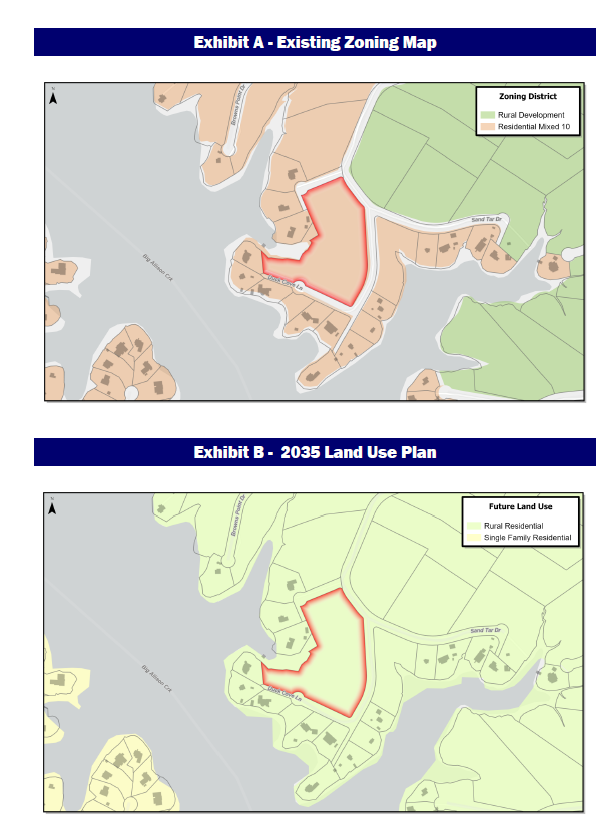
Council held a public hearing and approved the first reading of a rezoning request for 8.38 acres off Santar Drive, south of the Duke Energy Nuclear Facility on Lake Wylie, from RMX-10 to RUD. The applicant proposes to subdivide the property into six large-lot homes of approximately one acre each. Planning staff and the Planning Commission both recommended approval by a 6-1 vote, finding the request consistent with the comprehensive plan’s rural residential future land use designation and compatible in scale with neighboring properties.
One neighbor, William Larry Bergen of Duck Cove Lane, spoke against the request, saying he and other adjacent property owners had been assured when the original Premier Properties development was approved that no lots in the area could be less than five acres, and that allowing this rezoning would undercut both the letter and spirit of that limitation.
Council members asked for clarification and learned that the current RMX-10 zoning could allow approximately 30 to 32 homes on the same acreage, compared to the six proposed under RUD. One council member emphasized to the audience that the rezoning actually reduces the number of homes that could be built, offering more protection to existing neighbors than the current zoning would. Bergen was encouraged to contact planning staff directly and to attend the two remaining readings. The motion to approve first reading carried with opposition noted.
Public Hearing 2: Rezoning Case 26-06 — Highway 160 Commercial Property (District 1)
First Reading — Approved
Council approved the first reading of a rezoning request for approximately 1.776 acres off Highway 160 near Fort Mill from a Planned Development established in 2008 to General Commercial, to allow two drive-through-centric businesses — identified during discussion as a Dutch Brothers Coffee and an ice cream shop. Planning Commission unanimously recommended approval, finding the PD outdated and the GC designation consistent with surrounding commercial development along Highway 160.
Jacquelyn Alby of the Fieldstone community, whose home abuts the property at the end of Gentle Winds Court, spoke in opposition, raising concerns about traffic on an already congested Highway 160, food smells and odors directed toward homes, noise, lighting, and trash management potentially attracting rodents. Her neighbor Justin Murray echoed the concerns, noting that a prior promise of a buffer when Goodwill was built nearby resulted in removal of the tree line and persistent noise from a trash compactor.
The applicant’s representative, Molly Kilpatrick, said the site plan includes an eight-foot fence and landscape buffer, a photometric lighting plan ensuring zero light spill across property lines, and coordination with SCDOT on Highway 160 access requirements.
Council raised multiple questions for staff to answer before second reading, including the adequacy of driveway separation between the proposed access point and Goodwill’s existing curb cut, whether deceleration lanes should be required, what traffic volumes Dutch Brothers generates at comparable locations, and whether moving to GC provides more or less buffer protection than the existing PD. One council member noted observing at least 15 vehicles backed onto Selenise Road waiting for Dutch Brothers coffee at another location the previous evening. Staff committed to providing answers before the next meeting. The motion to approve first reading carried.

Public Hearing 3: Rezoning Case 26-07 — Gold Hill and Highway 21 Light Industrial to GC (District 7)
First Reading — Approved Unanimously
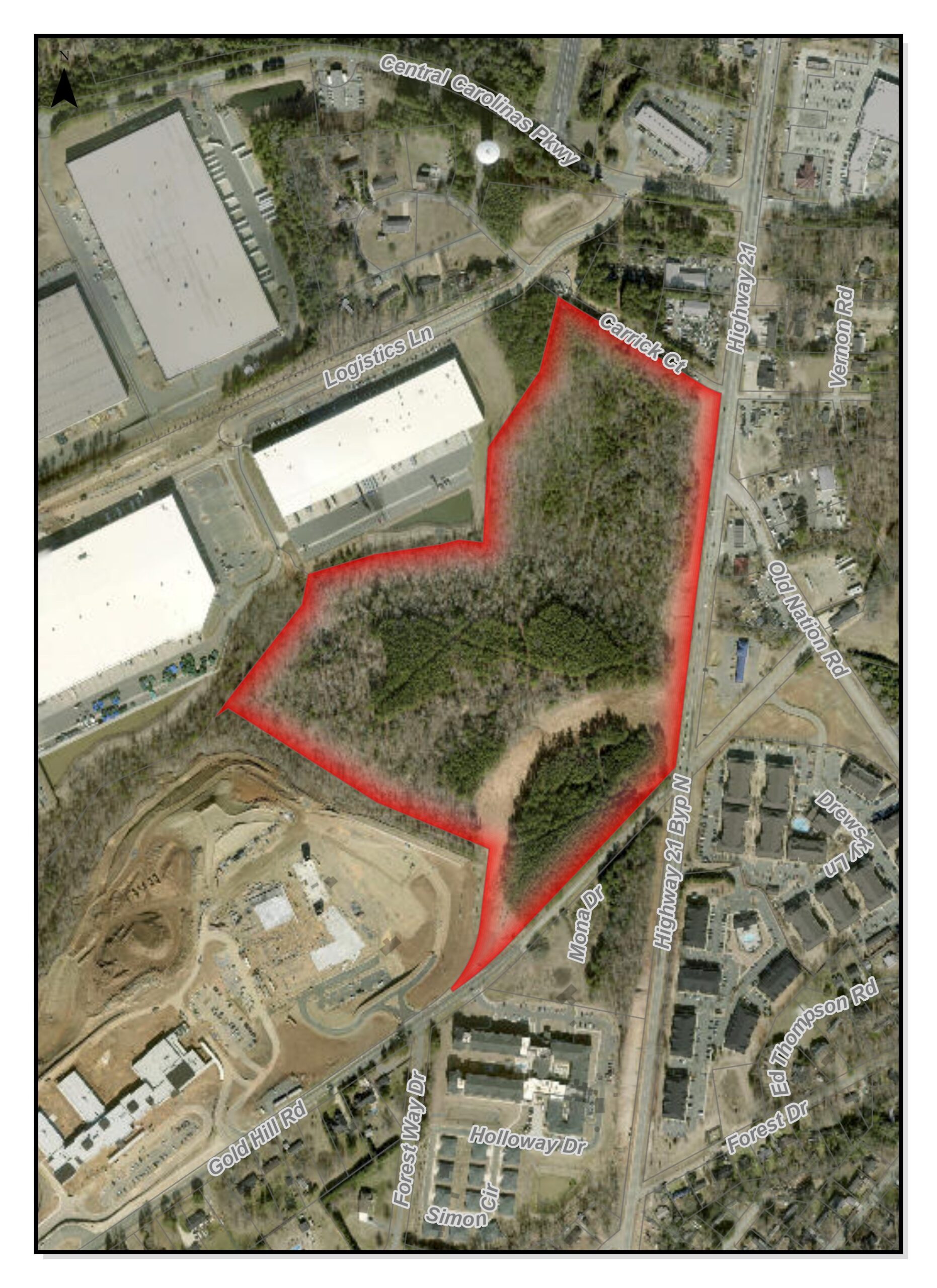
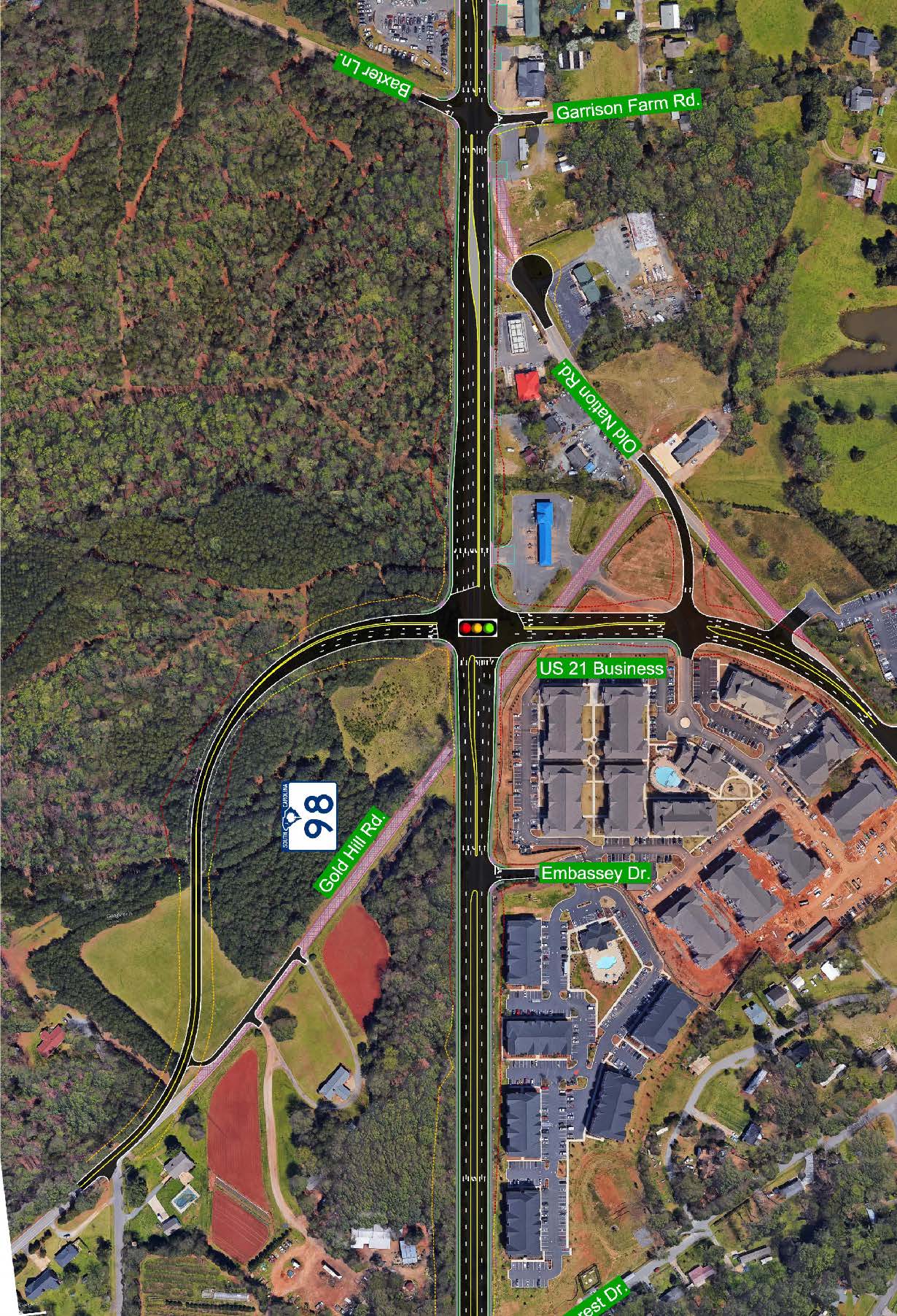
Council unanimously approved the first reading of a rezoning request for approximately 50.8 acres at the intersection of Gold Hill Road and Highway 21 from Light Industrial to General Commercial. The property belongs to the Eubanks family, which has held the land for over 100 years. The applicant’s attorney, Stephen Acra, detailed the family’s long history with the land, including land donated to the Fort Mill School District for an elementary school, 28 acres donated to the district as a natural preserve honoring the Eubanks family’s ancestor Thomas Hall (for whom Tom Hall Street is named), and a prior sale of the northern portion to the Rockefeller Group that eventually resulted in the Silfab solar manufacturing facility — a development the family deeply regrets.
Acra said Lee Eubanks desires the GC rezoning specifically to prohibit both industrial manufacturing and warehouse and distribution uses on the remaining 50 acres, and intends to record a declaration of restricted covenants upon rezoning approval that would also prohibit certain GC special exception uses such as adult businesses and emergency shelters. His vision is for a mixed-use business park offering retail, medical office, and restaurant services to the growing community east of I-77. Planning Commission unanimously recommended approval. The Fort Mill School District superintendent also submitted a letter stating the school board voted unanimously to support the rezoning.
One council member thanked the family effusively, saying constituents had called and emailed with an outpouring of gratitude. The motion carried unanimously.
Note: Council was advised that the public hearing notice for this case contained an error, and a corrected public hearing will be held at third reading, scheduled for May 4.
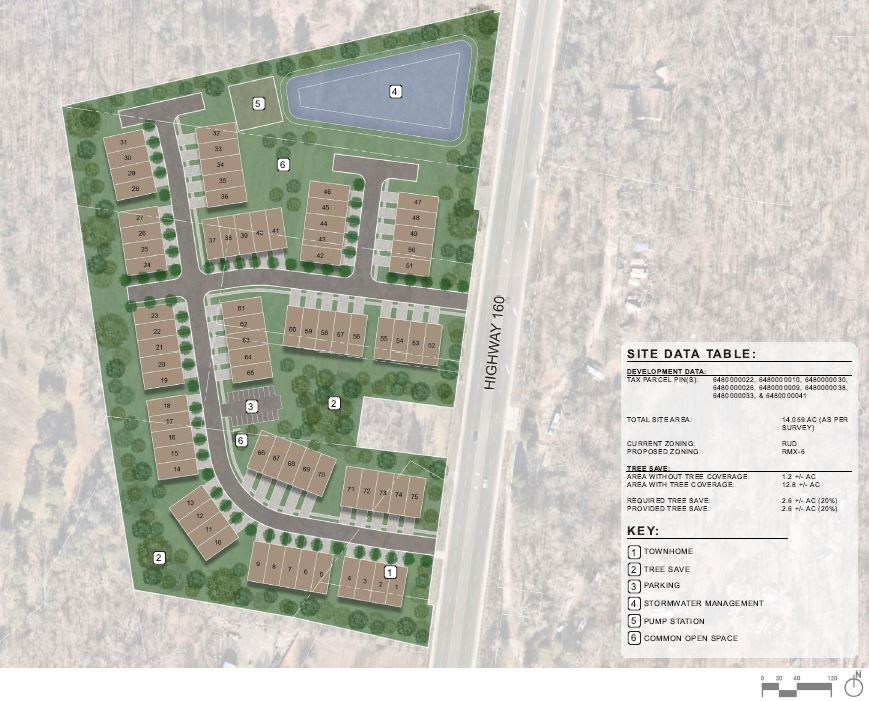
Public Hearing 4: Rezoning Case 26-08 — Highway 160 Age-Restricted Community Condition Amendment (District 1)
First Reading — Approved Unanimously
Council unanimously approved the first reading of an amendment to conditions from a previous rezoning for approximately 14 acres off Highway 160, covering multiple parcels in an age-restricted residential development. The request, by Stanley Martin Homes, seeks to change the deed restriction language from “age-restricted town home community” to “age-restricted single family attached homes or multifamily units.” No density increase is proposed.
The applicant’s representative from Kimley-Horn explained that York County’s zoning code defines “town home” very specifically to require individual lot lines around each unit, including front, rear, and side yards. Stanley Martin intends a condo-style ownership structure where the lot is the interior of the unit itself, with the HOA maintaining all exterior spaces. This structure is not permissible under the current town home restriction, though it is allowed within the RMX-6 zoning district. The representative noted a Tier 2 traffic impact analysis has already been completed and approved by both York County and SCDOT, and confirmed the primary entrance will be off Highway 160 with a two-way turn lane, while a secondary southern entrance will be gated for emergency access only. The motion carried unanimously.
Public Hearing 5: Rezoning Case 26-09 — Charlotte Highway Commercial Property (District 2)
First Reading — Approved Unanimously
Council unanimously approved the first reading of a rezoning request for approximately 0.81 acres on Charlotte Highway near Buster Boyd Bridge, across from Camp Thunderbird, from Urban Development to General Commercial. The applicant seeks to expand the permitted commercial uses of an existing four-unit multi-tenant commercial building to broaden its potential tenant base. Planning Commission unanimously recommended approval.
One council member noted concern that the rezoning was marked as not fully consistent with the comprehensive plan’s Village Center future land use designation for the area, but staff explained the Village Center designation is aspirational and the entire surrounding area is already occupied by large-scale general commercial uses, making the GC designation consistent with existing conditions. Staff noted that a nearly identical adjacent parcel was already rezoned to GC for the same purpose in a prior case. The motion carried unanimously.

Public Hearing 6: Clover School District Development Agreement — Third Reading
Approved Unanimously
Council unanimously approved the third and final reading of a development agreement between York County and Clover School District Number Two for the development of two schools and a pertinent facility on a 172.42-acre parcel on Cannonball Run and Liberty Hill Road West, and for mitigation of traffic impacts. The chairwoman noted that this type of development agreement under the South Carolina Local Government Development Agreement Act requires two public hearings, and this meeting constituted the second. No members of the public wished to speak. The motion carried unanimously.
New Business Item 1: Land Use Code Diagnostics and Revisions Update
Assistant County Manager Tom Couch and Planning Director Jonathan Buono presented an update on a targeted initiative to update and clarify York County’s 600-page land use code without undertaking a full rewrite. Couch said the department has made measurable progress since August in customer service, process improvement, and staff performance, and is now positioned to begin focused code improvements.
He outlined several known areas requiring attention, including special event and event venue regulations, trade services uses, manufactured homes in RSF-40 zoning, tree preservation, accessory dwelling units and tiny homes, self-storage units, and split zoning issues on county maps. The proposed process would begin with a brief survey sent to each council member to gather priorities, followed by a phase work program, referral to the Planning and Zoning Commission, and a goal of returning recommendations to council by late summer.
One council member asked how public input would be incorporated, and Couch acknowledged that broader public engagement would extend the timeline — noting the rural zoning project was completed in just under six months with a structured public process — and said the breadth of public engagement can be calibrated based on council’s direction. Chairwoman Cox confirmed this represents the next phase of a two-year initiative to simplify and modernize the code and said council’s workshops will be used to advance the discussion.
New Business Item 2: Stopple Certification — FEE/FILOT Agreement for Mountain SC LLC (FedEx Facility)
Approved Unanimously
Council unanimously approved a stopple certification tied to a 30-year fee-in-lieu of tax agreement originally executed in 2010 with what is now Mountain SC LLC, a Delaware limited liability company. The current tenant in the facility is FedEx. The certification is required by the property owner’s lender in connection with refinancing and simply confirms the county’s acknowledgment that the agreement is in good standing and that the property owner is in compliance with its investment commitment. No modification to the agreement and no new financial obligations are involved. One council member pulled the item from consent to allow for public explanation in the interest of transparency, noting the agreement predated the current council.
Council Member Comments and Data Center Discussion
Following business items, council members offered extended comments on several topics. One member formally recommended that when the data center use regulations go before the Planning and Zoning Committee, council should consider implementing a moratorium on new data center applications given the volume of activity at both the local and state level. Another member offered a detailed defense of the decision to permit 80-foot building heights for data centers, explaining that taller buildings reduce the ground-level footprint — and potentially ground-level noise — compared with shorter, more sprawling facilities, using the Fayetteville, Georgia comparison made by a speaker as context.
That same member urged council and the planning committee to think about applying industry-neutral standards — for water usage, power consumption, and decommissioning — across all industries rather than singling out data centers, given that whatever comes next technologically may bring the same concerns. She noted that in 2022 only 7 percent of businesses used AI, today it is 23 percent, and in three years it is expected to exceed 60 percent, making it impossible to predict what industry will create similar pressures next.
Several members expressed frustration with inaccurate information circulating on social media about council decisions, calling it demoralizing and difficult to navigate while still making sound decisions on behalf of the community. One member used the occasion of Kendry’s death to urge residents to focus on what truly matters in life rather than using social media disputes to build personal platforms. Chairwoman Cox acknowledged the difficulty while also reminding the public that council operates within defined statutory and constitutional parameters and cannot simply wave away regulatory frameworks, noting that those constraints also shape what can and cannot be done in response to the pending data center ordinance questions.
Executive Session and Post-Session Actions
Council entered executive session to receive legal advice on a general litigation update, a contractual matter related to the county attorney’s office, and consideration of a settlement in project number 17228-003, Track 97. After approximately two hours in executive session, council returned and took two votes. First, council unanimously approved an amendment to a 2024 mediation settlement agreement (Case CP-46-04). Second, council unanimously approved a 30-day extension to a building permit application deadline, moving the deadline to May 24, 2026. Council then adjourned.

Sign up for our Sunday Spectator. Delivered to your inbox every Sunday, with all the news from the week.

Thomas Hyslip lives in Tega Cay with his wife and daughter. After 27 years in the U.S. Army and Federal Law Enforcement, he retired to pursue his passion for teaching. Tom is now an Assistant Professor of Instruction at the University of South Florida. In 2 short years he has won 10 awards from the South Carolina Press Association, including first place in column writing, education beat reporting and best podcast.