
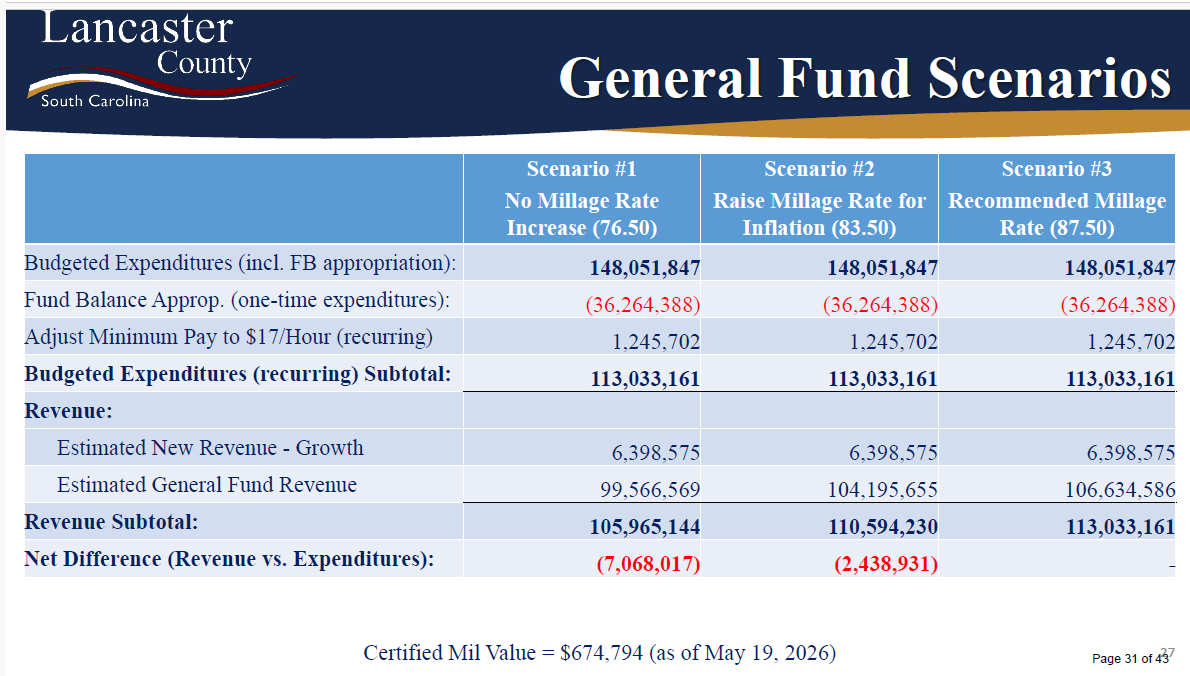
Lancaster County Council held a special meeting on May 21, 2026 devoted entirely to the Administrator’s Recommended FY27 Budget, presented by Interim County Administrator Steve Willis with CFO Sabrena Harris and Budget Director Jamie Privuznak. The recommended package whittles 91 requested new positions costing $9,921,762 down to 58.5 positions at $5,594,138 (48.5 general-fund positions at $4,975,217 plus 10 Indian Land Consolidated Fire Service District positions at $618,921 funded from Fund 52 rooftop fees), and trims overall new-request spending from $58.4 million requested to $16.1 million recommended. Staff laid out three general fund millage scenarios against a new certified mill value of $674,794: a flat 76.5 mills producing a $7,068,017 shortfall, an inflation-adjusted 83.5 mills with a $2,438,931 shortfall, and a fully balanced 87.5 mills, with Mr. Willis recommending the middle path that adds 2.3 mills countywide (97.2 to 99.5 total, roughly $27.60 per year on a $300,000 home). Council also worked through a proposed $36,264,388 fund balance appropriation drawn against $70,234,561 in estimated unaudited reserves, weighed three hourly-wage floors ranging from $17 to $21 with cost impacts from $1,245,702 to $3,890,553, debated multi-station fire construction funded by either fund balance or a future general obligation bond, and identified an immediate $670,000 savings on the 12-position Motorola 911 console replacement after Robert presented a revised quote. Council directed staff to remove the $4 million CIP-approved development services building from fund balance, move the $430,000 Solicitor capital project from operating into fund balance, drop the $72,500 Olde English District allocation pending verification, and explore standardized “cookie-cutter” fire station designs for three locations. Mr. Graham and Mr. Carnes stated they cannot support any millage increase given anticipated revenue growth, and Mr. Harper challenged the $6,398,575 new revenue projection as potentially conservative. No formal votes were taken despite the special-meeting setting allowing them; revised numbers will return for first reading on May 26, with the budget cycle continuing through second reading June 8, an additional special meeting June 10, and third reading and adoption June 22.
Call to Order, Pledge, Invocation, and Agenda Approval
Chair Brian Carnes called the special meeting to order, with the clerk noting a quorum present and proper public notice given. Council Member Billy Mosteller led the Pledge of Allegiance and delivered the invocation, asking guidance and wisdom in discussing the county budget and thanking department heads for attending. The agenda was approved unanimously on a motion by Ms. McGriff, seconded by Mr. Neal. There were no citizens comments, and Council moved directly to the budget discussion.
Discussion of Administrator’s Recommended Budget
Opening framing from the Administrator
Mr. Willis opened by emphasizing that the budget adheres to council’s strategic-plan priorities, with public safety as the dominant theme. The 48.5 general-fund new positions break down as follows: one Case/Records Data Manager at the Coroner’s Office; 15 EMS positions (nine paramedics and EMTs tied to the schedule change from 24/48 to 24/72, five paramedics for the EMS-Fire Services partnership previewed at the March 11 COW meeting, and one Paramedic Instructor coming off a grant ending September 2026); four Lancaster County Firefighter positions (two Firefighter Engineers for the EOC, plus a Logistics Officer and Apparatus Technician); 16 positions at the Sheriff’s Office (a Staff Attorney starting January 1, 2027 at $166,408 including vehicle—reduced from the $230,888 request; a Gang Investigator and a Criminal Justice Coordinating Council Coordinator both rolling off grants in October 2026; one Real-Time Crime Center Manager tied to $1.26 million in federal funds; eight Corrections Officers; and four Non-Sworn Booking Clerks); plus an Auditor’s Clerk, an Animal Shelter Kennel Technician, a Building Inspections Development Services Coordinator Technical Assistant, one Building Maintenance Aide (from three requested), a half-time Finance Accounting Specialist, an IT Cybersecurity Manager, an IT ERP Specialist, two Parks & Recreation Recreation Facility Managers for Buford and Andrew Jackson, two Recreation Associate conversions from part-time to full-time, a Procurement Specialist II, and a Veterans Affairs Receptionist. The 10 Indian Land Consolidated Fire Service District positions—three Firefighter I, three Captains, three Engineer Drivers all starting January 1, 2027, and one Logistics Officer—are funded from Fund 52 rooftop fees rather than general fund.
Among the positions requested but not recommended for FY27: a Residential Plans Examiner, three QRV Response Team EMTs, a Family Court Legal Clerk 1, two Human Resources positions (Generalist II and Support Technician), an IT Technician I, a GIS Analyst, three Shift Captains and three Shift Engineers for Station 2, a Firefighter Technician’s Assistant, a Community Engagement/Fire Safety Educator, two Traffic Deputies tied to an ending grant (the Sheriff said he’s gambling on grant renewal), a Library Circulation Assistant, two Parks and Recreation Program Activity Leaders, a Procurement Specialist I, and four 12-hour response unit EMS positions split between Indian Land and the City of Lancaster.
Mr. Willis warned that with no millage increase, council would need to “take a buzz saw” to the budget, and even with the inflation-adjusted increase he recommended, about $2.4 million in cuts would still be needed. He cited public works examples—a $190,000 increase in stone costs (from $710,000 to $900,000) and $351,609 more in road maintenance contract services (from $3,148,391 to $3,500,000)—as illustrations of inflationary pressure. He also flagged a $400,000 increase in Solid Waste Collections (from $2.1 million to $2.5 million) reflecting tipping fee and tonnage increases. He invoked the old Fram oil filter line “pay me now, pay me later” to push back against further deferral.
New positions and timing
Mr. Mosteller asked whether positions could be staggered to start mid-fiscal-year. The Sheriff confirmed the Staff Attorney is already budgeted at a half-year start, the grant rollover positions all begin around October 1, and he could accept the detention center hires—eight Corrections Officers at $776,837 and four Booking Clerks at $284,580—split half up-front and half in January, provided officers come first and booking clerks follow. Chief Nicholson’s Logistics Officer is full-year while his Indian Land firefighters are budgeted at half-year (Firefighter I reduced from $302,745 to $151,373, Captains from $399,588 to $199,794, Engineer Drivers from $332,061 to $166,031). Clay (EMS) confirmed EMS positions are budgeted at 12 months but agreed that of the 15 medic allotments, only two need to start immediately, with the other 13 able to begin in January when the 24/72 shift transition occurs. Council asked staff to track the cumulative savings from this staggered approach.
Non-personnel line items over $50,000
Ms. Privuznak walked through line items with deltas above the $50,000 threshold, totaling $3,116,868 in net increases. Key items included Building Maintenance Service Agreements rising $77,194 to $377,194 (elevator repairs and similar); County Council Local Grant Match jumping $519,492 to $1,379,506 (includes $400,000 matches for Rural Infrastructure Authority grants and a $119,000 Year 1 local match for two Mobile Crisis Units at the Sheriff’s Office); Fire Service Equipment up $58,070; HR Contract Services rising $73,053 for background checks, history checks, and drug screenings; HR Professional Services Medical at $142,290 (an on-site nurse practitioner transferred in from the Administrator’s operating budget, which Mr. Harper raised as a clarification point); HR Tuition Assistance at a new $60,000; Non-departmental Insurance General up $84,662; Parks & Recreation Special Events doubling from $60,000 to $120,000 to host events like July 4th; Sheriff’s Office Contract Services up $350,202 for additional Flock cameras and body cameras; Sheriff’s Office Professional Services Legal/General up $80,296 (transferring the on-staff attorney cost from wages to contract services); and the road maintenance and solid waste increases noted above.
The slide listing “Registration & Elections – Contract Services” at $280,000 (a $250,000 increase) was struck for first reading—that work was moved into part-time employment under a separate ordinance council was set to pass Monday. The remaining $220,000 Registration & Elections line item ($150,000 for redistricting and two August elections plus $70,000 for printing and mailing new voter registration cards) hinges entirely on whether the General Assembly passes the proposed congressional redistricting moving Lancaster County from the 5th to the 6th Congressional District. Mr. Willis said he expects the Senate to pass it on simple majority during special session and the governor to sign, but emphasized that if it doesn’t pass, the money rolls back to fund balance.
External agencies
External agency funding totaling $3,316,546 (a $1,012,011 increase over the $2,304,535 adopted last year) drew several questions. The 250 Committee is recommended at $20,200 (new) covering promotional expenses, administrative expenses, and Hanging Rock Project bench purchases. The Association of Counties is at $13,041 (down $378). Catawba Mental Health, which requested $80,000 for a new Mental Health Clinician, is again recommended at zero; Mr. Willis invited council to push back if they disagreed. Catawba Regional Council of Governments holds at $58,172; Clemson Extension drops $2,500 to $25,000 at the agency’s request; Council on Aging holds at $100,000 for the LARS program (the agency requested more for substantial growth and increased usage); Delegation Disbursement rises $5,000 to $30,000; Historical Commission rises $14,242 to $22,812 (intern, marker repair, hosts, and marketing, with the Director and Intern requests stripped out by Admin); Lancaster Soil and Water Conservation rises $88,741 to $228,221 (with the part-time Education/Outreach Coordinator at $20,000 stripped out by Admin); Public Defender rises $164,274 to $787,220 (new part-time law clerk, new full-time attorney, attorney career ladder); and Solicitor rises $219,932 to $1,526,670 (Veterans Court, Axon Justice, attorney career ladder).
The Olde English District line at $72,500 (new) was questioned by Mr. Harper, who recalled the organization had previously been funded through hospitality tax dollars; the justification was a $16,500 increase for a new Revolutionary War Trail tied to 250th anniversary tourism. Council signaled it should be removed pending further information. The Solicitor – Capital Project at $430,000 for the 3rd floor courthouse renovation suite—a figure validated by Tim Green and Chad Catage—was, at Mr. Harper’s suggestion, moved from the external agency operating list into the fund balance appropriation list.
Fund balance: $72M audited, $70.2M unaudited estimate, $36.26M proposed appropriation
Ms. Harris and Ms. Privuznak walked council through fund balance mechanics. The audited June 30, 2025 balance was $72,005,083. After the FY2026 adopted appropriation of $5,065,474 and interim budget amendments totaling $1,309,070 (Solicitor $600,000, EMS Cardiac monitors $489,332, EMS Garage bay $180,000, EMS Temp devices for medications $39,738), and an estimated $4,604,022 contribution back at year end (revenues over expenditures net of remaining payroll, encumbrances, and outstanding obligations), staff projects $70,234,561 unaudited available. Mr. Harper publicly congratulated staff on the $4.6 million figure as evidence of a well-run organization, noting it reflects council and staff doing their jobs properly.
The proposed $36,264,388 fund balance appropriation (Exhibit C in the packet) would leave $33,970,173 remaining—within the 28–32% policy range of general fund operating budget. Key items include:
- Fire apparatus (Exhibit D): $18,747,966 at list price for 24 line items covering county-wide truck replacement. Priority 1 is Station 31’s 1994 Chevrolet Squad (1831, 140,353 miles) at $756,000; priorities 2–5 are 1998 KME/Ford Tankers at $575,000 each from Stations 1, 5, 8, and 16; priority 6 is a 2004 Spartan/Smeal Engine (1402, 89,944 miles, 6,179 hours) at $1,140,000; and priority 19 is the 1985 C70 Chevrolet Hazmat (133,791 miles) at $1,600,000. The list also includes a $1,600,000 County Wide Rescue and a $42,466.25 Light Trailer with $11,500 tax. Chief Nicholson confirmed roughly 28-month delivery on Pierce builds with historical 10% discounts for paying up front and multi-truck bundling, with Procurement Director Tracy expected to negotiate the actual price down.
- 911 console replacement: revised downward. Robert presented an updated Motorola quote dated April 10, 2026 (valid 60 days) at $1,571,229.94 inclusive of a $360,000 Access Console promotion savings—dropping the original $1.9 million line to roughly $1.25 million plus future service agreements. Mr. Harper, Mr. Graham, and others urged moving forward this year, citing risk of price escalation to potentially $2.5 million next year if the systems hit end-of-service-life and Motorola stops servicing them. Mr. Willis confirmed the line item would be reduced accordingly. The full Public Safety Communications appropriation also includes $750,000 Fire Dispatch CAD Integration and $300,000 Generator Replacement.
- Arrowwood drainage: an additional $400,000 (combined with last year’s $400,000 for an $800,000 total project). Public Works Director Mr. Kato (Jeff) explained the additional engineering revealed pipe work on both sides of the road conflicting with a sewer line. The project affects approximately eight property owners directly plus the Craig Avenue intersection ($100,000 per owner equivalent). Staff plans to apply in September for a small RIA grant (up to $5 million cap) to offset construction costs.
- Animal shelter renovation: $120,000. Mr. Kato described extending the concrete pad and prefab building to give animal control officers a dedicated office area with power and a mini-split. Ms. McGriff and Mr. Mosteller questioned the scope and longevity; staff agreed to revisit. Long-term shelter expansion is constrained—nursing home to the west, Ageland Highway north, detention pond south—leaving only an eastward triangular parcel that would need to be acquired.
- Christmas bonus increase to $860,500. At Ms. McGriff’s recommendation, the bonus rises from $500 to $1,000 for the 747 full-time staff and from $250 to $500 for the 227 part-time staff. The increase, funded from fund balance as a one-time item, adds approximately $450,000 over last year.
- CIP-approved development services building: $4,000,000 removed. Council agreed the planned building under Planning & Zoning is not needed at this time.
- Special election contingency: $250,000 for printing and mailing new voter registration cards and conducting the August election only if redistricting passes.
- Economic development spec building: $2,041,675 — Mr. Harper recommended removing this CIP-approved site prep and vehicle purchase and deferring the decision until the new administrator is in place.
- Parks & Recreation mini buses: $266,800 (two of four requested) — Mr. Harper proposed cutting; Ms. McGriff disagreed.
- Walnut Creek soccer field turf replacement: $1,108,739 (partially funded by CPST3).
- Flat Creek improvement: $72,800 — the county share of a state-grant-funded project secured by Parks Director Chris.
- Coroner’s new facility: $850,000 (partially ARPA-funded).
- Sheriff’s Office vehicles: $1,053,878 for 15 replacement deputy vehicles at $66,000 each plus one new vehicle for the Staff Attorney. Mr. Willis clarified the Sheriff procures 25 total replacement vehicles annually, with 15 from fund balance and 10 from Fund 11 capital replacement.
- Other items: ERP Project Year 2 of 3 at $1,539,151; Information Technology hardware for vehicle upfits at $560,222; Airport Operations Fund transfer at $214,004; Building Maintenance new van at $56,988; Fleet floor scrubber at $20,466; EMS floor replacement, commercial kitchen, and station generator at $91,199; Country Club Park playground equipment at $85,000; and Road Maintenance equipment, inventory, transportation plan, and additional projects at a combined $1,375,000.
Major capital items not recommended
Significant items that did not make the recommended list include the $6,228,000 Riverchase Development Agreement Fire Station, the $26,228,000 Fire Service County Training Center, $320,000 for concrete at Indian Land Station 1, $1,200,000 for a Planning Commission EMS Microhub, $1,000,000 for a Workforce/Affordable Housing Land Control Fund, $80,000 for Welcome Signs for Lancaster County, a $9,350 Council Chamber Audio Video improvement, $451,220 in Sheriff’s Office Parking Lot Resurfacing, a $100,000 Sheriff’s Office Painting Project, and three 45-Passenger Buses at $587,940.
Fire station funding debate
The longest single discussion centered on fire station construction. Mr. Mosteller pushed for $6 million per station for three locations: a Pleasant Valley/Indian Land station on Harrisburg Road, an Edgewater-area station, and a Haven station on donated land. He cited a recent Indian Land fire where Pineville responded in 9 minutes, the closest Lancaster County station was 12.5 minutes out, and a station at the proposed Station 3 location would have responded in 2 minutes 36 seconds. He noted lost structure and firefighter injuries that occurred, and that fire doubles every minute. Mr. Graham, Mr. Carnes, and Mr. Mosteller emphasized that the Sunday timing avoided weekday traffic that would have made the response even slower.
Mr. Willis suggested a countywide general obligation bond as a more sustainable funding mechanism than fund balance, with first-year carrying costs built into the borrowing and debt service millage picking up in year two, referencing Franny and McNair Burr Foreman as past bond counsel. Council members discussed adopting a standardized “cookie-cutter” fire station design that could be replicated across all three locations to reduce engineering and construction costs, with departments free to add brick or other upgrades from their own funds. Mr. Mosteller offered to work with Chief Nicholson on standardized plans.
Mr. Graham raised significant concerns about the Haven location, where building a new station would overlap with Shallow Zion’s existing ISO coverage area. He warned that placing a paid station inside a strong volunteer district risks destroying volunteer recruitment and retention, citing a decline in countywide volunteers from roughly 500 when he came on to about 275 currently. He suggested expanding Shallow Zion’s station and supporting their transition to paid staff instead. Greg agreed that once paid staff enter a volunteer district, volunteer response willingness drops. Mr. Carnes acknowledged the trade-off but argued that council’s votes approving dense development require corresponding public safety infrastructure investment, citing the EMS-fire land accepted from LStar as another example of needing to follow through.
Riverchase has $2 million committed from a developer toward its station, which Mr. Carnes suggested may not need to be a fully manned station. The Edgewater situation was identified as the “next monster,” with one council member noting 1,500 to 15,000 additional units potentially coming. Council discussed reapproaching Edgewater developers about land and building contributions, noting an earlier offer through Beltown had been declined. Mr. Mosteller suggested telling developers “no building permits this year” Mount Pleasant–style if they don’t come to the table.
A side discussion on combination EMS-fire stations referenced the prior failed EMS-2 at City Fire 2 experiment, where shared sleeping quarters caused mutual disruption. Wesley Chapel’s model—shared utilities and generator but separate quarters with a firewall buffer—was cited as a workable design. Mr. Kato noted a Colombia meeting where a county had eliminated EMS stations and built ambulance bays on fire stations using 12-hour shifts; he cautioned that 70% of current Lancaster EMS staff drive an hour to work and would not accept 12-hour shifts, potentially closing EMS.
Hourly wage options
Ms. Harris presented three scenarios for raising the countywide minimum hourly wage above the current $15 floor, drawn from a 372-employee non-sworn population. The current breakdown shows 240 employees below $17/hour, 74 between $17.00 and $19.00, and 58 between $19.01 and $21.50.
- Option 1: $17 minimum — annual salary $35,360 at 2,080 hours, total budget impact $1,245,702 (with $980,513 to bring the 240 employees up, $174,257 for 5% compression adjustment on Tier II, and $90,932 for 3% compression adjustment on Tier III).
- Option 2: $19 minimum — annual salary $39,520, total budget impact $2,391,678.
- Option 3: $21 minimum — annual salary $43,680, total budget impact $3,890,553.
The 35 employees showing up as Voter Registration & Elections poll workers in the under-$17 count were flagged as a classification issue HR is correcting; the new ordinance moving them into their own category should largely zero that line. Ms. McGriff strongly supported Option 2, arguing $17/hour is not livable given current gas, grocery, utility, and insurance costs, and that surrounding counties pay more. Mr. Luis raised the question of how many Lancaster residents earn under $17, expressing reluctance to ask constituents earning less than that to fund increases; using a ChatGPT search of census data, he noted roughly 7,700 households make less than $35,360. Mr. Willis cited 2024 census data showing Lancaster County median household income at $78,869 (versus $80,734 nationally) and per capita income at $34,133, while cautioning that countywide averages mask significant variation between the panhandle and the Kershaw end. Discussion of a compensation and classification study was raised but not resolved. Council deferred the wage decision to Monday with more information.
Salary increases and compression
The recommended budget includes a 2% across-the-board increase plus a 6% career ladder adjustment for sheriff’s deputies depending on their step. Mr. Mosteller advocated raising 911 telecommunicators by approximately 5% rather than 2%, citing retention concerns against surrounding counties. He also flagged compression issues in the magistrate’s office, where the chief magistrate—the only attorney in the building—earns the same as non-attorney magistrates, and where the deputy chief earns the same as regular magistrates. Mr. Luis countered that hiring appropriate staffing levels matters more than salary increases, arguing overwork drives turnover more than pay. Mr. Carnes emphasized prioritizing public safety personnel “putting their lives on the line every single day.”
Revenue projections questioned
The recommended new revenue total of $6,398,575 breaks down as Ad Valorem $3,763,526, Vehicle Tax $1,239,917, State Aid to Subdivisions $238,935, Road Improvement Fees $346,140, 1% Local Option Revenue $671,014, and Fee in Lieu of Taxation $139,043. Mr. Harper challenged the projection. Using the new certified mill value of $674,794 against the 76.5-mill general fund rate, he calculated something closer to $5.5 million in new property tax revenue alone—suggesting the overall revenue projection may be conservative. Staff agreed to verify with the Auditor’s Office. Mr. Harper and Mr. Graham both argued that overly conservative revenue projections force unnecessary expense cuts and leave deployable money on the table. Mr. Graham and Mr. Carnes both stated they cannot support any millage increase given anticipated revenue growth.
Millage scenarios
Against a certified mill value of $674,794 as of May 19, 2026, and recurring expenditures of $113,033,161 (after the $36.26M fund balance pull-down and adding the $1.25M Option 1 wage adjustment):
- Scenario 1: No millage increase at 76.5 mills — General Fund revenue $99,566,569, total revenue with growth $105,965,144, net shortfall $7,068,017.
- Scenario 2: Inflation-adjusted at 83.5 mills — General Fund revenue $104,195,655, total revenue $110,594,230, net shortfall $2,438,931.
- Scenario 3: Recommended at 87.5 mills — General Fund revenue $106,634,586, total revenue $113,033,161, balanced.
Mr. Willis noted that under Scenario 2, the total countywide millage (general plus capital plus debt) moves from the current 97.2 to 99.5, a 2.3-mill increase equating to roughly $27.60 per year on a $300,000 home.
Cyber security manager position questioned
Mr. Harper questioned the proposed Cyber Security Manager position in IT at $146,657, noting an existing cyber security specialist role. Staff did not provide a detailed defense; the position remains on the recommended list pending further review. Mr. Harper also asked how AI factors into county finance and procurement; Ms. Harris explained that Workday’s AI features are part of the ERP rollout the existing ERP Specialist will eventually train on.
Airport operations
A $214,004 general fund transfer to the airport operations fund prompted Mr. Luis to ask when council would address making the airport self-sustaining. Mr. Willis acknowledged that general aviation airports outside passenger-service operations like Florence and Hilton Head rarely turn a profit. Airport Director Stephanie Snowden, who took over airport oversight in July 2025 and began intensive management in January, reported doubling fuel sales, hosting roughly 10 major Gulfstream visits this month including two simultaneously that afternoon, and pursuing FAA operations funding to relieve general fund support after hosting South Carolina Aeronautics the prior week. She emphasized that the corporate hangar build-out is the path to revenue, citing Sumter’s example of generating roughly $850,000 annually in tax revenue from corporate hangar tenants. Mr. Willis flagged a state-law change eliminating the automatic tax nexus for hangared planes—the county may be missing tax revenue on planes hangared locally but taxed elsewhere, which Ms. Snowden will audit. MUSC is in discussions to base a helicopter and pilots at the airport, generating hangar rental revenue. Mr. Luis, Mr. Graham, and Mr. Carnes pressed for a transparent profit-and-loss view including tax revenue generated by airport-based aircraft. Mr. Neal said shutting the airport down is not an option; it is a service akin to other county departments.
Coroner’s innovative autopsy plan
Coroner Hancock presented an in-house autopsy concept that would save approximately $40,000 annually from day one by eliminating Charleston travel (3.5 hours on a good day, up to 6 hours on a bad day) and could ultimately position Lancaster as a regional autopsy center generating revenue from surrounding counties. The plan would also reduce travel costs for the Sheriff’s Office and other agencies and reduce vehicle wear. Mr. Willis cited it as an example of department-head innovation worth supporting.
Next steps and timeline
Staff will bring revised numbers reflecting the discussion to first reading on Tuesday, May 26, alongside the CIP public hearing and ordinance reading. The schedule continues with second reading of the budget ordinance, budget public hearing, and CIP ordinances on June 8; a special meeting for further FY27 operating budget discussion on June 10; and third reading and adoption of both the budget and CIP ordinances on June 22.
Closing personal notes
Mr. Mosteller noted his 38th wedding anniversary fell on the meeting date and that he had skipped the anniversary to attend. Chair Carnes acknowledged his birthday, joking he was meeting his financial planner the next day to discuss starting Social Security.
Adjournment
The meeting adjourned on Mr. Mosteller’s motion.
Sign up for our Sunday Spectator. Delivered to your inbox every Sunday, with all the news from the week.

Thomas Hyslip lives in Tega Cay with his wife and daughter. After 27 years in the U.S. Army and Federal Law Enforcement, he retired to pursue his passion for teaching. Tom is now an Assistant Professor of Instruction at the University of South Florida. In 2 short years he has won 10 awards from the South Carolina Press Association, including first place in column writing, education beat reporting and best podcast.