
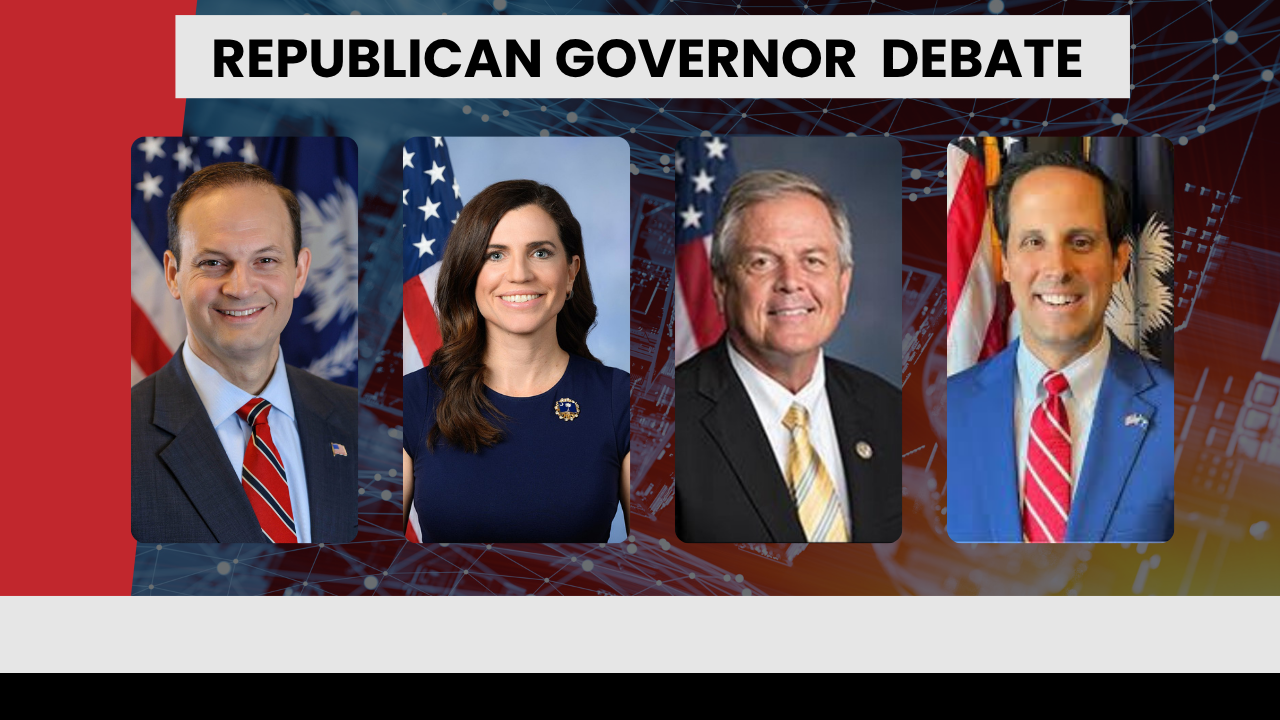

Attorney General Alan Wilson, Congressman Ralph Norman, Congresswoman Nancy Mace, and State Senator Josh Kimbrell took the stage Wednesday night, with affordability, infrastructure, and government waste dominating the conversation.
South Carolina’s Republican race for governor officially kicked off Wednesday evening as four candidates gathered at the historic Newberry Opera House for the first in a series of debates ahead of the June 9th primary. The hour-long forum, co-moderated by Justin Dory of Fox Carolina and panelists from Gray Media outlets across the state, offered voters their first direct comparison of the candidates vying to become the state’s 118th governor.
Six candidates received invitations from the South Carolina GOP, but only four accepted. Lieutenant Governor Pamela Evette declined, and real estate developer Rom Ready, who is self-funding his campaign and could not meet the original donor threshold requirements, also sat out, though he has committed to the second debate.
The tone on stage was notably civil. Senator Kimbrell acknowledged it in his closing, joking that holding the debate on April Fool’s Day meant “none of us are going to act like fools tonight.” The four candidates mostly stayed on message, with few direct attacks, though real disagreements emerged on gambling, military deployment, and fiscal strategy.
The candidates
Attorney General Alan Wilson was the first to announce his campaign and one of the first to agree to the full debate series. A 30-year Army National Guard veteran and four-term attorney general, Wilson has centered his campaign on affordability, crime, and defending President Trump’s agenda in court, something he was quick to remind voters he has literally done. He has been endorsed by roughly 80% of the state’s Republican sheriffs.
Congresswoman Nancy Mace, who represents South Carolina’s First Congressional District, is perhaps the most nationally prominent candidate in the field. A Citadel graduate and the first woman to complete the Corps of Cadets, she has built a campaign around grassroots donor support, 42,000 individual donations, dwarfing her opponents, and a detailed plan to eliminate the state income tax within five years.
Congressman Ralph Norman, the most fiscally conservative candidate on the stage, spent much of the night focused on waste, fraud, and corruption at the state level. A real estate developer and 40-year businessman, he has proposed a South Carolina Department of Government Efficiency and has been a leading voice for term limits, even calling out fellow Republicans for voting themselves pay raises while roads crumble.
State Senator Josh Kimbrell came into the night as the least-known candidate outside his Spartanburg home district. He has been stuck at around 2% in polling, but turned in a strong debate performance, staying sharp on policy, citing his own legislative record on nearly every topic raised, and presenting himself as the only candidate on stage who has had to actually vote on these issues in real time.
Key topics
Affordability was the consensus answer when each candidate was asked to name the single biggest issue facing South Carolina. All four promised to eliminate the state income tax and reduce the property tax burden on families. Mace outlined the most specific plan, proposing to freeze the general fund at 2023–24 levels and return every dollar above that threshold as a permanent tax cut. Kimbrell pointed to his sponsorship of the largest income tax cut in state history. Wilson told the story of a woman in her 40s who bought a home a few years ago and can no longer afford to live in it due to rising property taxes, insurance, and utility costs. Norman said cuts must be preceded by a forensic audit of every agency so voters know exactly what is being eliminated.
On the gas tax, all four supported temporarily suspending South Carolina’s gas tax and criticized Republican legislative leadership for blocking the measure. Wilson called for a 30 to 60 day suspension, funded by the state’s reserve fund. Mace said she had drafted a proposal that very day for a 180-day suspension. Kimbrell said he co-sponsored a bipartisan bill already filed in the Senate. Norman said cuts without a corresponding audit are irresponsible.
On infrastructure, panelist Raphael James of WCSC pressed the candidates on why voters should expect change given that South Carolina ranks 36th in infrastructure nationally despite decades of Republican leadership. Candidates largely blamed the structure of state government rather than the party. Wilson called for monetizing interstate medians with express toll lanes and leasing easements to telecom and energy companies. Mace highlighted over $400 million in federal infrastructure grants she secured for the state and called for a 10-day pothole repair requirement at SCDOT. Kimbrell cited concurrency legislation he supports that would prevent growth from outpacing roads and schools.
The most pointed disagreement of the night came on gambling. Norman was unequivocal — he opposes casino expansion of any kind, warned of human trafficking, and challenged other candidates to disclose whether they had accepted money from the gambling industry. Kimbrell said he does not want South Carolina to become Atlantic City, opposed statewide casino development and online betting, but left the door open for limited resort-style development in economically depressed communities along I-95. Wilson said he opposes brick-and-mortar casinos after extensive conversations with law enforcement and faith leaders, but acknowledged the difficulty of blocking online betting given VPN technology. Mace said she would want to review any legislation and was open to a public referendum.
On Iran and military deployment, Kimbrell was the only candidate to say without hesitation that he would support sending the South Carolina National Guard if the president asked. Wilson and Mace both noted that governors have no legal authority to block federal nationalization of state troops, and said they would not seek to put boots on the ground but would support the president at a diplomatic level. Norman aligned with sending troops if requested, and added a pointed pledge of his own — that under his administration, South Carolina would never be shut down again by any federal COVID-style directive.
On government waste, every candidate ran on a DOGE-style platform for state government. Kimbrell said he introduced a state DOGE bill two years ago and helped eliminate all legislative earmarks in the Senate budget process. Wilson said he uncovered a $20 million Medicaid fraud last summer and called for AI, blockchain, and cryptography to modernize how the state tracks spending. Mace pointed to the explosion in legislative earmarks — from roughly $30 million to $700 million in two years — as her first target and flagged SNAP fraud as a pressing problem that could cost the state hundreds of millions if not addressed quickly. Norman called out specific examples of what he called wasteful spending and pledged to actually act on a DOGE commission’s findings rather than let the report collect dust.
On school choice, all four expressed support for universal school choice and for funding following the child. Kimbrell noted he is the only candidate who has cast actual Senate votes on the issue. Wilson spoke personally, recalling that his parents sacrificed to send him to a small Christian school to meet his individual learning needs. Norman, citing his 17 grandchildren in public schools, called the system “a war zone” and advocated for merit-based teacher pay. Mace called for expanding vocational programs and pointed to Florida’s dual-diploma model as a template.
The moment of unity
At the close of the question portion, the moderator asked all four candidates by a show of hands, whether they would support the eventual Republican nominee, whoever that turns out to be. All four raised their hands without hesitation.
Debate takeaway
The post-debate consensus was that Kimbrell had his moment. Coming in as a virtual unknown to most of the state, he was consistently prepared, specific, and confident across every topic. Whether that translates into movement in the polls remains to be seen.
In an informal YouTube viewer poll conducted during the broadcast by Live 5 News, 59% said Mace won the debate, followed by Wilson at 19% and Norman at 15%. Kimbrell did not register in the viewer poll, a sign that his strong performance may have been less about winning over existing viewers and more about introducing himself to voters for the first time.
The next debate in the series is scheduled for April 21st at the Sottile Theatre in Charleston. Rom Ready is expected to participate. Lieutenant Governor Evette has not committed.
The Republican primary is June 9th.
Sign up for our Sunday Spectator. Delivered to your inbox every Sunday, with all the news from the week.

Thomas Hyslip lives in Tega Cay with his wife and daughter. After 27 years in the U.S. Army and Federal Law Enforcement, he retired to pursue his passion for teaching. Tom is now an Assistant Professor of Instruction at the University of South Florida. In 2 short years he has won 10 awards from the South Carolina Press Association, including first place in column writing, education beat reporting and best podcast.