


A Switzerland-based biopharmaceutical company that has quietly operated out of Charlotte for years stepped into the spotlight Monday night in York, revealing itself as the company behind Project Palmetto Rock and laying out plans to build its first U.S. manufacturing facility on the former Carolina Panthers practice site in Rock Hill.
Octapharma, founded in 1983 and still privately owned by the Margger family, presented its case to York County Council and a standing-room crowd at the York County Government Center during a special called meeting June 29. York County Council voted 7-0 to approve second reading of a fee-in-lieu of tax incentive agreement with the company after nearly two hours of public hearing.
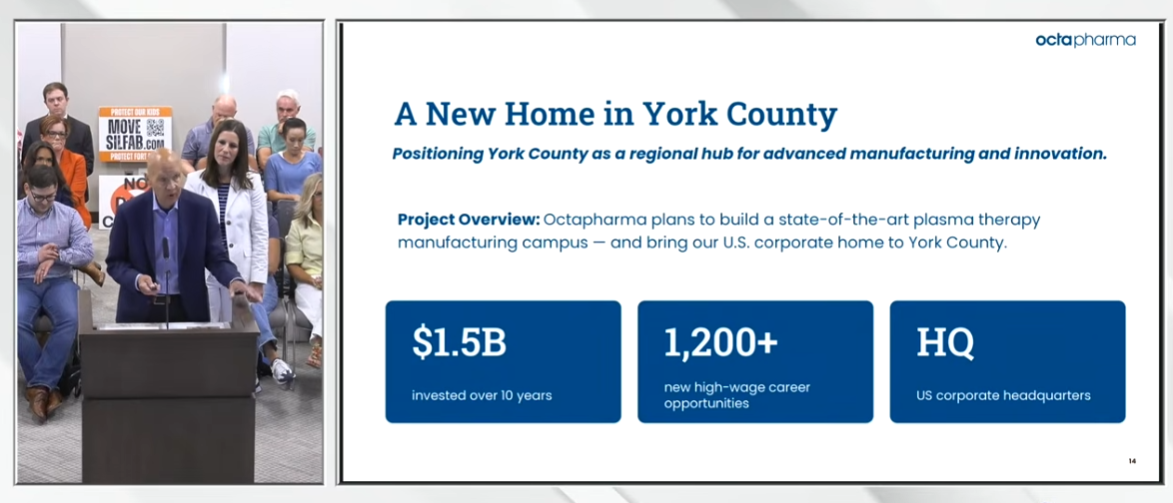
The project calls for a $1.5 billion investment over 10 years, more than 1,200 new high-wage jobs and the relocation of Octapharma’s U.S. corporate headquarters from Charlotte to the Palmetto Research Park site near Interstate 77 and Palmetto Parkway in Rock Hill.
Who Is Octapharma
Most people in the room had never heard the name before Monday night. When Vice President of Finance Barry Pomeroy asked the audience whether anyone recognized the company, nearly no hands went up.
“Well, Alice, we got quite a job ahead of us,” Pomeroy said with a laugh.
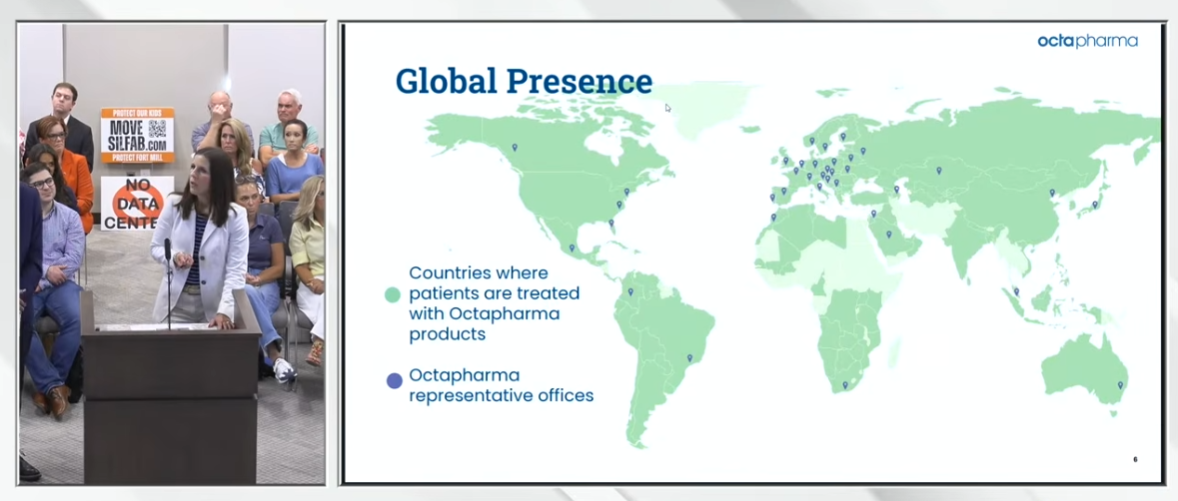
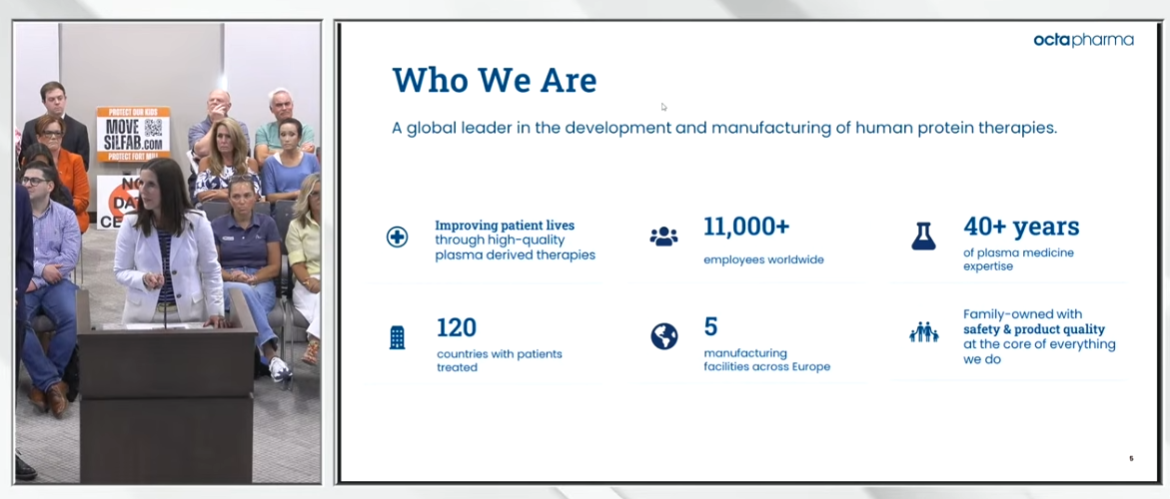
Octapharma has operated for 43 years under a single founding mission: to make medicines from donated human plasma that treat patients with rare and serious conditions. The company is the largest privately owned and independent plasma fractionator in the world, with more than 11,000 employees worldwide, five manufacturing facilities in Europe and sales offices across more than 30 countries. Its medicines reach patients in 118 countries.
Despite that global footprint, the company’s largest single operation is already located in the Charlotte region. Octapharma Plasma, the division responsible for collecting the raw material that becomes medicine, runs its U.S. headquarters off Westlake Drive in southwest Charlotte and operates more than 182 plasma donation centers across the country. Pomeroy and Alice Stewart, Octapharma’s chief operating officer, both run that division and both have deep personal roots in the Carolinas.
Stewart worked for Springs Industries in Fort Mill and Lancaster before joining Octapharma in 2009 and is a current York County resident. Pomeroy, a Virginia native, moved to Belmont, North Carolina in 1984 for a job with a textile company and has lived in the area for more than 40 years.
“To Alice and I, it is personal,” Pomeroy said of the York County project.
How Plasma Becomes Medicine
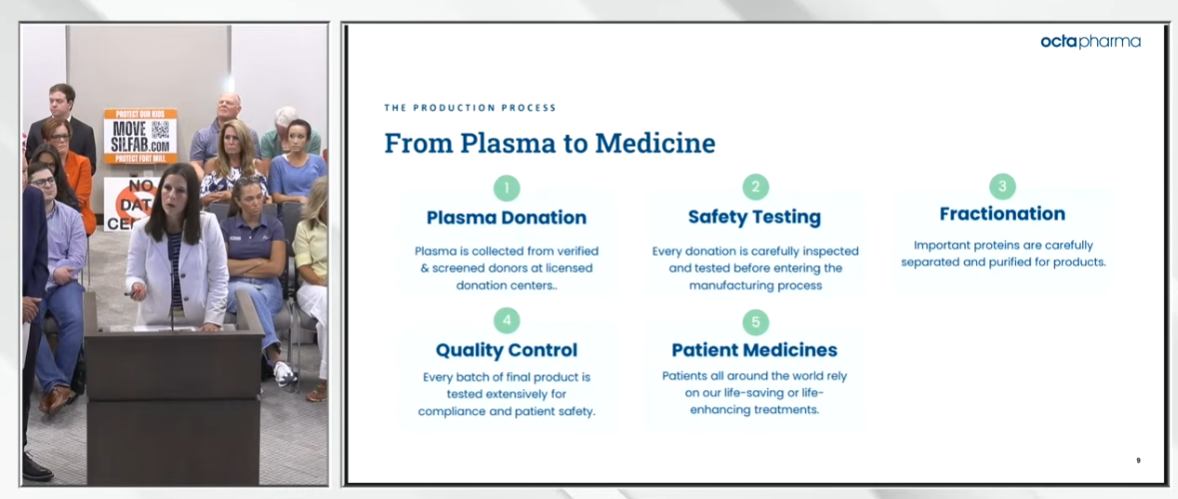
At the core of Octapharma’s business is a five-step manufacturing process that begins with plasma donation and ends with finished therapies shipped to hospitals around the world.
Donors give plasma at one of the company’s collection centers much like donating blood. A centrifuge separates the plasma from red blood cells, which are returned to the donor. The plasma is immediately frozen, and a sample from every donation is tested before the unit can leave the collection center. Any unit that does not come back disease-free is disposed of on site.
“I can’t emphasize enough,” Stewart told council. “Everything coming to the manufacturing site is disease-free.”
The frozen plasma is then shipped to a manufacturing facility, where a process called fractionation separates and purifies the proteins and antibodies. An extensive quality control process follows before the final medicine is packaged for patients.
Octapharma produces therapies in three areas. In hematology, the company makes medicines for patients with bleeding disorders such as hemophilia, helping them clot after injuries that could otherwise be fatal. In immunotherapy, the company produces treatments for patients with compromised immune systems, including cancer patients whose immune function has been suppressed by chemotherapy. In critical care, the company makes therapies used in trauma and emergency settings and during surgeries to help patients stop bleeding.
Stewart noted that the proteins in plasma cannot be made synthetically. Donated plasma is the only source of these therapies.
Why Rock Hill, and Why Now
Pomeroy said the company considered sites across the country, including in Texas where Octapharma already operates more than 20 donation centers. But when executives took a close look at the Palmetto Research Park property and the offer from the state and county, York County rose to the top.
“We struck up some conversations and we looked at ourselves one day and said, well, let’s really look pretty hard at where we are first,” Pomeroy said.
A major driver is economics. When Pomeroy and Stewart joined the company 16 years ago, U.S. revenues represented about 25 percent of Octapharma’s global total. That figure has now climbed to 50 percent and is still growing. At the same time, 88 percent of the plasma the company uses is collected here in the United States and currently shipped overseas to five European manufacturing plants.
“It makes a whole lot of sense to save all the shipping,” Pomeroy said. “If we can keep it domestic, it can be a big timesaver for us.”
Supply chain security also factored in. With global trade disruptions from tariffs and other shocks affecting industries worldwide, Octapharma wants to control the entire production chain within U.S. borders, from plasma collection through finished medicine delivery.
The company also told council it is developing a hemostatic patch for the U.S. Department of Defense, a product designed to allow wounded soldiers to treat bleeding in the field without the need for extensive medical equipment. Having a domestic manufacturing site supports that defense-related work as well.
What Gets Built
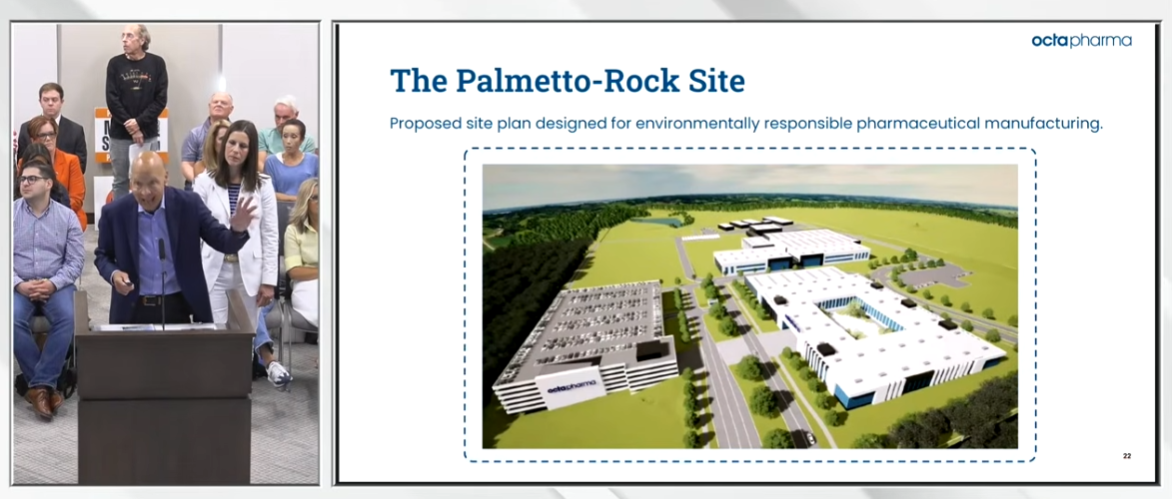
Octapharma presented a rendering of the Palmetto Rock site showing a multi-building campus the company is calling its “forever U.S. home.” The initial buildout over 10 years would add approximately 3.5 million liters of plasma processing capacity, equivalent to roughly one-third of the company’s current total worldwide capacity.
Pomeroy said the property includes enough undeveloped green space to double that manufacturing capacity in a second phase, which he estimated could come 10 to 15 years after the first phase is complete.
In addition to the manufacturing plant, the campus will include Octapharma’s relocated U.S. corporate headquarters and a plasma testing laboratory that mirrors the existing testing lab the company already operates in Charlotte. Stewart was careful to clarify the distinction.
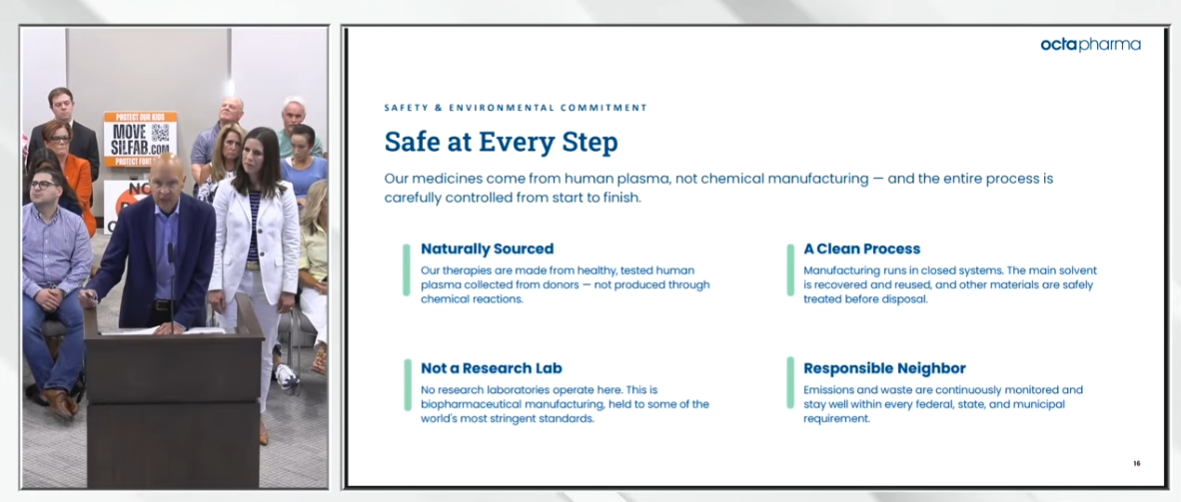
“This is not a research laboratory,” she said. “It’s the laboratory for the safety testing of the plasma.”
Construction could begin as early as 2027, pending final approvals from York County Council and Rock Hill City Council. The full buildout would take approximately 10 years.
Jobs and Economic Impact
The project is projected to create more than 1,200 new positions in addition to approximately 300 corporate jobs relocating from Charlotte, bringing total employment at the Rock Hill campus to about 1,500.
Manufacturing roles are projected to pay between $56,000 and $115,000 annually, with a 10-year potential range of $73,000 to $150,000. Headquarters positions would range from $51,000 to $168,000, with the majority of roles averaging around $115,000.
Economic Development Director Mitch Miller estimated the project could generate an additional 1,000 indirect jobs in the surrounding community through supplier relationships, small businesses and services that spring up to support the workforce. The overall economic benefit to York County has been estimated at nearly $500 million beyond the direct investment.
Pomeroy compared the potential ripple effect to the impact BMW had on Greenville and Spartanburg when the automaker located there, drawing in suppliers and support businesses that multiplied the economic benefit.
Safety and Environmental Questions
With signs in the audience referencing concerns about other industrial projects in the area, Octapharma executives addressed environmental and health questions directly.
The manufacturing process runs in what Pomeroy described as a closed system. The primary solvent used in production is ethanol, and the company recovers 95 to 99 percent of it for reuse. Any remaining ethanol is collected and disposed of by licensed contractors. Wastewater is treated before discharge and monitored daily, Pomeroy said, to meet or exceed all federal, state and municipal standards.
“It’s 10 times less than what’s going on 100 yards away on Interstate 77,” Pomeroy said of the facility’s emissions.
He pointed to Octapharma’s manufacturing plant in Stockholm, Sweden, which sits in the middle of a residential neighborhood and has operated there for decades, as evidence of the company’s safety record. He also noted that European environmental standards are stricter than those in the United States.
Stewart and Pomeroy both gave direct answers when Chairwoman Christi Cox asked before the public hearing whether there was any potential for biohazard or chemical exposure to residents near the site.
“No, there is not,” Stewart said.
Community Ties and Long-Term Commitment
Octapharma executives told council the company considers the Rock Hill site its permanent U.S. home, a point they credited in part to company founder and Chairman Wolfgang Margger. When executives suggested they might not need to move their Charlotte headquarters only 13 miles away to the new campus, Margger’s response was immediate.
“We want you invested in this community because this is going to be our home,” Pomeroy said, paraphrasing Margger. “This is going to be our generational home.”
The company said it intends to pursue partnerships with local colleges and universities including York Technical College and Winthrop University, pursue internship pipelines and engage with the Ready SC workforce training program, which Pomeroy said had already offered to set up a dedicated training center for Octapharma operators.
“We want to become part of the fabric of this community,” Pomeroy said.
For community members with questions about the project, Octapharma has set up a public email address: [email protected].
The incentive agreement requires one additional York County Council vote before it is finalized. Rock Hill City Council must also vote to approve its portion of the tax incentive package following an amendment that adjusted how the tax break burden is shared among the county, the city and local school districts.
Sign up for our Sunday Spectator. Delivered to your inbox every Sunday, with all the news from the week.

Thomas Hyslip lives in Tega Cay with his wife and daughter. After 27 years in the U.S. Army and Federal Law Enforcement, he retired to pursue his passion for teaching. Tom is now an Assistant Professor of Instruction at the University of South Florida. In 2 short years he has won 10 awards from the South Carolina Press Association, including first place in column writing, education beat reporting and best podcast.