

The York County Planning & Zoning Committee, chaired by Debi Cloninger (District 7), convened on May 26, 2026 with committee member Tommy Adkins (District 3) present at the opening; Andy Litten (District 2) joined shortly into the meeting. Staff in attendance included Assistant County Manager Tom Couch, Planning & Development Director Jonathan Buono, and Interim County Attorney Laura Dover, along with Planning staff member Diane Dill. The committee began by suspending its rules to move the data center standards item to the front of the agenda, then voted to recommend that County Council adopt a nine-month moratorium on new data centers to allow additional research on outstanding issues including rate-making, on-site power generation, noise studies, and generator use limitations. Staff provided an informational update on the ongoing batch rezoning of existing townhomes to RMX-6, with roughly 3,000 parcels across 29 communities to be processed in 10 batches over approximately two years; the first batch is set for third reading on June 1. Assistant County Manager Tom Couch presented an overview of the proposed Newport Area Plan, a small-area and corridor study to be funded through the Economic Development Fund pending budget adoption; no committee action was required. On industrial uses, the committee voted to forward a text amendment to the Planning Commission adding several uses to the Industrial District (ID) and General Commercial (GC) districts, and separately voted to defer to the next meeting a follow-up discussion on incorporating North American Industry Classification System (NAICS) references into industrial use definitions.
Suspension of Rules
At the opening of the meeting, Chairwoman Cloninger moved to suspend the rules to move agenda item number five (data center standards) to the number two position. The motion was seconded and passed on a voice vote with all in favor.
Agenda Item 1 — Approval of Minutes
The committee considered the minutes of the May 6, 2026 Planning & Zoning Committee meeting. Chairwoman Cloninger moved approval; the motion was seconded and passed on a voice vote with all in favor.
Agenda Item 2 (originally Item 5) — Data Center Standards
Interim County Attorney Laura Dover reported back on the research items the committee had requested at its May 6 meeting. She advised that several items were not problematic. Compliance with state law, for example, is already a baseline requirement of all county ordinances; to the extent anyone believed an ordinance did not comply, that question would ultimately be resolved through legal challenge.
Other items required further work. The committee had asked for additional research on rate-making issues, on whether data centers should be permitted to generate their own power, on noise studies separate and apart from the existing nuisance ordinance, and on generator use limitations. Ms. Dover noted that issues such as noise, vibration, and heat had already been incorporated into the pending ordinance after second reading by County Council, but advised that if the committee wanted to put finer points on these provisions, the better course would be to retain a subject-matter expert to examine how other jurisdictions have addressed these specific issues and how those approaches could best be implemented within a zoning ordinance.
Chairwoman Cloninger observed that more work and additional time would be needed. Committee member Tommy Adkins concurred. A motion was made to recommend that County Council approve a nine-month moratorium to allow time for the additional research to be completed. Chairwoman Cloninger seconded the motion. The motion passed on a voice vote with all in favor and none opposed.
Agenda Item 3 (originally Item 2) — Ongoing Existing Townhome Rezonings to RMX-6
Planning staff member Diane Dill provided an informational update on the ongoing batch rezoning of existing townhomes to the RMX-6 zoning district. She explained that the purpose of the project is to bring existing townhome communities — which are currently nonconforming — into a zoning classification appropriate for their existing use. The work follows the apartment rezonings completed roughly 18 months ago.
The project encompasses 29 townhome communities throughout the county and approximately 3,000 parcels. To avoid overwhelming the committee, staff, and affected property owners, the rezonings have been broken into 10 batches. The first batch came forward earlier in March and is scheduled for third reading on June 1. Staff anticipates bringing the remaining batches forward over the next two years. Because the majority of affected townhomes are in District 1 and District 7, those will be addressed first, followed by District 2 and then Districts 4 and 6.
Chairwoman Cloninger raised concerns about communication with affected homeowners, noting that she frequently receives calls from residents who do not understand the meaning of the rezoning signs in their neighborhoods. Ms. Dill outlined the notification procedure: certified letters are mailed to every homeowner with a user-friendly synopsis of the action and staff contact information; signs are posted at neighborhood entrances and throughout each community (not in front of every individual home); postcards are sent to surrounding neighbors as well as affected homeowners; and a legal notice is published in the newspaper.
In response to a question from committee member Tommy Adkins, Ms. Dill confirmed that the rezonings will not allow any new townhome construction; all parcels are existing and built out. The action will simply place each community in its correct zoning district and will remove the legal nonconforming designation, which can pose hurdles when owners attempt to refinance. Chairwoman Cloninger asked whether a future buyer could redevelop a community into additional townhomes; Ms. Dill explained that because townhomes are individually owned — unlike apartment complexes, which have a single owner — a developer would have to acquire every single unit to assemble any redevelopment, making such a scenario impractical.
No motion was required; the item was presented for information only. Planning & Development Director Jonathan Buono added that staff’s intent in bringing these updates forward is to keep the committee familiar with the broader project as individual batches come up for action.
Agenda Item 4 (originally Item 3) — Newport Area Plan
Assistant County Manager Tom Couch presented an overview of the proposed Newport Area Plan. The plan originated in discussions of the Economic Development Committee in the fall of 2025 and gained momentum approaching December. The slides presented were a modified version of materials previously discussed at the December 2025 Economic Development Committee meeting. As the budget process has progressed, the plan remains within the proposed budget and would be one of two plans funded through the Economic Development Fund.
Mr. Couch described the scope of work as combining a small-area plan with corridor transportation planning. The proposed study area encompasses a corridor running roughly from Newport to a point a few miles outside the City of York, along with a broader area surrounding that corridor. He cited growth pressures along Highway 161 and Anderson Mill Highway (Hands Mill Highway), particularly in the Newport Commons area, as motivation for getting ahead of expected growth.
He emphasized that the plan is complementary to several other planning efforts already underway, including the comprehensive plan update and a proposed I-77 corridor plan south of Rock Hill. Mr. Couch presented a crosswalk illustrating how the Newport Area Plan would align with both the county strategic plan and the comprehensive plan. He estimated a 10-to-12 month timeline from initiation to adoption, compared with approximately 18 months for the comprehensive plan, noting that the comprehensive plan would ultimately reflect and integrate the other planning work.
Mr. Couch advised that the staffing plan may need to be reconsidered if budget reductions to the long-range planner position move forward; in that event, existing personnel — likely with Ms. Dill serving as lead project manager — would need to be mobilized to coordinate this project alongside the other planning efforts. He also indicated that the scope may require slight adjustments depending on available budgeted funds; a housing element could potentially be removed, and natural resources analysis might be reduced and absorbed into the comprehensive plan.
In response to a question from committee member Tommy Adkins about coordination with the City of Rock Hill, Mr. Couch reported that Rock Hill has recently completed its comprehensive plan update and that his review does not suggest aggressive annexation plans into the proposed study area. He emphasized the need to maintain an ongoing conversation with Rock Hill regardless of which planning effort is underway. Planning & Development Director Jonathan Buono added that the utility services boundary, located at Antioch Church, effectively limits Rock Hill’s opportunities for westward and northward annexation until that boundary is adjusted.
Chairwoman Cloninger requested additional time to study the materials before asking substantive questions. Mr. Couch suggested speaking with members of the Economic Development Committee, which has been moving in lock step with the process. County Manager Josh Edwards added that the item originated in the Economic Development Committee but was brought to the P&Z Committee so that members could have an opportunity to contribute from their committee’s perspective, and that going forward, staff intends to report on the project simultaneously to both committees.
No action was required.
Agenda Item 5 (originally Item 4) — Follow-Up Discussion Regarding Industrial Uses
Planning & Development Director Jonathan Buono presented two related items continuing the committee’s ongoing discussion of industrial uses.
Part 1 — Text Amendment Adding Uses to ID and GC Districts
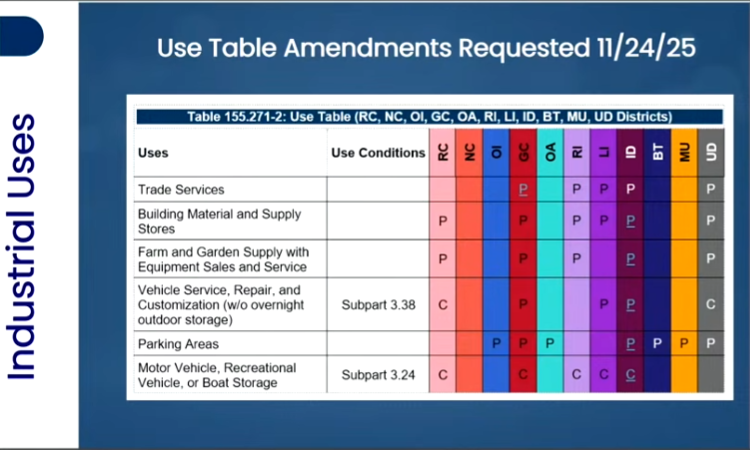
Mr. Buono presented draft text amendment language reflecting the committee’s November vote to add certain uses to certain districts. The amendment would add to the Industrial District (ID) the following uses as permitted: building material and supply stores; farm and garden supply; vehicle service, repair and customization without overnight storage; parking areas; and boat, RV, and motor vehicle storage as a conditional use. The amendment would also add trade services as a permitted use in the General Commercial (GC) district.
Mr. Buono explained that the change reflects committee member Andy Litten’s original motion. Mr. Litten elaborated that these uses are already permitted in the Light Industrial (LI) and Restricted Industrial (RI) districts, and that the change addresses a specific situation in which an ID property owner wishes to put the property to a lighter, less intense use than ID currently permits without having to seek a rezoning. Mr. Buono added that staff would not direct property owners to rezone to ID for uses such as building supply; the change will not generate additional industrial space but will give existing ID property owners more business options without rezoning. In response to a question from Chairwoman Cloninger about proximity to residential areas, Mr. Buono noted that far fewer properties are zoned ID than are zoned LI.
A motion was made to approve the draft text amendment and forward it to the Planning Commission for recommendation. Chairwoman Cloninger seconded. The motion passed on a voice vote with all in favor and none opposed.
Part 2 — Use of the NAICS System in Industrial Definitions
The second portion of the discussion responded to the committee’s November vote asking staff to come back with an explanation and example of how the county’s industrial definitions could be improved through more explicit use of the North American Industry Classification System (NAICS).
Mr. Buono described NAICS as a federal classification system that sorts businesses and industries into hierarchical categories and is widely used in zoning codes — particularly for manufacturing uses, where the universe of products is too large to enumerate in code. He walked through the NAICS hierarchy from the two-digit sector level down to the six-digit national industry level, using the committee itself as an illustration (legislative bodies fall under NAICS code 921120).
He then presented examples from peer jurisdictions to illustrate different approaches:
- Town of Clover and City of Camden assign a NAICS reference number to every use in their use tables — a very conservative approach.
- Chester County and Pine Ridge reference NAICS codes selectively where most helpful, particularly for manufacturing special exceptions.
- Gaston County uses limited NAICS references concentrated in manufacturing definitions and includes language clarifying how an establishment’s primary engagement is determined when products span multiple categories.
To demonstrate the practical benefit, Mr. Buono used the example of shoe manufacturing. The county code’s definition of “leather and allied products manufacturing” addresses establishments that transform animal hides into leather and fabricate finished products — language that on its face does not capture manufacturers of sneakers, flip-flops, or other non-leather footwear. No jurisdiction’s use code lists “shoe manufacturing” directly. Under NAICS, however, the subsector “leather and allied products manufacturing” expressly includes footwear manufacturing as an industry group, which in turn captures footwear made from rubber and synthetics. Referencing NAICS in the county definition therefore clarifies that a sneaker manufacturer such as Sketchers falls within the existing use and may locate in RI and ID districts where the use is currently permitted.
Mr. Buono noted that this approach is already consistent with several existing county definitions, including non-metallic mineral product manufacturing, trade services, and a catch-all “miscellaneous manufacturing” definition that explicitly captures anything not defined elsewhere in NAICS and treats it as a special exception. He also presented examples of additional definitions that could be clarified in the same manner, including fabricated metal product manufacturing, fiberglass manufacturing (which corresponds to mineral wool manufacturing at the six-digit NAICS level), food manufacturing, and furniture manufacturing.
In response to questions from committee member Andy Litten, Mr. Buono confirmed that the existing code provision treating undefined uses as not permitted would remain in effect; the NAICS clarifications would simply reduce the instances in which that provision must be invoked. He also confirmed that adding the references would not change any uses that are or are not currently permitted, but would clarify what each use term means. Mr. Litten asked whether it might be worthwhile to use the opportunity to rewrite portions of the use table to clean up outdated definitions; Mr. Buono noted that many definitions were carried over from prior ordinances (including from a 2017 ordinance) during the recent recode and that some defined terms are no longer referenced in the code. He cautioned, however, that the more the county drills down into specific six-digit NAICS levels, the more it obligates itself to maintain that level of specificity. He also noted that staff is separately working on a much larger annual omnibus process to take a wholesale look at the development codes, which will include opportunities for council and committee involvement and public input.
A motion was made by Chairwoman Cloninger to refer the item to the committee’s next meeting to allow time to digest the material and to give staff a charge for additional examples illustrating Mr. Litten’s suggestion of cleaning up outdated verbiage. After a brief procedural clarification noted by Mr. Buono that a second was needed, the motion was seconded and passed on a voice vote with all in favor.

Sign up for our Sunday Spectator. Delivered to your inbox every Sunday, with all the news from the week.

Thomas Hyslip lives in Tega Cay with his wife and daughter. After 27 years in the U.S. Army and Federal Law Enforcement, he retired to pursue his passion for teaching. Tom is now an Assistant Professor of Instruction at the University of South Florida. In 2 short years he has won 10 awards from the South Carolina Press Association, including first place in column writing, education beat reporting and best podcast.