

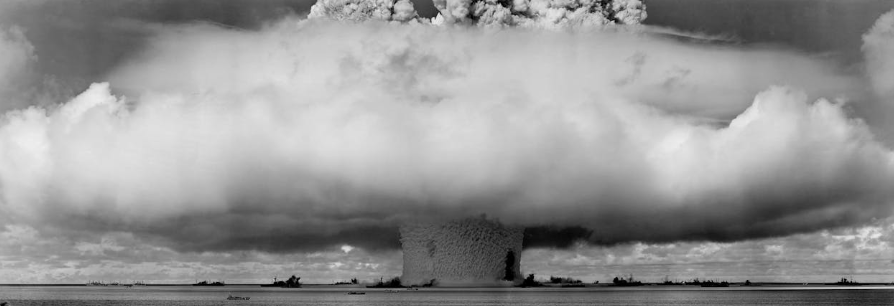

When I was a child, the threat of war with the Soviet Union was always present but it didn’t consume my everyday life. The drills where we hid under our desks were exactly that, drills. Although the movie Red Dawn made the idea of nuclear war all too real, I wasn’t seriously concerned it would ever happen. As a matter of fact, I believed the notion of world peace was far more likely. The innocence of childhood has a way of masking the realities of the world.
Once you’ve grown up, that veil is lifted and you see the world for what it is. An infinite struggle of good versus evil.
What you may define as evil may be different from your counterpart half way around the world. Killing someone for a cause, religion or their country is wholly justified in the mind of someone who thinks they’re doing good. An act of violence is framed differently depending on the perception of the audience receiving the information.
According to historians, dropping an atomic bomb on Hiroshima in 1945 saved millions of American lives and, along with the second bomb dropped on Nagasaki, resulted in a formal surrender by Japan. Killing thousands of Japanese civilians ended WW2 and resulted in what is now a prosperous country whom we claim as a powerful ally. The historical argument is often made that a horrible act resulted in a greater good.
One of the world’s oldest religions is Zoroastrianism. Founded in the 6th century BC in ancient Persia (modern day Iran), Zoroastrianism is a monotheistic faith which focuses on a struggle between truth or goodness and falsehood or evil. By implementing “good thoughts, good words and good deeds,” you’re living in accordance with the teachings of the creator, known as Ahura Mazda. Living a life of greed, wrath and envy places you in opposition to the creator, aligning you with falsehood known as Angra Mainyu.
At one point in time, Zoroastrianism rivaled both Islam and Christianity in popularity and number of believers. Today, there are less than 200 thousand people who still practice the faith. And yet, the Zoroastrian concepts of heaven and hell, good versus evil and one creator live on in the more popular faiths practiced throughout the world. It’s also very interesting that this fringe religion was founded in the site of a modern day conflict we’re currently embroiled in. A conflict pitting good versus evil, depending on who you ask.
World peace is a noble concept. It’s also utopian in that there is no recognition of what has been established as an ancient concept of good and evil. As long as there are human beings in charge of the places where we live, there will always be conflict and war. It’s an unfortunate reality but it’s a reality all the same.
The question you need to ask yourself is, what is good and what is evil? The idea of killing Hitler as a baby comes into play here. If you could go back in time and kill Hitler as a baby, would you do it? If you say yes, what happens? Is there someone or something else that steps in to fill the void? It’s hard to imagine it could’ve been worse but what if it was?
These are philosophical and revisionist history questions but the answer would likely be the same. Removing one threat will not stop wars or conflicts from happening; however, it may reduce or delay the destruction that will inevitably take place. World peace is a noble concept but it’s also unrealistic. General peace is far more attainable and something we can and should strive for.
Good thoughts, good words and good deeds make sense for all of us, regardless of what religion you may or may not believe in.
Sign up for our Sunday Spectator. Delivered to your inbox every Sunday, with all the news from the week.

Patrick Byrne lives in Tega Cay with his wife and two daughters. After 25 years working for a Big 4 bank, he retired to pursue his passion for writing. Additional articles and content can be found on his blog (reverian1776.blogspot.com) and freethepeople.org.