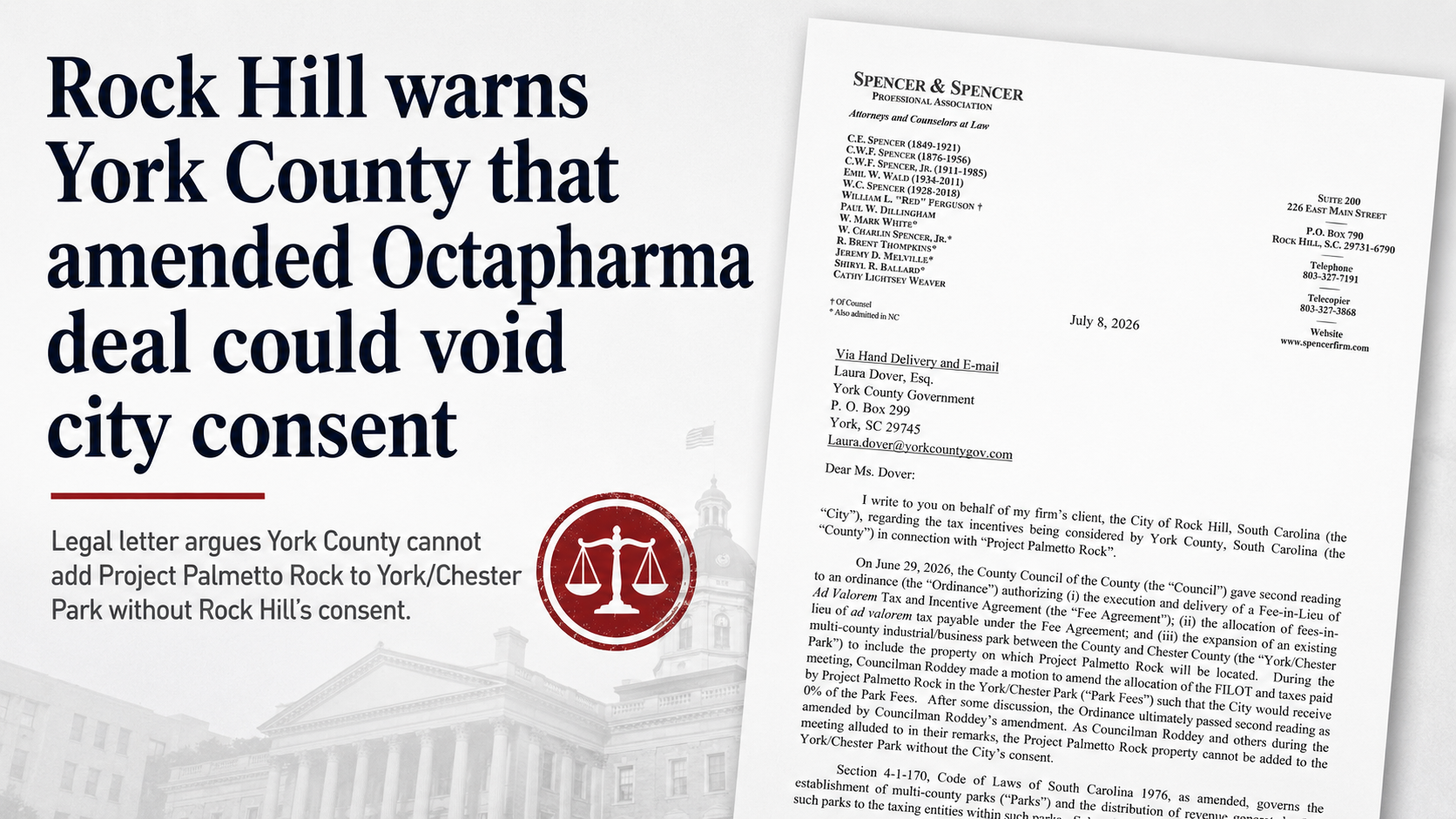
An attorney for the city of Rock Hill warned York County in writing that the tax incentive deal for the Octapharma plant, as the county has amended it, would cancel the city’s consent to the deal and could strip the county of the authority to grant the tax breaks at the heart of the package.
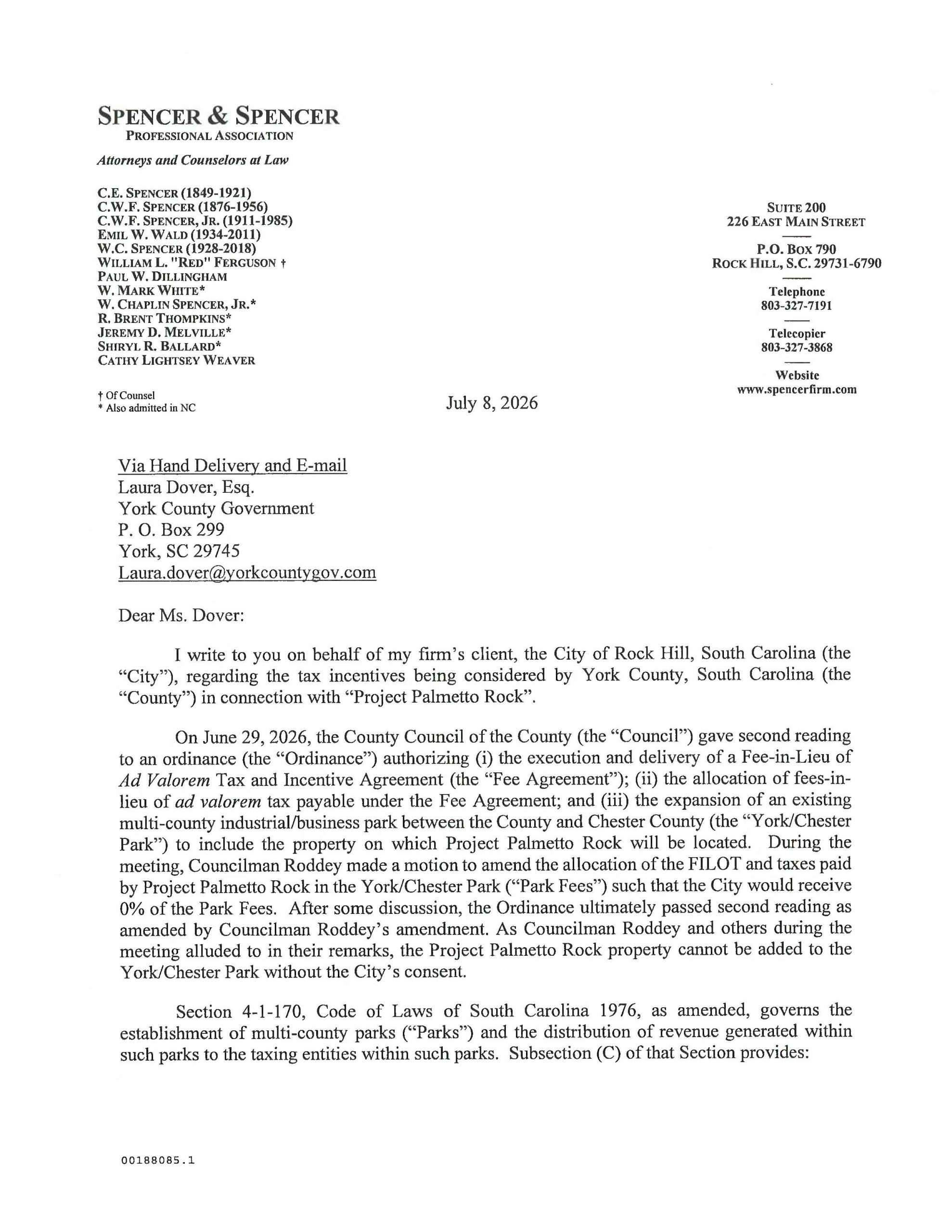
The warning came in a July 8 letter to York County Attorney Laura Dover from Paul W. Dillingham of Spencer & Spencer, the Rock Hill firm representing the city. It landed the same day County Council took up third and final reading of the fee-in-lieu-of-taxes ordinance for the project, known in county documents as Project Palmetto Rock.
The letter does not dispute the project itself. It argues that the way the county has chosen to divide the revenue breaks the specific conditions the city set when it agreed to let the project into a multi-county park, and that breaking those conditions carries a built-in penalty the city wrote into its own approval.
The consent the county needs
Multi-county parks depend on municipal consent. Section 4-1-170(C) of the South Carolina Code provides that when such a park takes in all or part of a municipality, the counties must obtain that municipality’s consent before creating the park. Because the plant site sits inside Rock Hill’s city limits, the county cannot add the property to the York-Chester Industrial Park, the arrangement that makes the incentives possible, without the city’s sign-off.
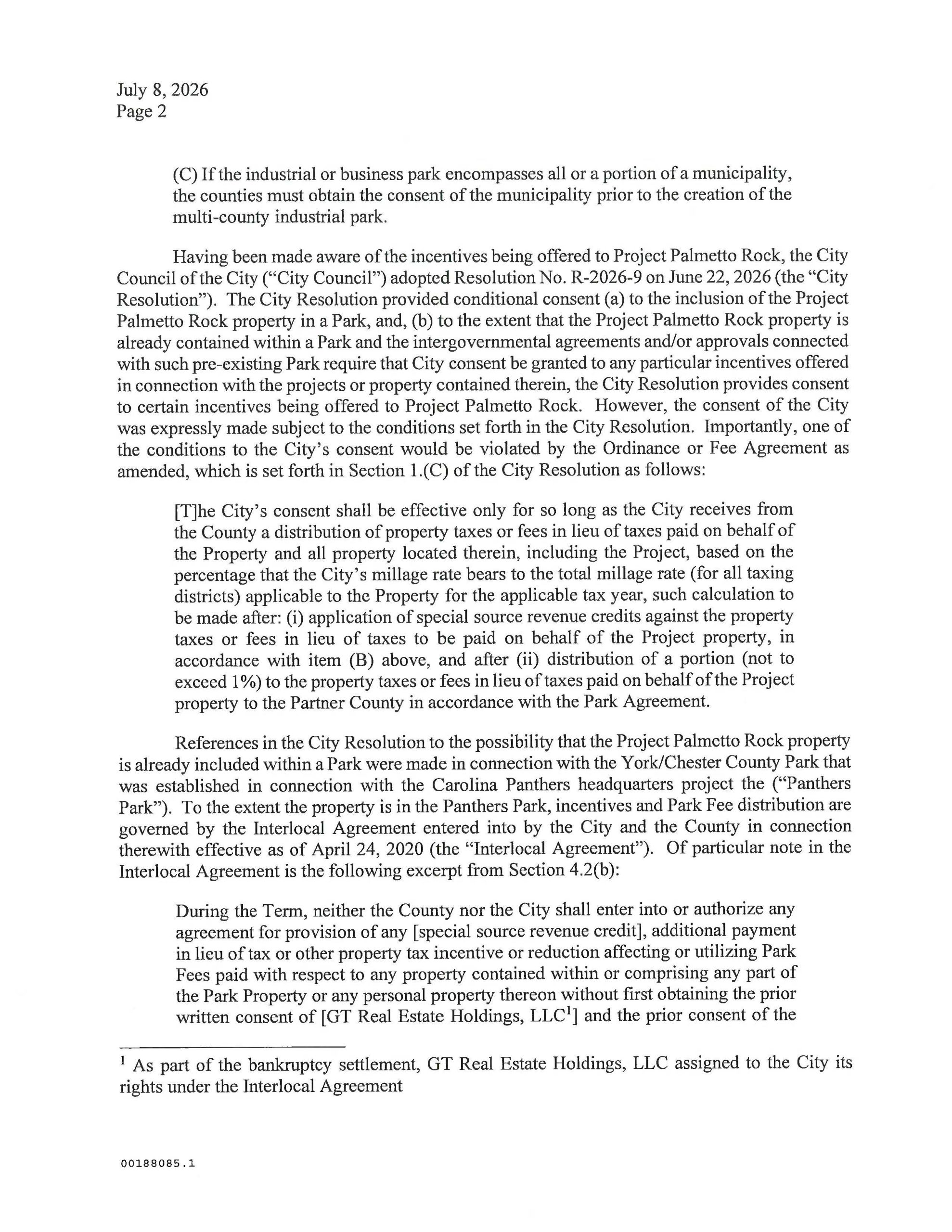
Rock Hill City Council gave that consent on June 22 through Resolution R-2026-9, but only conditionally, and one condition is central to the dispute. Under the resolution, the city’s consent “shall be effective only for so long as the City receives” its distribution of the taxes or fees paid on the project, measured by the share the city’s millage rate represents of the total millage and calculated after the special source revenue credits are applied and after a small cut, no more than 1 percent, goes to the partner county. If any condition is broken, the resolution says, the city’s consent is immediately “rescinded and void.” In effect, the city built a trip wire into its own approval, and the trip wire is its proportional share of the money.
The county’s amendment and the trip wire
The letter recounts that at the county’s June 29 second reading, Councilman William “Bump” Roddey moved to amend the revenue split so the city would receive none of the park fees, and the ordinance passed as amended. The city argues that arrangement violates the condition requiring the city to receive its proportional share, which would automatically void its consent.
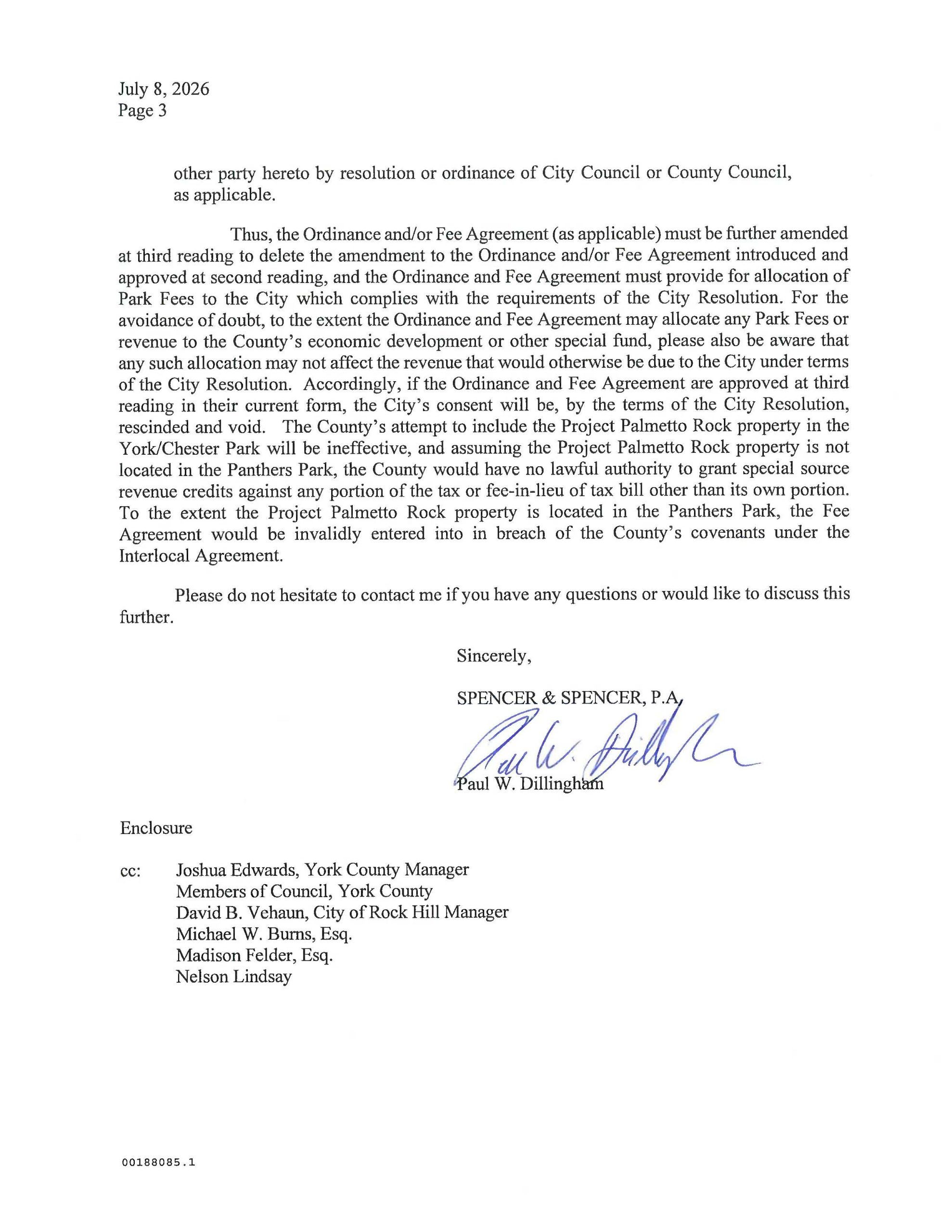
The letter closes the most obvious workaround in advance. To the extent the county routes the money to its economic development fund or another special fund, Dillingham wrote, that redirection “may not affect the revenue that would otherwise be due to the City” under the resolution. In the city’s reading, sending the revenue elsewhere, including to a school district, is not the same as the city receiving its distribution, so the condition is still broken.
If the ordinance passed third reading in that form, the letter states, the city’s consent would be rescinded, the county’s attempt to add the property to the York-Chester park would be ineffective, and the county would have “no lawful authority to grant special source revenue credits” against any portion of the tax bill other than its own share.
A second path through the Panthers land
The letter raises a second and separate legal exposure tied to the site’s history. The parcel may already sit inside an older multi-county park created for the failed Carolina Panthers headquarters project, which the letter calls the Panthers Park. If it does, the city argues, the incentives are governed by an interlocal agreement between the city and county dated April 24, 2020.
That agreement, according to the letter, bars either the county or the city from authorizing any special source revenue credit or other incentive affecting park fees on the property without the prior written consent of GT Real Estate Holdings and the other government. The letter notes that GT Real Estate assigned its rights under that agreement to the city as part of its bankruptcy settlement, meaning the city now holds that consent power as well. If the property is in the Panthers Park, the letter argues, the fee agreement would be “invalidly entered into in breach of the County’s covenants” under that 2020 agreement.
Whether the parcel falls inside the Panthers Park is not resolved in the letter, which frames both scenarios as possibilities. Either way, the city’s position is that the deal cannot move forward on the county’s terms without the city’s agreement.
What the city asked for
The letter tells the county what it would need to do to keep the deal intact. The ordinance and fee agreement, it says, must be amended at third reading to delete the June 29 change and to allocate park fees to the city in a way that satisfies the June 22 resolution.
What comes next
York County Council did not adopt that fix. On Wednesday night, it passed the ordinance on third and final reading 4-3, with an amendment from Roddey that redirects 85 percent of the city’s share and the county’s 10 percent economic development allocation to the Rock Hill School District rather than restoring the city’s full proportional distribution. Whether that structure satisfies the city’s conditions, or trips the same wire the letter describes, is the question now facing Rock Hill City Council.
The county has not publicly responded to the letter’s legal arguments. The letter was copied to York County Manager Joshua Edwards, members of County Council, Rock Hill City Manager David B. Vehaun and the county’s bond counsel, Madison Felder of Parker Poe Adams & Bernstein.
Sign up for our Sunday Spectator. Delivered to your inbox every Sunday, with all the news from the week.
Thomas Hyslip
Thomas Hyslip lives in Tega Cay with his wife and daughter. After 27 years in the U.S. Army and Federal Law Enforcement, he retired to pursue his passion for teaching. Tom is now an Assistant Professor of Instruction at the University of South Florida. In 2 short years he has won 10 awards from the South Carolina Press Association, including first place in column writing, education beat reporting and best podcast.