
With the June 9 primary now less than two months away, first quarter campaign finance reports filed with the South Carolina Ethics Commission reveal a Republican field dominated by two well-funded frontrunners and a Democratic contest where a self-financed candidate has quietly emerged as the cash on hand leader.
Republican Primary
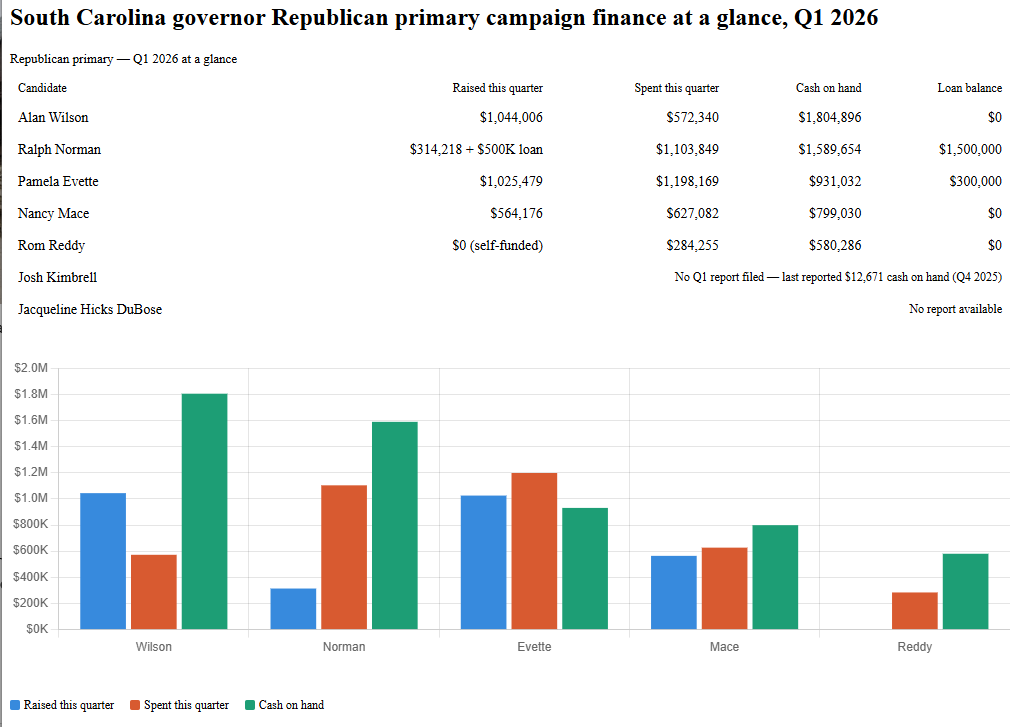
Attorney General Alan Wilson enters the closing stretch of the primary season with the strongest financial position in the Republican field. Wilson raised $1,044,006 in cash contributions during the first quarter and ended the period with $1,804,896 in cash on hand after spending $572,340. He carries no loan balance and is campaigning alongside Florence Sen. Mike Reichenbach, his prospective lieutenant governor pick, a pairing that has drawn attention from rival campaigns.
Lt. Governor Pamela Evette trails Wilson in available cash but leads the field overall in total cycle fundraising. Evette raised $1,025,479 in cash contributions this quarter and $3,476,702 across the full election cycle, including a $300,000 personal loan. She spent $1,198,169 during the period, an aggressive burn rate that left her with $931,032 in cash on hand. Her campaign has attributed the heavy outlays to a sustained advertising presence. Wilson noted in a statement that he was humbled by donor support and pledged to keep pushing through primary day. Evette spokesman Matthew Goins pointed to what he called consistent fundraising dominance as evidence of confidence heading into the final stretch.
Congressman Ralph Norman of Rock Hill holds $1,589,654 in cash on hand, the second highest total in the Republican field, but that figure is propped up heavily by personal lending. Norman has loaned his campaign $1.5 million and added another $500,000 personal loan during the quarter. He raised $314,218 from outside donors this period and spent $1,103,849, leaving his campaign substantially reliant on his own fortune.
Congresswoman Nancy Mace has built her campaign on a national network of small donors, drawing contributions from 24,302 individual contributors across the election cycle, the largest donor count in the field. She raised $564,176 in the first quarter, spent $627,082, and reported $799,030 in cash on hand at the end of the period.
Activist Rom Reddy, a self-funded candidate who entered the race in March, reported no outside donations whatsoever. His $2 million in personal contributions represents his entire funding base. Reddy spent $284,255 this quarter and reported $580,286 in cash on hand after cycle expenditures of $1,419,713.
Joshua Kimbrell of Boiling Springs has not filed a first quarter report. His most recent filing, a fourth quarter 2025 report submitted in January, showed $12,671 in cash on hand after raising $18,000 and spending $12,127 during that period.
Jacqueline Hicks DuBose has filed as a Republican candidate. No campaign finance report was available for review.
Democratic Primary
On the Democratic side, self-funded candidate Mullins McLeod of Charleston holds the largest cash reserve in his party’s primary by a wide margin. McLeod has invested $2.35 million of his own money into the race across the election cycle, raised just $8,169 from outside donors this quarter, and spent $725,609 during the period. He ended the quarter with $1,228,201 in cash on hand.
Billy Webster of Greenville raised $158,513 this quarter and ended the period with $274,383 in cash on hand after spending just $7,530. Webster has been notably frugal in his campaign spending, with total cycle expenditures of only $11,773.
Jermaine Johnson has built his campaign on grassroots small dollar donors. Johnson raised $159,705 in cash contributions during the first quarter and spent $203,973 during the period, reporting $99,094 in cash on hand at the close of March. Johnson notably flirted with the idea of exiting the race earlier this spring before ultimately pressing forward.

The Big Picture
Wilson leads the Republican field with the most cash on hand and no personal loans on his books, giving him arguably the most sustainable financial position in the race. Norman and Evette have spent heavily to remain competitive, with Norman leaning on his personal fortune and Evette drawing down reserves at a pace that has some supporters watching closely. On the Democratic side, McLeod’s $2.35 million personal investment has given him a financial cushion his opponents cannot match through traditional fundraising, while Johnson enters the final stretch with the least cash on hand of the three Democratic candidates.
Source: South Carolina Ethics Commission campaign finance disclosure reports, Quarter 1 2026, filed April 2026.

Sign up for our Sunday Spectator. Delivered to your inbox every Sunday, with all the news from the week.

Thomas Hyslip lives in Tega Cay with his wife and daughter. After 27 years in the U.S. Army and Federal Law Enforcement, he retired to pursue his passion for teaching. Tom is now an Assistant Professor of Instruction at the University of South Florida. In 2 short years he has won 10 awards from the South Carolina Press Association, including first place in column writing, education beat reporting and best podcast.