
A New Weapon, A New Law, A First Conviction
The rise of artificial intelligence has brought remarkable tools into everyday life, but it has also handed dangerous capabilities to dangerous people. This week, a federal courtroom in Columbus, Ohio made history, and the outcome sends a clear message to anyone who might think AI-generated abuse exists in a legal gray area.
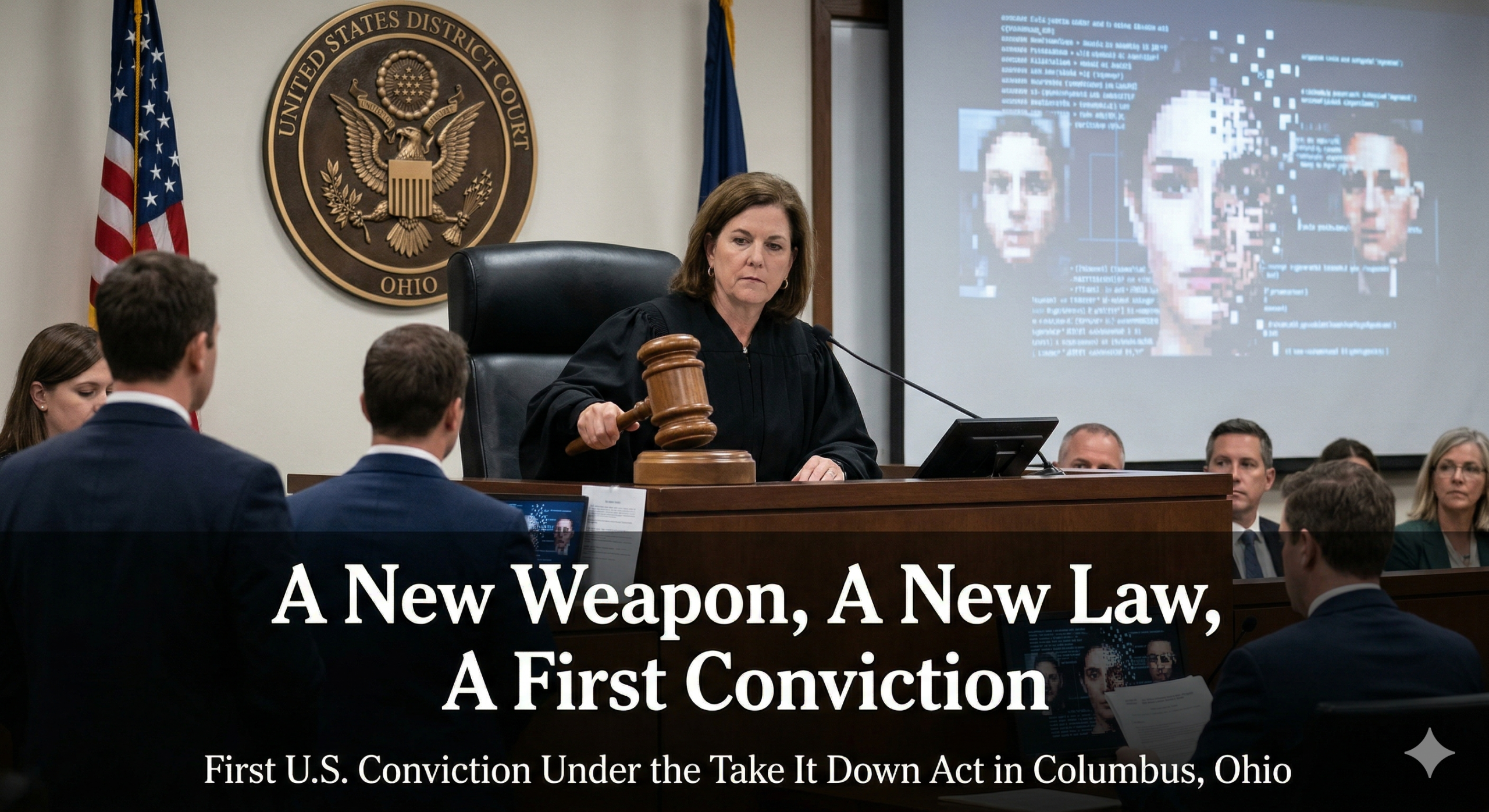
On April 7, 2026, James Strahler II, 37, of Columbus pleaded guilty to a campaign of cyberstalking and AI-assisted abuse targeting multiple victims, both adults and children. Prosecutors announced that his conviction on one of the charges makes him the first person in the United States to be convicted under the Take It Down Act, a landmark federal law signed by President Trump in May 2025 that specifically criminalizes the non-consensual creation and publication of AI-generated intimate imagery.
What Strahler Did
According to court documents, between December 2024 and June 2025, Strahler weaponized artificial intelligence in a sustained campaign of harassment against at least six adult female victims. He had installed more than 24 AI platforms and more than 100 AI web-based models on his phone, tools he used not for any legitimate purpose, but to fabricate explicit imagery of real people without their knowledge or consent, and then use those images to terrorize them.
The conduct described in the press release is deeply disturbing. He distributed fabricated videos to victims’ coworkers. He contacted victims’ family members with threats. He left voicemails containing explicit threats of violence. He referenced specific home addresses in those threats. He also created and posted AI-generated obscene material depicting minor children from his own community, morphing their faces onto explicit content and posting it to a website dedicated to child sexual abuse.
Strahler created more than 700 such images and had an additional 2,400 images and videos on his phone flagged as depicting nudity, morphed child sexual abuse material, or violence.
He was arrested on federal charges in June 2025 after the case was referred to the FBI by the Hilliard Police Department and the Delaware County Sheriff’s Office. He pleaded guilty to cyberstalking, producing obscene visual representations of child sexual abuse, and publication of digital forgeries, that last charge being the Take It Down Act count that makes this case historic.
What Is the Take It Down Act?
Until 2025, there was no comprehensive federal law specifically addressing AI-generated non-consensual intimate imagery, what many people call “deepfakes.” The Take It Down Act was introduced by Senator Ted Cruz following a 2023 incident in which a Texas high school student used AI software to create and post manipulated nude images of classmates on Snapchat. The school district could not act because it happened off school grounds, and local law enforcement felt unable to intervene.
Congress passed the Take It Down Act on April 28, 2025, and President Trump signed it into law on May 19, 2025. The law passed the House by a vote of 409–2. First Lady Melania Trump was a prominent advocate for the legislation as part of her “Be Best” anti-cyberbullying initiative.
The law does two important things. First, it criminalizes the knowing, non-consensual publication of intimate visual depictions, both real and AI-generated — of identifiable individuals. Any person who shares deepfakes or threatens to share intimate images of an adult faces fines and up to two years in prison. Penalties are steeper for content involving minors, with potential imprisonment of up to three years.
Second, and equally significant, the law requires covered online platforms to provide the public with the ability to report non-consensual intimate imagery and mandates that platforms remove the content and make a reasonable effort to remove identical copies within 48 hours of a report. Platforms have until May 19, 2026 to have those takedown systems in place.
Why This Case Matters
This conviction matters for several reasons beyond the historic legal milestone. It demonstrates that AI-generated abuse is not a victimless technical novelty — it is a weapon that causes profound real-world harm to real people. It also demonstrates that existing AI tools are readily accessible, alarmingly easy to misuse, and increasingly being turned against ordinary people in their own communities.
At least 45 states have now passed local laws related to AI deepfakes, some specifically tailored toward protecting minors. The federal Take It Down Act adds a powerful national floor beneath those state laws and gives prosecutors a tool that did not exist even two years ago.
What Parents and Families Should Know
The Strahler case is an extreme example, but the underlying threat — AI tools being used to create fake explicit images of real people, including children — is not rare. Here is what families should know and do:
- Talk to your children about this threat. Teens and young adults need to understand that photos shared innocently online — school portraits, social media photos, group pictures — can be misused. The conversation is uncomfortable but essential.
- If you or someone you know is a victim, report it immediately. Contact local law enforcement and the FBI’s Internet Crime Complaint Center at IC3.gov. Do not assume the material cannot be traced or that nothing can be done.
- Request takedowns directly from platforms. Under the Take It Down Act, covered platforms are now required to have reporting and removal processes. Use them. Most major social media platforms have reporting mechanisms accessible through their settings or help menus.
- Document everything. Before requesting removal, screenshot URLs and preserve any evidence. Once content is taken down, it can be difficult to reconstruct the record needed for a legal case.
The technology that made Strahler’s crimes possible is not going away. But as of this week, the legal system has caught up and the first conviction under the Take It Down Act serves notice that AI-generated abuse carries real federal consequences.
Stay safe out there, and I’ll see you next week!
Feeling lost in the digital world? Dr. Tom is here to help!

Sign up for our Sunday Spectator. Delivered to your inbox every Sunday, with all the news from the week.

Thomas Hyslip lives in Tega Cay with his wife and daughter. After 27 years in the U.S. Army and Federal Law Enforcement, he retired to pursue his passion for teaching. Tom is now an Assistant Professor of Instruction at the University of South Florida. In 2 short years he has won 10 awards from the South Carolina Press Association, including first place in column writing, education beat reporting and best podcast.