

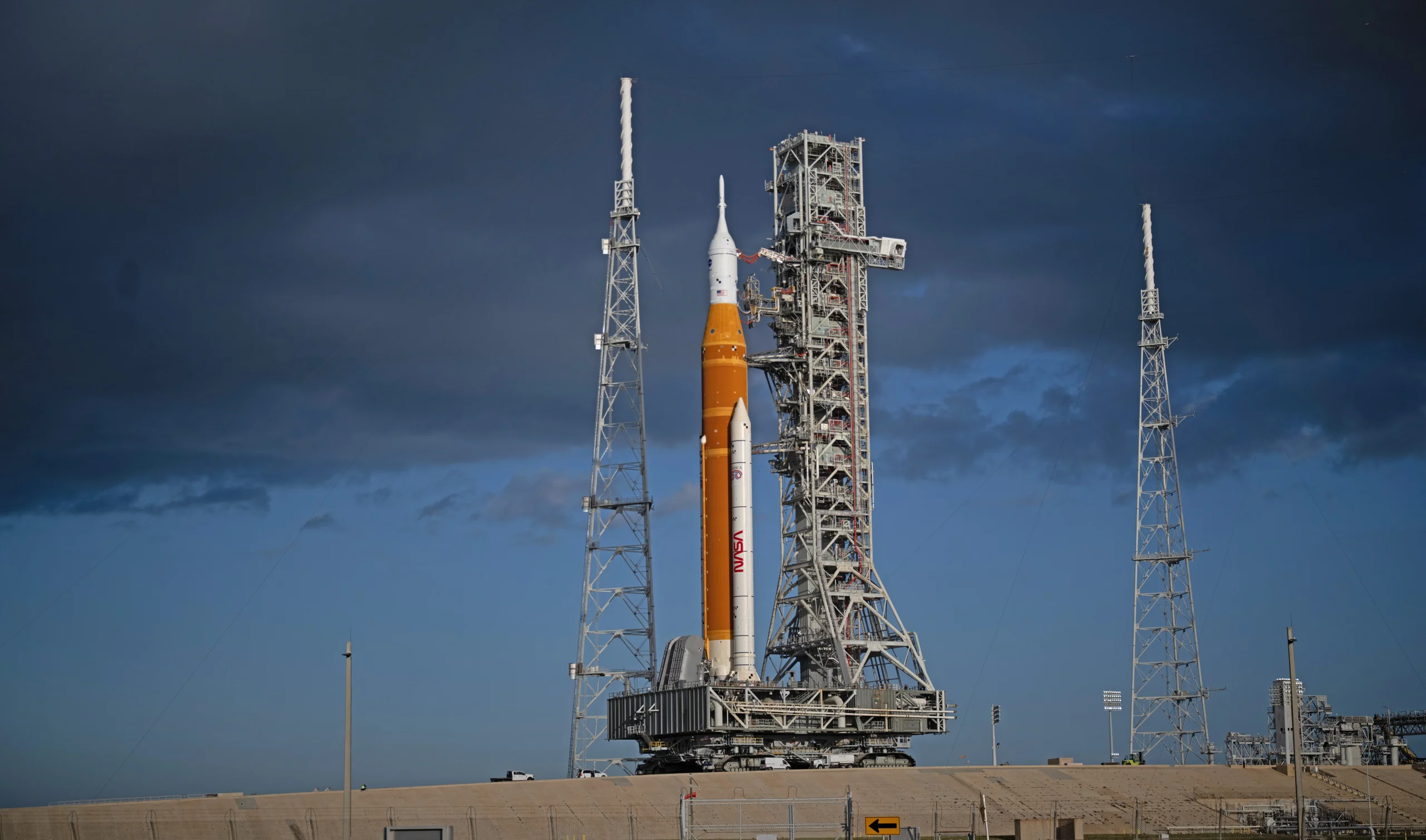

The most historic human spaceflight in over 50 years is just days away.
Artemis II is NASA’s planned crewed lunar flyby launching no earlier than April 1, 2026. The ten-day mission will carry NASA astronauts Reid Wiseman, Victor Glover, and Christina Koch, along with Canadian Space Agency astronaut Jeremy Hansen, on a free-return trajectory around the Moon and back to Earth.
Artemis II will be the first crewed mission beyond low Earth orbit since Apollo 17 in 1972. That’s more than half a century, a full generation since humans have ventured this far from home.
The Mission
Artemis II is a test flight, meaning its primary objective is to demonstrate key systems needed for a crewed mission to land on the Moon. That includes the Space Launch System (SLS) rocket and the Orion crew capsule. The mission will launch from NASA’s Kennedy Space Center in Florida, using Launch Complex 39B — the same historic pad used for Apollo and Space Shuttle missions.
After SLS carries Orion into space, Orion will orbit Earth twice while the crew tests its systems. Then the mission will head for the Moon, eventually flying as close as 8,000 kilometers (5,000 miles) from its surface.
Artemis II will set several human spaceflight records. Glover will become the first person of color, Koch the first woman, and Hansen the first non-U.S. citizen to travel beyond low Earth orbit. At a distance of roughly 4,700 miles beyond the Moon, and at an atmospheric reentry speed of approximately 25,000 miles per hour, Artemis II is set to become the farthest and fastest crewed spaceflight in history.
The Crew

The four astronauts making NASA’s next lunar leap bear little resemblance to those of the Apollo era. The Americans who blazed the trail to the moon more than half a century ago were white men chosen for their military test pilot experience.
Leading the crew is Reid Wiseman, 50, a retired Navy captain. Wiseman was serving as NASA’s chief astronaut when asked three years ago to lead humanity’s first lunar trip since 1972. Victor Glover will make history as the first person of color to travel beyond low Earth orbit. Christina Koch, a 47-year-old electrical engineer from Jacksonville, North Carolina, holds the record for the longest single spaceflight by a woman — 328 days. She took part in the first all-female spacewalk during her lengthy stay at the space station in 2019. And Jeremy Hansen of the Canadian Space Agency will be his country’s first emissary to the Moon.
A Rocky Road to the Pad
Getting to this moment has not been easy. The earliest launch window was set for early February 2026. A January 2026 North American winter storm delayed preparations. A wet dress rehearsal in February revealed a liquid hydrogen leak, and a helium flow issue triggered a rollback to the Vehicle Assembly Building, delaying the mission to April at the earliest.
NASA’s Artemis 2 Space Launch System rocket completed its second journey from the Vehicle Assembly Building to Launch Complex 39B on March 20, 2026, ending a roughly 10-hour overnight journey.
As of today, March 30, the mood at the Cape is focused. “The crew is ready, the rocket is ready, the spaceship is ready, the ground systems are ready,” said Sean Quinn, NASA’s Exploration Ground Systems Program Manager, during a press briefing Sunday afternoon. “We only need the weather to cooperate on Thursday — we’re ready to go.”
Artemis 2 is currently scheduled to lift off at 6:24 p.m. EDT on April 1 aboard NASA’s Space Launch System rocket from Pad 39B. The launch window runs through April 6, with opportunities available each day.
One Bonus for the Crew
If Artemis II launches April 1, there’s an additional highlight waiting for the crew: a rare solar eclipse opportunity visible from their unique vantage point in lunar space. The crew will have a chance to observe the solar corona as the moon eclipses the sun from their perspective during the outbound leg of the mission.
Can You See It From York County, SC?
This is the big question for locals. The short answer: it’s possible, but don’t count on a dramatic view.
York County is roughly 500 miles from Kennedy Space Center in Cape Canaveral, Florida. At that distance, the SLS rocket itself won’t be visible — it’s far too far away to see the vehicle. However, there’s a chance you could spot the bright exhaust plume on the horizon in very clear conditions, especially since the April 1 launch window opens at 6:24 p.m. EDT — right around dusk — which can actually help a bright plume stand out.
To maximize your chances from the York County area:
- Find an open, south-facing view with no buildings or trees blocking the southern horizon
- Use binoculars or a camera with zoom
- Check weather — you’ll need exceptional atmospheric clarity
Why This Matters
The flight is designed to test out much of the technology that will be used in later moon missions, informing NASA’s future plans for a permanent human settlement on the Moon. Artemis III is now planned to practice rendezvous and docking with lunar landers, and a human moon landing is targeted to take place during Artemis 4.
Whether you watch from your backyard in York County, stream it live online, or make the drive to Florida’s Space Coast, April 1, 2026 is a date worth marking on your calendar. The countdown begins today.
Sign up for our Sunday Spectator. Delivered to your inbox every Sunday, with all the news from the week.

Thomas Hyslip lives in Tega Cay with his wife and daughter. After 27 years in the U.S. Army and Federal Law Enforcement, he retired to pursue his passion for teaching. Tom is now an Assistant Professor of Instruction at the University of South Florida. In 2 short years he has won 10 awards from the South Carolina Press Association, including first place in column writing, education beat reporting and best podcast.