

YORK, SC — Seeking to balance rapid technological growth with community well-being, the York County Council passed the second reading of Case 26-02 on March 16, 2026, significantly tightening the regulations governing data center developments. The vote was 5 in favor and 2 opposed. Council members Andy Litten and Bump Roddey voted against the measure. The new ordinance moves data centers from a “by-right” permitted use to a “special exception” in Light Industrial (LI) and Industrial Development (ID) zones, forcing developers to undergo rigorous public review before the Board of Zoning Appeals.
Under the leadership of Chairwoman Christi Cox, the Council also invoked the “pending ordinance doctrine,” meaning these stricter standards—which target noise, water consumption, and building design—apply immediately to any new development plans submitted after the initial February 6 special meeting.
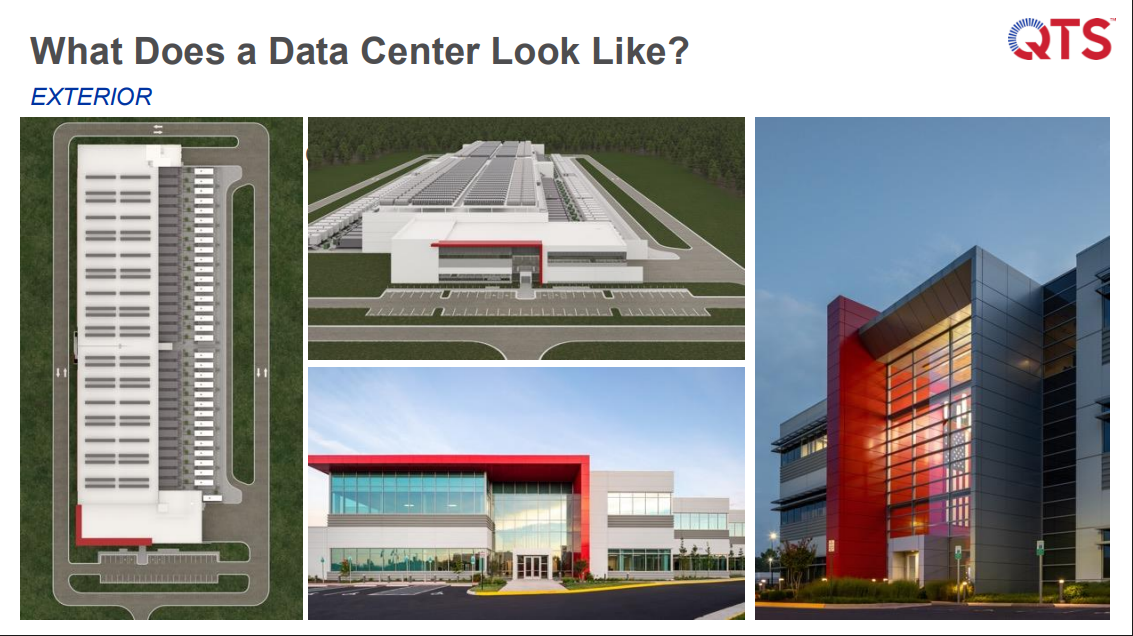
View the QTS material shared at the York County Community Event held on February 10th.

Stricter Standards for Noise and Public Health
A primary driver for the new regulations is the mitigation of “negative externalities,” specifically the persistent mechanical hum and vibration associated with large-scale data center cooling systems.
-
Mandatory Noise Studies: All new applicants must submit a formal study conducted by an acoustical engineer to ensure full compliance with the county’s noise ordinance.
-
Equipment Screening: The ordinance requires mandatory sound-dampening screens for all rooftop mechanical equipment and the enclosure of ground-level units.
-
Vibration Control: Data centers are prohibited from producing vibrations detectable at the property line without the aid of specialized instruments.
-
Generator Restrictions: To protect local air quality and reduce noise, on-site diesel generators are strictly limited to emergency use and periodic testing.
Public health concerns featured prominently in the discussion, with residents and risk professionals noting that chronic exposure to industrial-scale noise and light pollution can lead to serious cardiovascular and sleep disorders.
Protecting Critical Natural Resources
The ordinance introduces a “low water” mandate for cooling systems, reflecting growing community anxiety regarding the impact of hyperscale facilities on the Lake Wylie watershed.
-
Closed-Loop Mandate: The Council approved an amendment requiring data centers to utilize closed-loop cooling or similar technologies that minimize water resources.
-
Groundwater Protection: A newly added amendment strictly prohibits the use of groundwater wells for data center operations to safeguard the local water table.
-
Utility Disclosure: Future applicants must provide full disclosure of their projected peak water and electrical demand, along with a “willingness and capability” letter from utility providers.
Aesthetic and Community Buffers
To prevent data centers from “visually overwhelming” rural and residential landscapes, the Council enacted significant changes to setbacks and design.
-
Increased Setbacks: Data center buildings must now be set back at least 200 feet from residential property lines, with ground equipment required to maintain a 300-foot distance.
-
Industrial Buffers: Data centers were reclassified into the same high-impact buffer category as salvage yards and heavy manufacturing, requiring the most intensive “Type D” screening.
-
Design Modulation: Massive building facades must now incorporate vertical or horizontal modulation every 150 feet and use non-reflective “earth tone” finishes to minimize glare.
Looking Forward
While industry representatives expressed concern that the “special exception” process introduces subjectivity into economic development, Council members emphasized their responsibility to protect residents.
“Residents of York County deserve protections that are clear, measurable, and enforceable,” noted one community speaker during the three-hour public hearing.
The ordinance will proceed to a third and final reading following further evaluation by the Planning and Zoning Committee regarding decommissioning plans and the potential for on-site power generation.

Sign up for our Sunday Spectator. Delivered to your inbox every Sunday, with all the news from the week.

Thomas Hyslip lives in Tega Cay with his wife and daughter. After 27 years in the U.S. Army and Federal Law Enforcement, he retired to pursue his passion for teaching. Tom is now an Assistant Professor of Instruction at the University of South Florida. In 2 short years he has won 10 awards from the South Carolina Press Association, including first place in column writing, education beat reporting and best podcast.