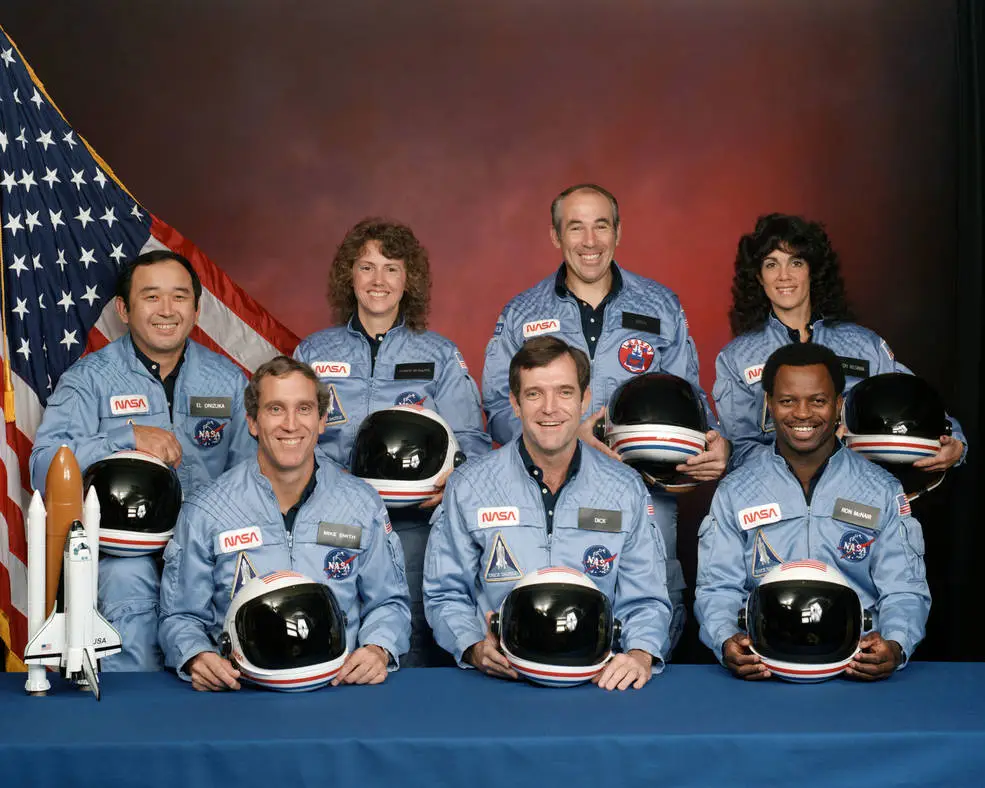
It has been exactly 40 years since the nation looked skyward in hope, only to witness one of the most searing tragedies in American history. On the morning of January 28, 1986, the Space Shuttle Challenger broke apart just 73 seconds after liftoff, claiming the lives of all seven crew members aboard.
Today, four decades later, the images of that cold January morning remain etched in the collective memory of a generation.
A Day of Promise Turned to Grief
The launch of the Challenger for its 10th mission was more than just a routine orbital flight; it was a national event. Among the crew was Christa McAuliffe, a 37-year-old social studies teacher from New Hampshire. As the winner of NASA’s “Teacher in Space” program, she was set to be the first civilian to teach lessons from orbit, capturing the imagination of millions of schoolchildren who tuned in to watch the launch live on television.
At 11:39 a.m., the shuttle lifted off from Kennedy Space Center. But barely a minute into the flight, the spacecraft disintegrated in a plume of smoke and fire over the Atlantic Ocean, killing McAuliffe and her six crewmates: Commander Francis “Dick” Scobee, Pilot Michael J. Smith, and Mission Specialists Ellison Onizuka, Judith Resnik, Ronald McNair, and Gregory Jarvis.
The Cause: Warnings Unheeded
In the wake of the disaster, President Ronald Reagan appointed the Rogers Commission to investigate the cause of the explosion. The commission, which included figures such as Neil Armstrong and Chuck Yeager, uncovered a fatal flaw that had been exacerbated by the weather.
The investigation revealed that rubber O-rings, designed to seal the joints of the shuttle’s solid rocket boosters, had failed due to the unusually cold temperatures that morning. Engineers from Morton Thiokol, the contractor responsible for the boosters, had warned superiors that the components were vulnerable to failure in freezing conditions. Tragically, those warnings went unheeded, and the launch was allowed to proceed.
During the hearings, theoretical physicist Richard Feynman famously demonstrated the flaw to the public by dropping a piece of the O-ring material into a glass of ice water, showing how brittle and unyielding it became in the cold.
A Lasting Legacy
The Challenger disaster forced a suspension of the shuttle program for more than two years as NASA redesigned critical safety features and overhauled its management culture. Flights did not resume until the launch of Discovery in September 1988.
While the shuttle program eventually continued—aiding in the construction of the International Space Station and the maintenance of the Hubble Telescope—it came to a final close in 2011.
Today, 40 years after the tragedy, the legacy of the Challenger crew endures not only in the safety protocols of modern spaceflight but in the educational centers and scholarships established in their names. The mission that ended in 73 seconds continues to inspire a future generation to reach for the stars, despite the risks.

Sign up for our Sunday Spectator. Delivered to your inbox every Sunday, with all the news from the week.