Have you purchased a car, boat, motorcycle, or ATV recently? You may be affected by this.
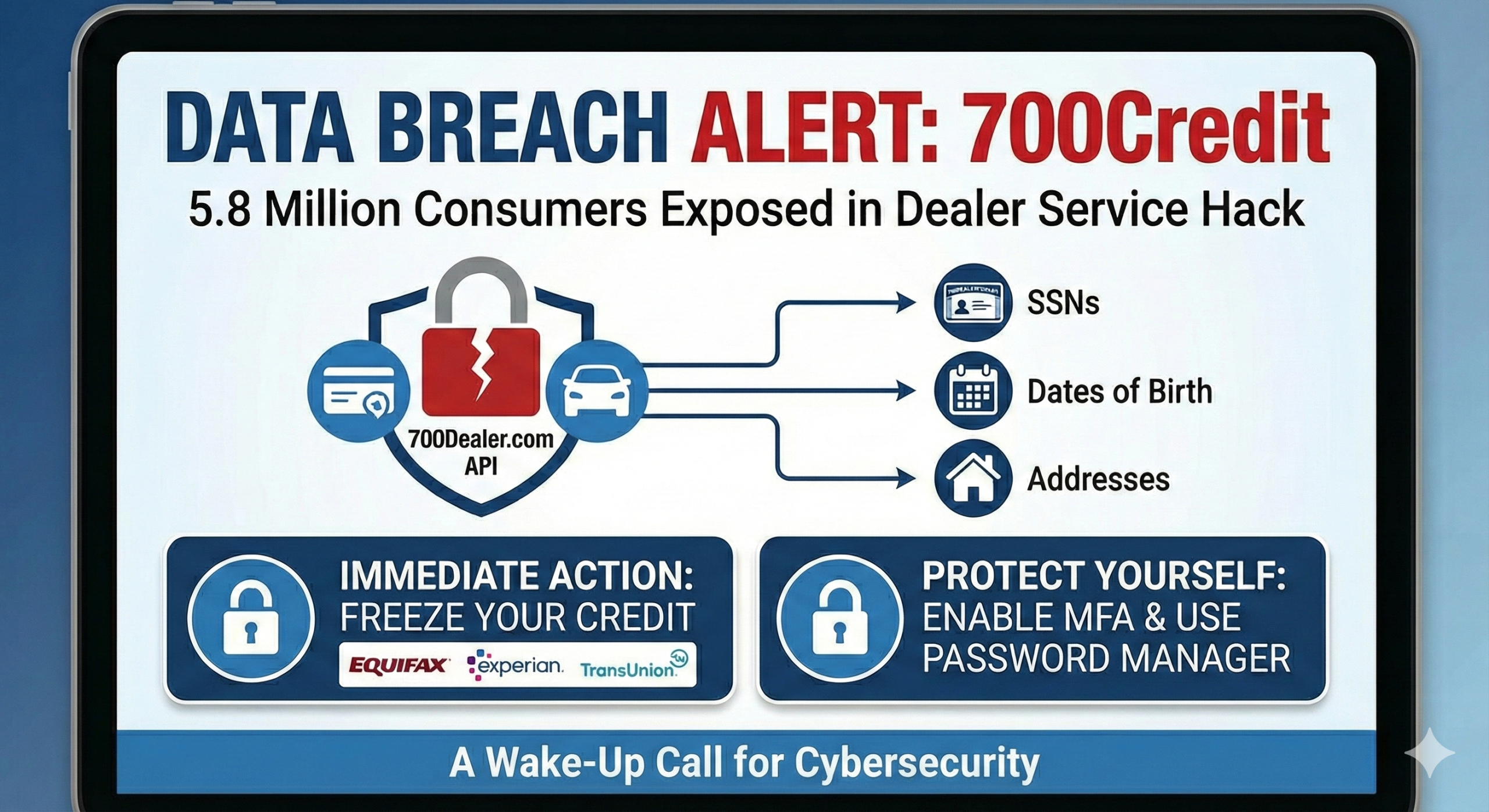
If you have visited a dealership for financing in the last few months, your personal information could be at risk. 700Credit, the leading provider of credit and compliance solutions for automotive retailers, has confirmed a massive security lapse exposing the sensitive data—including Social Security numbers—of approximately 5.8 million consumers nationwide. The South Carolina Department of Consumer Affairs reports 108,829 South Carolina residents are affected by this incident.
Here is what we know about the breach and, most importantly, how to protect your identity immediately.
In a significant cybersecurity incident rocking the automotive retail industry, 700Credit—the largest provider of credit, compliance, and identity verification solutions for auto dealerships—has confirmed a major data breach exposing the sensitive personal information of approximately 5.8 million consumers.
According to Managing Director Ken Hill, the security failure traces back to the 700dealer.com platform, where hackers exploited a vulnerability in a third-party vendor’s API to gain entry. 700Credit moved to seal the breach immediately upon discovery, subsequently utilizing a two-week window to reinforce their internal systems before publicly disclosing the incident.
While the company’s internal corporate network reportedly remained secure, the attackers successfully exfiltrated data logs containing highly sensitive consumer records before the vulnerability was patched.
Who is Affected?
The breach casts a wide net, impacting roughly 23,000 dealerships across the United States, including car, RV, marine, and powersports dealers.
If you applied for financing or had a credit check run at a participating dealership between May 2025 and October 2025, your data is likely involved. The stolen information is particularly concerning as it includes:
-
Full Names
-
Residential Addresses
-
Dates of Birth
-
Social Security Numbers (SSNs)
700Credit has begun notifying affected consumers and offering 12 months of free credit monitoring and identity restoration services.
Steps to Protect Yourself
This latest breach is a stark reminder that relying on outdated security practices is a recipe for disaster. With Social Security numbers exposed, your first line of defense should be to sign up for the free monitoring offered by 700Credit and, more importantly, lock down your credit file.
Immediate Action: How to Freeze Your Credit
A credit freeze is the single most effective tool against financial identity theft. It seals your credit report so that no one—including you—can open a new account, credit card, or loan in your name without a special PIN.
To be effective, you must place a freeze at each of the three major credit bureaus individually:
-
Equifax: Visit equifax.com/personal/credit-report-services
-
Experian: Visit experian.com/freeze
-
TransUnion: Visit transunion.com/credit-freeze
Beyond these immediate actions, it’s time for both individuals and tech companies to embrace more robust security measures to prevent future identity theft. Here’s why you should prioritize these additional key steps:
1. Embrace the Power of a Password Manager
Reusing or weak passwords create a domino effect, where a single compromise can expose multiple accounts. This is where a password manager becomes an indispensable tool.
-
What is a password manager? It’s a secure application that generates and stores complex, unique passwords for all your online accounts. Instead of remembering dozens of complicated passwords, you only need to remember one strong master password to unlock your manager.
-
Why use one?
-
Generates Strong, Unique Passwords: Password managers create long, random, and unique passwords for each of your accounts, making them incredibly difficult for attackers to guess or crack.
-
Eliminates Password Reuse: With a password manager, you’ll never reuse a password again. Even if one service is breached, your other accounts remain secure.
-
Secure Storage: Your passwords are encrypted and stored securely, typically with strong encryption algorithms.
-
Convenience: Many password managers offer browser extensions and mobile apps, making it easy to autofill login credentials and sync them across your devices.
-
Beyond Complex Passwords: The Power of Passphrases and Password Managers
2. The Golden Rule: Never Reuse Passwords
This point cannot be stressed enough. The recent leak underscores the catastrophic consequences of password reuse. If you use the same password for your email, banking, and social media, a breach of one account can grant attackers access to all of them.
-
Think of it like this: If you had the same key for your house, car, and safe deposit box, losing that one key would expose everything. Digital security is no different. Every online account should have a unique, strong password.
3. Fortify Your Accounts with Multi-Factor Authentication (MFA)
Even if your password is stolen, Multi-Factor Authentication (MFA), often referred to as two-factor authentication (2FA), adds an essential layer of security. MFA requires a second form of verification in addition to your password, making it significantly harder for unauthorized individuals to access your accounts.
-
Common MFA methods include:
-
Authentication Apps: Generating time-sensitive codes (e.g., Google Authenticator, Microsoft Authenticator, Authy).
-
Biometric Confirmation: Fingerprint or facial recognition.
-
Hardware Security Keys: Physical devices that provide a second factor of authentication.
-
SMS Codes (with caution): While better than nothing, SMS codes are generally less secure due to potential SIM swapping attacks. Authentication apps are preferred.
-
-
Why enable MFA? Cybercriminals rely on stolen usernames and passwords. With MFA enabled, even if they have your password, they cannot gain access without the additional security step. Make it a priority to enable MFA on all your critical accounts, including email, banking, social media, and work-related logins.
Beyond Passwords: A Holistic Approach to Cybersecurity
While strong passwords, password managers, and MFA are foundational, a comprehensive approach to digital security involves more:
-
Strong Antivirus Software: Infostealer malware is a primary cause of password leaks. Reputable antivirus software can detect and block these threats, which often spread through malicious downloads, phishing emails, and fake websites. Always stick to official sources for downloads.
-
Keep Software Updated: Outdated software is a common vulnerability. Regularly update your operating system, browsers, and security software to patch known weaknesses that cybercriminals exploit.
-
Consider Personal Data Removal Services: With billions of records leaked, your personal information is likely scattered across various data broker sites. Data removal services can systematically erase your information from these platforms, reducing your digital footprint and making it harder for attackers to compile comprehensive profiles for targeted scams.
The recent 700Credit breach serves as a powerful wake-up call. The era of lax digital hygiene is over. By embracing password managers, committing to unique passwords, and fortifying accounts with multi-factor authentication, you can significantly enhance your digital resilience and protect your online life from the ever-present threat of cybercriminals. Your digital security is in your hands—it’s time to take control.

Feeling lost in the digital world? Dr. Tom is here to help!
Join Dr. Tom every week in his column, Dr. Tom’s Cyber Bits and Tips, for byte-sized advice on all things cyber and tech. Whether you’re concerned about online safety, curious about the latest cybercrime trends, or simply want to navigate the ever-evolving digital landscape, Dr. Tom has you covered.
From practical cybersecurity tips to insightful breakdowns of current threats, Dr. Tom’s column empowers you to stay informed and protect yourself online. So, dive in and get savvy with the web – with Dr. Tom as your guide!

Sign up for our Sunday Spectator. Delivered to your inbox every Sunday, with all the news from the week.