
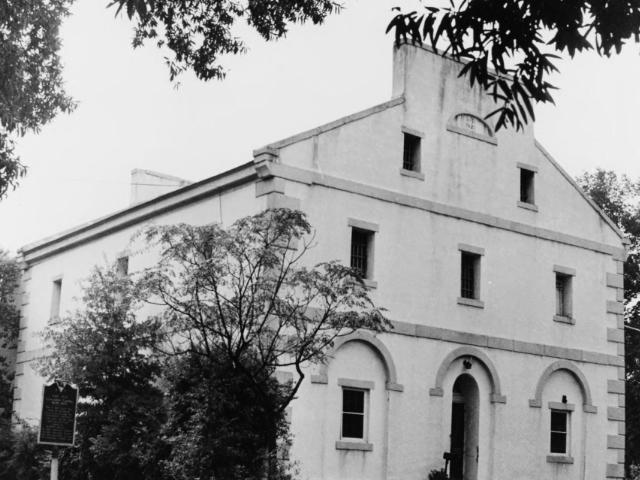
In the heart of Lancaster, South Carolina, stands a building that feels less like a structure and more like a tomb that hasn’t been buried yet. The Old Lancaster County Jail, a National Historic Landmark, is a heavy, imposing ediface of stucco and stone. To the casual observer, it is a marvel of early American engineering. To the locals and those sensitive to the unseen, it is a repository of 150 years of accumulated misery.
The story of the jail is really the story of two things: the genius of a famous architect, and the spirits that his “perfect building” has refused to release.
The Architect: The Man Who Built the Monument
To understand the jail, one must understand its creator, Robert Mills (1781–1855).
Mills is arguably the most important architect in early American history. He was the first native-born American to be professionally trained as an architect, studying under Thomas Jefferson. His resume is legendary; he designed the U.S. Treasury Building, the Patent Office, and, most famously, the Washington Monument in Washington, D.C.
While the Washington Monument is a soaring symbol of hope and democracy, Mills’ work in South Carolina was driven by a darker, more pragmatic obsession: Fire.
In the early 19th century, public buildings—especially jails—were notorious firetraps. Prisoners were often burned alive in their cells when wooden structures caught fire. Mills became obsessed with creating “fireproof” buildings.
When he designed the Lancaster County Jail in 1823, he didn’t use wood. He used a system of heavy masonry vaulting. The floors, the ceilings, and the walls are all thick stone and brick. There are no timber beams to burn. He effectively built a man-made cave.
The Design: A Tomb for the Living
The jail is a masterpiece of function. The ground floor housed the jailer’s family (a common practice at the time), while the second and third floors were for the prisoners.
The architecture is suffocating. The “Mills design” meant that sound had nowhere to go. Because of the vaulted stone ceilings, a whisper in one corner can be heard in another, but it also means screams and clanging chains would echo endlessly, amplifying the psychological torture of the inmates.
The jail was in continuous operation from 1823 until 1979. For over a century and a half, murderers, thieves, and the condemned were locked inside Mills’ fireproof box.
The Haunting
It is widely believed that the very features Robert Mills designed to keep the building standing—the stone, the quartz, the granite—have acted as a “battery,” storing the emotional energy of the past.
The Slamming Doors
The most common report from the jail involves the heavy iron cell doors. Visitors and tour guides frequently report hearing the distinct, heavy clang of a cell door slamming shut on the upper floors, even when the building is empty. Some witnesses have watched the heavy doors, which require significant force to move, swing shut on their own.
The Third Floor
The third floor is considered the epicenter of the activity. This was the area often reserved for the most dangerous criminals.
-
The Shove: Several visitors and paranormal investigators have reported physical contact on this floor. It is usually described as a firm, angry shove in the middle of the back, as if a prisoner is trying to push them out of their territory.
-
The Voices: Disembodied voices are often heard echoing off the vaulted ceilings. Unlike the typical “whispers” of ghost stories, these are often described as loud, agitated shouts—perhaps a residual echo of the arguments and pleas that bounced off these walls for 150 years.
The “Watcher”
There are reports of a shadow figure that paces the hallway of the second floor. Some lore suggests this might not be a prisoner, but a former jailer who died on the property, eternally walking his rounds to ensure no one escapes Robert Mills’ impenetrable fortress.
The Irony of Robert Mills
There is a dark irony to the Old Lancaster County Jail. Robert Mills is celebrated in our nation’s capital for designing the white obelisk that reaches toward the heavens—a symbol of freedom. Yet, in Lancaster, his legacy is a squat, stone box designed to strip freedom away.
He designed the jail to be indestructible so that the people inside would be safe from fire. But in making it indestructible, he may have created a place that the dead find impossible to leave. The stone walls that were built to last forever seem to have ensured that the spirits inside do, too.

Sign up for our Sunday Spectator. Delivered to your inbox every Sunday, with all the news from the week.