
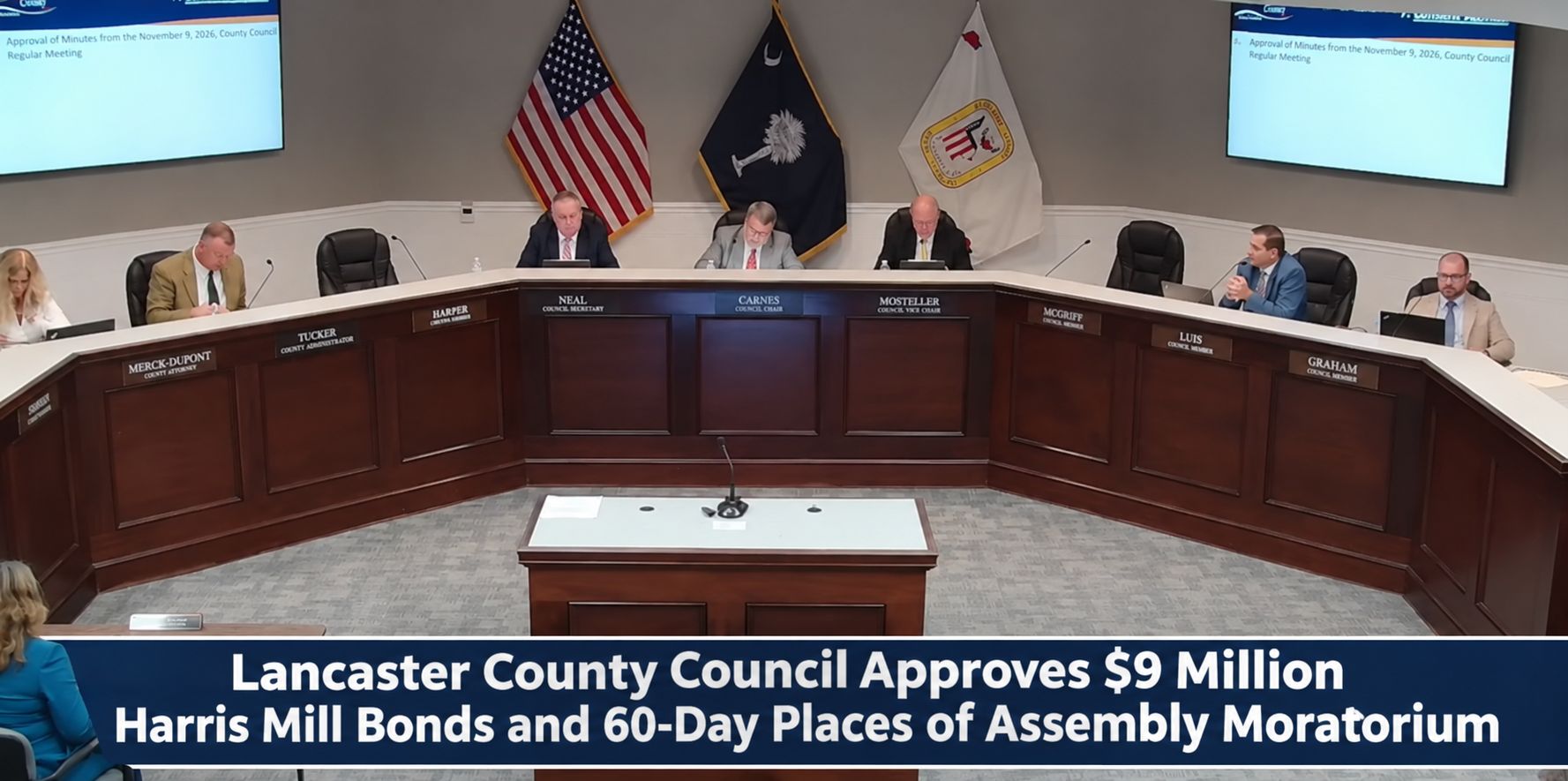

Lancaster County Council on Monday, Nov. 23, gave final approval to up to $9 million in assessment revenue bonds for the Harris Mill Residential Improvement District, a 60-day moratorium on new places of assembly in unincorporated parts of the county, and an update to the county’s building codes. Council also passed the second reading of a budget amendment that adds state library aid and realigns funding for the coroner’s forensic pathologist position.
Council unanimously adopted a performance framework for County Administrator Brian Tucker that, at his request, works as an assessment of the entire county organization rather than a review of one person. Tucker said the framework will guide next year’s budget process and reported that 71.1% of county employees took part in a first-ever engagement and culture survey.
The meeting opened with recognition of the Lancaster County Veterans Affairs Office for bringing The Wall That Heals to Lancaster Nov. 5 through 8 and of the first three graduates of the county’s in-house paramedic program. On the consent agenda, council passed the second reading of three rezonings and a gas pipeline easement by a 4-1 vote. Council also adopted its 2027 meeting and holiday calendars and appointed a manufacturing representative to the Economic Development Advisory Board. A Catawba Workforce Development Board member seeking a second term was not reappointed when no motion was made.
Council members Charlene McGriff and Steve Harper were absent. Every vote among the five members present was 5-0 except the consent agenda.
Citizen comments
One resident spoke, backing Tucker’s proposal that council develop a legislative agenda to take to lawmakers in Columbia. She said the state has surplus money and the county should put together a list of its needs, pointing to discussion in recent meetings about road and infrastructure funding.
The Wall That Heals
Robin Ghent, director of Veterans Affairs, reported on the Nov. 5 through 8 visit of The Wall That Heals, the traveling replica of the Vietnam Veterans Memorial. She said more than 200 volunteers worked the event, including overnight and security shifts, and a 20-member community committee met monthly to plan it. Donors and sponsors gave almost $40,000, and Ghent said money left over will be sent back to Washington, D.C., for upkeep of the Vietnam Veterans Memorial grounds.
Ghent thanked county EMS, city and county fire departments for raising and taking down the wall, the Parks and Recreation staff, Emergency Management, the city of Lancaster, veteran service organizations and her own staff, who she said worked 14-hour days. She also thanked Council member Jose Luis for working a cold, rainy overnight volunteer shift. Ghent described the event as a partnership between the county and the city of Lancaster.
Chairman Brian Carnes noted the wall visits only 40 to 50 communities a year and presented Ghent and the Veterans Affairs staff a certificate of recognition. Ghent handed out challenge coins to council.
First in-house paramedic graduates
EMS Director Clay Catoe recognized the first graduates of the county’s in-house paramedic program, which he said grew out of an EMT class the county started in 2019 so it could train its own staff rather than pay to send them elsewhere. The program’s lead instructor, Danny, became a full-time county employee Sept. 1 after council approved the position when the grant funding it ran out.
All three students passed, and Catoe said they also passed their national board exams on the first attempt, which he called rare. Graduates Trey Ellis and Eric Moore were recognized with their families. The third graduate was absent after recently becoming a father. Catoe said Ellis and Moore each drive nearly an hour to work in Lancaster County.
A representative of the South Carolina EMS Association, which partnered with the county on the program, said only a handful of such programs exist in the state.
Consent agenda
Council approved the consent agenda 4-1, with Luis voting no. It included the Nov. 9 minutes and second readings of four ordinances:
Ordinance 2026-2066 rezones about 50.86 acres at 9546 Olin Yarborough Road from Low Density Residential to General Business. The Planning Commission recommended approval 4-2.
Ordinance 2026-2067 rezones about 12.96 acres at Charlotte Highway and Red Ventures Drive from Mixed-Use to Regional Business. The Planning Commission recommended approval unanimously.
Ordinance 2026-2068 rezones about 5.82 acres at 1743 Lynwood Drive from General Business to Medium Density Residential. The Planning Commission split 3-3, which counts as a recommendation of denial, while planning staff recommended approval.
Ordinance 2026-2069 grants temporary construction and permanent easements to Carolina Gas Transmission LLC on county-owned property at 286 Aviation Boulevard.
All four passed first reading 6-0 on Nov. 9 and still need a third reading. After the vote, Luis said he had missed the Nov. 9 meeting because of a death in the family and asked that items from that meeting be separated for future votes. Carnes agreed.
Harris Mill Residential Improvement District
Council gave final approval, 5-0, to two Harris Mill ordinances after public hearings at which no one spoke.
Ordinance 2026-2062 removes certain property from the Harris Mill Residential Improvement District. Michael Seezen of Burr & Forman, the county’s bond counsel, said the ordinance had not changed since second reading, when it was revised to reflect current property ownership within the district.
Ordinance 2026-2063 authorizes up to $9 million in Harris Mill Residential Improvement District assessment revenue bonds, issued in one or more series, along with the trust indenture, bond purchase agreement, disclosure agreement and offering memorandum documents.
Building codes update
Council unanimously adopted Ordinance 2026-2064 on third reading, amending Chapter 7 of the county code to adopt the updated uniform codes required by the South Carolina Building Codes Council, along with certain optional codes. Staff said the ordinance had not changed and reflects the routine code updates the county adopts each year. No one spoke at the public hearing.
Places of assembly moratorium
Council unanimously adopted Ordinance 2026-2065 on third reading, placing a 60-day moratorium on certain development approvals for new places of assembly, small and large, and on material expansions of existing ones in unincorporated Lancaster County. Tucker said staff is using the time to develop separate standards for small and large places of assembly, which will go through the text amendment process as the county adopts its new Unified Development Ordinance. No one spoke at the public hearing.
Budget amendment
Council unanimously passed the second reading of Ordinance 2026-2061, amending the fiscal 2026-27 budget. Sabrena Harris, the county’s chief financial officer and Financial Services division leader, said the two-part ordinance appropriates additional state aid funding for the library and realigns the budget for the coroner’s forensic pathologist position. Nothing changed from first reading. The ordinance requires a third reading.
County administrator evaluation
Council voted 5-0 to approve the recommendation of its ad hoc personnel committee on Tucker’s evaluation. Tucker, who started July 1, asked council to treat the document as an assessment of the organization and its priorities rather than an evaluation of him personally, saying county staff do the work and he is accountable for meeting council’s expectations.
Tucker outlined the main pieces. He will deliver a formal organizational assessment within a few weeks. Department and division leaders will set specific goals for the coming year. The employee engagement and culture survey, which closed Friday, set a minimum participation goal of 50% and a target of 70%, and reached 71.1%. Council’s broad priorities, such as economic development and infrastructure, will be narrowed through an exercise over the next few months. Other goals include a capital improvement plan for long-range budgeting, economic development pipeline and lead generation targets, countywide infrastructure planning looking 5 to 20 years out along with how to pay for it, and expanding countywide fire and EMS service to keep pace with growth.
Tucker said the document will serve as the framework for next year’s budget process, which is already underway.
Carnes, who chaired the committee, said the consultant had told the county to expect about 50% survey participation and that the idea to make the evaluation an organizational guide came from Tucker. Committee members Luis and Bryant Neal also praised the work. One member said the document sets guardrails and structure that had been lacking and that the county should listen to what employees said in the survey. It was also noted that the library had 100% participation.
Carnes dissolved the ad hoc personnel committee after the vote, saying its work was complete.
2027 calendars
Council voted 5-0 to adopt its 2027 calendars for council meetings, board and commission meetings, advisory board meetings and county holidays. Clerk to Council Sherrie Simpson said the schedules must be published in the newspaper under the Freedom of Information Act.
Board appointments
Council voted 5-0 to appoint Todd Lindler to the Economic Development Advisory Board as the manufacturing representative. By ordinance, Tucker makes the appointment subject to council approval, and he agreed to it. Lindler’s first four-year term ends Dec. 31, 2030.
Laura Taylor Haynes, who applied for reappointment to a second three-year term as a business representative on the Catawba Workforce Development Board through the Catawba Regional Council of Governments, was not reappointed after no council member made a motion. Simpson said most of the county’s six seats on that board expire this year, and more appointments will come at the next meeting. The appointment of Erica Hall to the Housing Committee was postponed indefinitely.
Council did not hold an executive session and adjourned.

Sign up for our Sunday Spectator. Delivered to your inbox every Sunday, with all the news from the week.

Thomas Hyslip lives in Tega Cay with his wife and daughter. After 27 years in the U.S. Army and Federal Law Enforcement, he retired to pursue his passion for teaching. Tom is now an Assistant Professor of Instruction at the University of South Florida. In 2 short years he has won 10 awards from the South Carolina Press Association, including first place in column writing, education beat reporting and best podcast.