
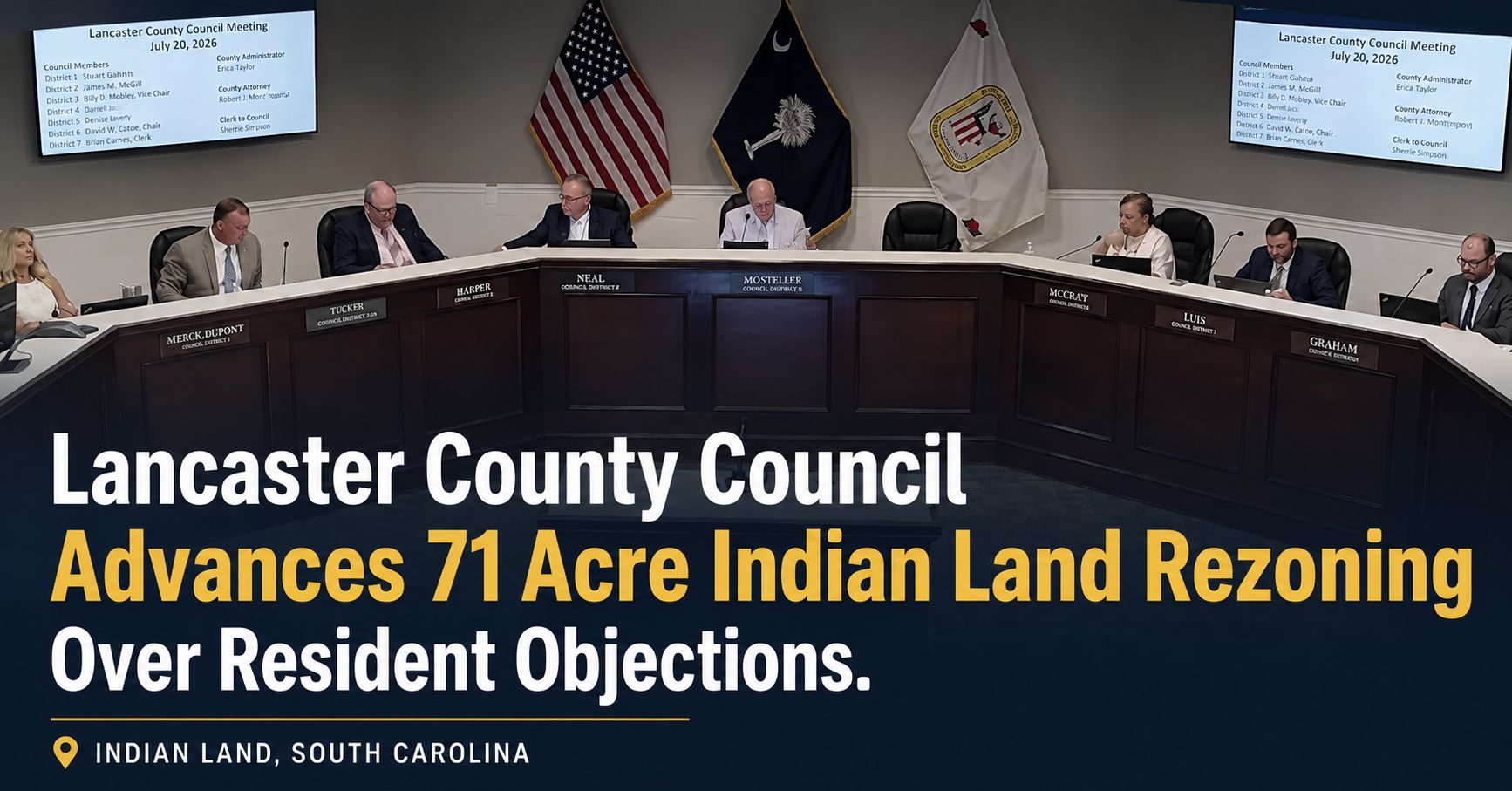

The Lancaster County Council voted 4 to 2 on Monday to advance a rezoning that would open 71.1 acres at Charlotte Highway and Laurel Hill Road in Indian Land to commercial development, pushing a long delayed project past a second reading over objections from residents who fear the change could invite apartments and worsen traffic on an already crowded stretch of Highway 521.
The measure, Ordinance 2026 2012, would change the tract from low density residential to regional business at the request of CF Smith Property Group, which has told neighbors it plans a shopping center. Planning staff recommended approval, but the Planning Commission recommended denial by a unanimous vote. Council members Stuart Graham and Jose Luis voted no. Chair Brian Carnes, who took part remotely, was not connected when the vote was called.
The project has moved in fits and starts. Council first passed the rezoning 5 to 2 in February, then postponed the second reading several times while the developer worked to resolve traffic and road connectivity questions raised by council and staff.
Residents ask for commitments in writing
Much of the public comment centered on whether promised traffic improvements and buffers will be enforceable. An attorney for CF Smith told council the applicant has reached a conceptual plan with the South Carolina Department of Transportation and Widewaters, owner of the neighboring Parkstone development, for improvements along Highway 521. Those include a full movement traffic signal at Halifax that he said the department has confirmed, a median at the Parkstone intersection, an added left turn into the CF Smith site, and the relocation of Laurel Hill Road.
Council member Jose Luis, an attorney, pressed the applicant’s representatives on whether the memorandum of understanding governing those commitments is enforceable, and whether the county could require the developer to sign it as a condition of the rezoning. The attorney said the county cannot make signing a condition of approval, but that the developer would hand over a signed memorandum before third reading. A CF Smith representative added that the county’s practical leverage is that the property cannot be built without relocating Laurel Hill Road, which requires county agreement. Council members Bryant Neal and Steve Harper asked whether the memorandum would bind a future owner if the land were sold and whether it could carry a time limit. Those questions were left unresolved.
Several Indian Land residents spoke during the meeting. One resident who lives next to the tract spoke in support of how the developer engaged neighbors, pointing to added buffering, berms, fencing, landscaping and setbacks. Others asked council to deny the request or narrow it to general business zoning, warning that regional business zoning could allow high density apartments and pointing to a nearby apartment complex that already carries the same designation. Another speaker asked council to delay the vote until traffic signals, roundabouts, a service road and buffers for neighboring homes are written into the memorandum, arguing that a site diagram alone does not hold a developer to anything. One resident opposed the rezoning outright, saying Highway 521 infrastructure has not improved. Two written comments also opposed the ordinance.
Charter school rezoning clears first reading
Council voted 6 to 0 to approve first readings of two related ordinances that would allow a charter school on 32.89 acres at 11632 Harrisburg Road, rezoning the property from light industrial to institutional and amending the 2040 comprehensive plan. Both the Planning Commission and planning staff had recommended denial.
Property owner Skip Powell said the building, once home to PCI Group, was surrounded by open land when it was built more than two decades ago and is now hemmed in by homes, making industrial use a poor fit. Natalia Panosuk, founder of Bridge Point Charter School, described the project as a tuition free public charter school serving kindergarten through eighth grade, and said the applicant is working with the state transportation department on traffic along Harrisburg Road. Commercial broker Charlie Swanson said he showed the property to 20 prospects over 12 months but could not land an industrial tenant because trucks cannot easily reach the site and homes surround it. Council member Charlene McGriff, whose district includes the property, backed the change as a reduction from the heavier truck traffic light industrial zoning would permit. A written comment from Nancy Dia opposed both ordinances.
New administrator takes his seat
Brian Tucker attended his first meeting as county administrator. Tucker, a Lancaster resident, comes to the county from the city of Myrtle Beach, where he served as assistant city manager, and previously spent about eight years as economic development director for Georgetown County. He is a Clemson graduate. He and his wife, Margaret, have two grown daughters.
Bonds, a moratorium and a shared park
Council gave first reading approval, 6 to 0, to Ordinance 2026 2047, authorizing up to $23 million in assessment revenue bonds for the Roselyn Residential Improvement District on Highway 521. Bond counsel Michael Seezen of Burr Forman said the bonds are the second and final round for the district, following a $15 million round issued in 2025, and are repaid only from assessments on property owners within the district rather than from county taxes. The annual assessment is capped at $1,550. Seezen said a 4 percent issuance fee would bring about $920,000 to the county. John Hardy of Lennar Carolinas reported that the development has sold 194 homes and closed 158, with 54 under construction and an amenity center that will include pickleball and bocce courts.
Council also approved, 6 to 0, a first reading extending the county’s nine month residential development moratorium an additional 90 days. Planning staff said the extension would carry the moratorium to November 10 and give the county time to finish its new Unified Development Ordinance, expected to reach third reading in October.
A third first reading approved 6 to 0 authorizes a multi county park agreement with Kershaw County for a joint industrial park to be located initially in Kershaw County. Economic Development staff member Brian Fulk said Lancaster would be the partner county, keeping 1 percent of the revenue while Kershaw keeps 99 percent, a share he said is projected to generate six figures a year for Lancaster with no capital outlay. Neal said he wanted more information before final readings but voted to approve.
Other business
Council approved 6 to 0 a first reading rezoning 8.53 acres at 1001 Lakefront Drive from rural neighborhood to agricultural residential, a request from owner Lori Cistar to allow her daughter to place a mobile home on family land. Members noted the surrounding parcels are owned by the same family. A first reading text amendment clarifying the county’s road acceptance criteria passed 6 to 0.
A third reading rezoning at 7319 Charlotte Highway, which had passed two earlier readings 7 to 0, died for lack of a motion after the applicant did not appear to answer council’s questions. Council also voted 6 to 0 to remove a District 2 planning commissioner, effective immediately, after she moved out of the district. The consent agenda, items A through I, passed 6 to 0. A written comment from Peter Lewis opposed a data center in Lancaster County.
The new Unified Development Ordinance is expected to reach third reading in October, and both the CF Smith rezoning and the charter school ordinances return for additional readings before any final adoption.
Reporting based on the July 20, 2026, Lancaster County Council meeting agenda and a recording of the meeting.
Sign up for our Sunday Spectator. Delivered to your inbox every Sunday, with all the news from the week.

Thomas Hyslip lives in Tega Cay with his wife and daughter. After 27 years in the U.S. Army and Federal Law Enforcement, he retired to pursue his passion for teaching. Tom is now an Assistant Professor of Instruction at the University of South Florida. In 2 short years he has won 10 awards from the South Carolina Press Association, including first place in column writing, education beat reporting and best podcast.