
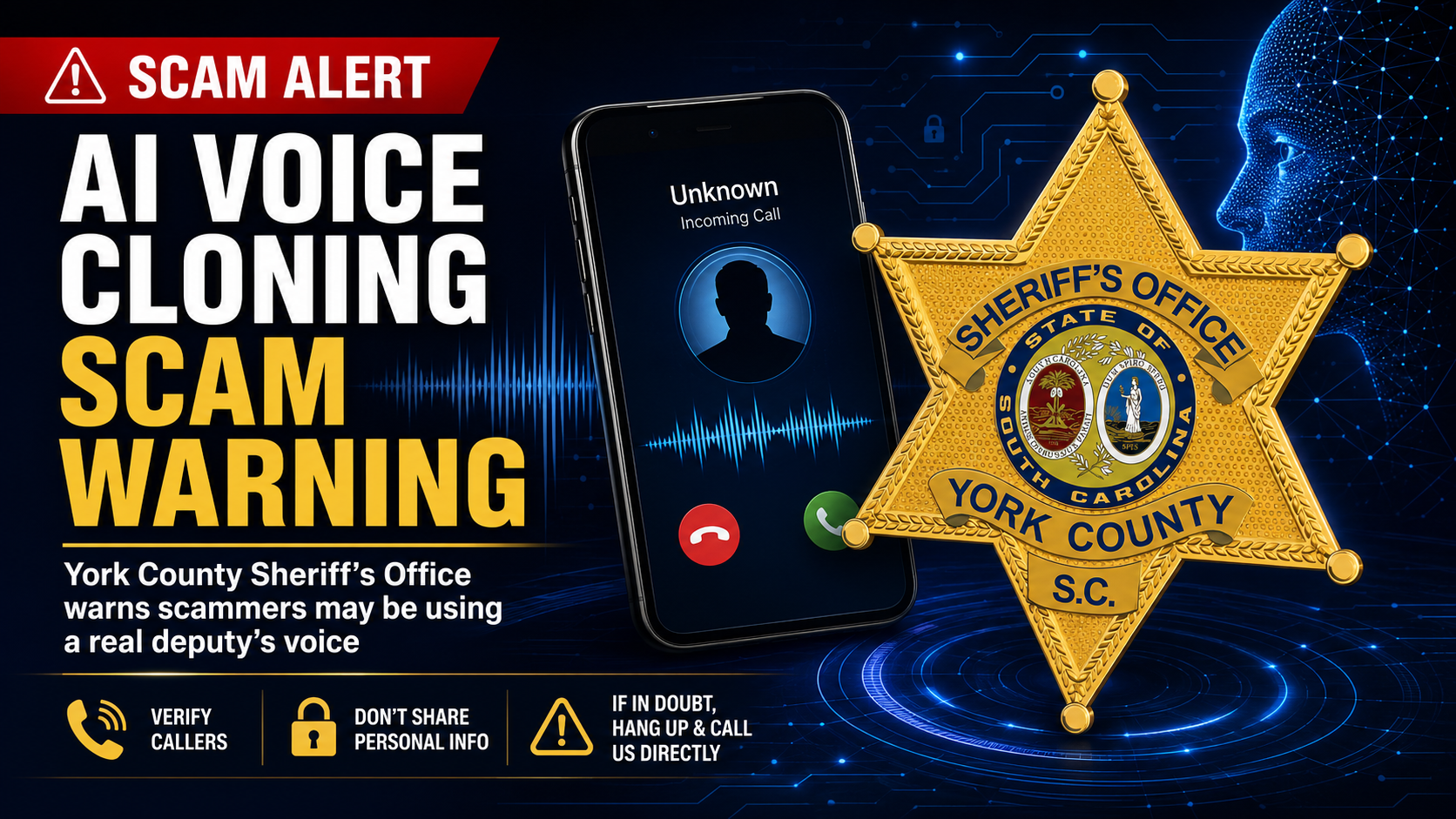

A Scam Call With a Disturbing New Twist
The York County Sheriff’s Office is warning residents about a wave of impersonation scam calls, and this time something about them is different. Callers claiming to be Captain Jonathan Reed, who leads the Sheriff’s Office Criminal Investigations Division, have been telling victims they have outstanding warrants for failure to appear for jury duty, and demanding payment to resolve the matter.
The twist is that at least one person who received a call reported that the voice on the other end sounded very similar to the real Captain Reed.
What Happened
The York County Sheriff’s Office posted a public scam alert on Facebook this week, writing: “We have received several calls reporting that police impersonators are using the name Captain Jonathan Reed and claiming they have warrants for failure to appear for jury duty.”
The post went on to note what made this particular wave of scam calls different from the usual: “What’s different this time is that one person said the voice sounded very similar to Capt. Reed, so scammers might be using AI to mimic the real person’s voice now.”
The Sheriff’s Office was direct about the bottom line: “Always remember, a real deputy will never call and ask for money over the phone. Just hang up even if they pressure you into staying on the phone.”
The implication is significant. If a victim genuinely believed the voice on the phone sounded like Captain Reed, the scammers may have moved beyond simple impersonation and into AI-generated voice cloning, using audio of the real captain pulled from somewhere online or recorded during a prior encounter to make their fraudulent calls sound far more convincing than the average scam attempt.
This Is Not a New Warning, But It Is a New Reality
Regular readers may recall that this is not the first time this exact threat has crossed Dr. Tom’s radar. Back in August 2024, I sat down with WBTV Consumer Investigator Caroline Hicks to demonstrate exactly how easily this kind of scam could be pulled off. At the time, I tested the technology myself by cloning Caroline’s voice and making several phone calls with it. Every single person who answered found it completely believable.
What I told WBTV then is even more true today: “It’s really enabled criminals to take the next step where they can mimic other people.” Voice cloning technology that once required sophisticated equipment and expertise can now produce a convincing clone from a matter of seconds of audio, often pulled from a person’s own social media videos, a recorded phone call, or even a local news interview.
In that same WBTV story, the FBI provided a written statement warning that AI-enabled synthetic audio content is becoming increasingly difficult to detect and easier to make, which will likely allow criminals to conduct successful fraud schemes against families, individuals, businesses, and financial institutions. The FBI urged the public to exercise caution when posting personal photos, videos, and identifying information on social media and other online platforms, since that content, while seemingly innocuous, can provide criminals an abundant supply of material to target victims and clone their voices.
The York County case is a textbook example of exactly what that warning described, now playing out in our own community against an actual law enforcement officer.
How to Protect Yourself
The York County Sheriff’s Office’s guidance is simple and direct: a real deputy will never call and ask for money over the phone. If a caller pressures you into staying on the line, just hang up, even if they push back.
Beyond that core rule, here is additional guidance worth committing to memory.
Resist the urge to act immediately. Scammers rely on panic and urgency to short-circuit careful thinking. Hang up. If you want to verify whether something is real, call the agency back directly using a number you look up independently, not one provided by the caller.
Never send money before verifying who you are actually speaking to. No legitimate law enforcement agency resolves warrants, fines, or legal matters by demanding immediate payment over the phone, especially through gift cards, wire transfers, or cryptocurrency.
Secure your accounts with multifactor authentication. While this will not stop a voice cloning scam call directly, it protects your other accounts if a scammer is also attempting to gather personal information alongside the phone call.
Tell your family and friends, especially older relatives. As I said in that 2024 interview, do not assume that because you hear a familiar voice on the phone, it is actually that person. Even when it does sound exactly right, that alone is no longer proof of anything.
Limit what you post publicly. As the FBI noted in their statement to WBTV, AI-enabled synthetic audio content is becoming easier to make, and the public should exercise caution when sharing personal videos and audio on social media, since that content provides criminals an abundant supply of material to clone voices and target victims.
If you receive a call like this, you can report it to the York County Sheriff’s Office directly, or file a report with the FBI’s Internet Crime Complaint Center at IC3.gov.
This case is a powerful reminder that the threats Dr. Tom has been writing about for years are no longer theoretical or distant. They are happening right here in York County, using the name and voice of a real captain at our own sheriff’s office.
Stay safe out there, and I will see you next week!
Feeling lost in the digital world? Dr. Tom is here to help!
References
- York County Sheriff’s Office. Facebook scam alert. June 2026.
- Hicks, Caroline. “Scammers Using AI to Clone Voices: How to Protect Yourself and Your Information.” WBTV. August 21, 2024. https://www.wbtv.com/2024/08/21/scammers-using-ai-clone-voices-how-protect-yourself-your-information/

Sign up for our Sunday Spectator. Delivered to your inbox every Sunday, with all the news from the week.

Thomas Hyslip lives in Tega Cay with his wife and daughter. After 27 years in the U.S. Army and Federal Law Enforcement, he retired to pursue his passion for teaching. Tom is now an Assistant Professor of Instruction at the University of South Florida. In 2 short years he has won 10 awards from the South Carolina Press Association, including first place in column writing, education beat reporting and best podcast.