

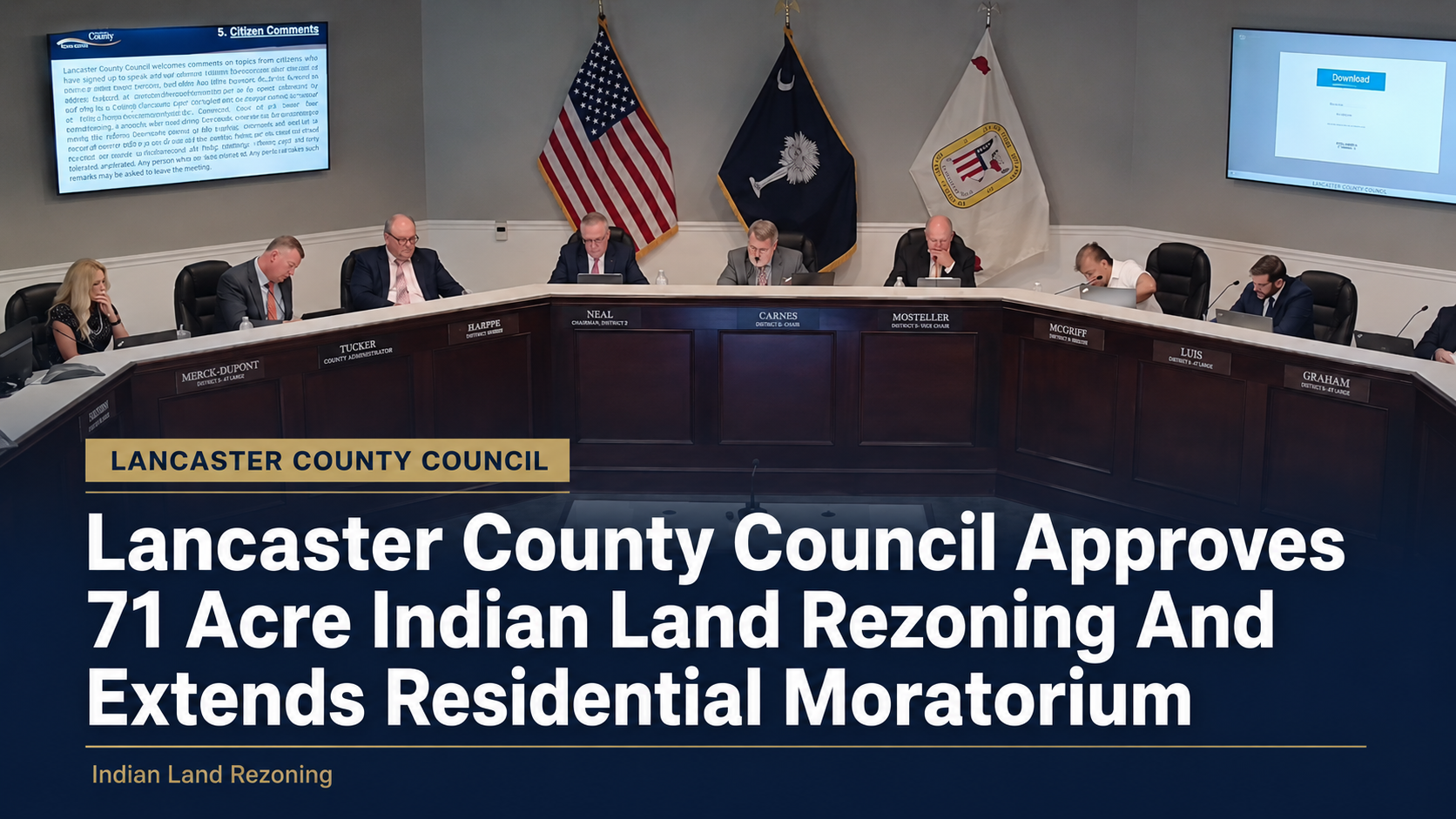

Lancaster County Council gave third reading Monday, Aug. 10, to a rezoning that clears the way for a commercial center on 71.1 acres at Charlotte Highway and Laurel Hill Road in Indian Land, voting 5 to 2 after turning down a motion to postpone the decision. Nine residents had asked council during citizens comments to hold the item until traffic, buffer and zoning questions were settled.
Council also gave third reading to a 90 day extension of the county’s residential development moratorium, approved a $23 million bond authorization for the Roselyn improvement district, and cleared a consent agenda that included second readings on the rezoning and comprehensive plan amendment for a proposed charter school on Harrisburg Road. Every vote other than the Charlotte Highway rezoning was unanimous.
The rezoning is the item Indian Land residents have tracked longest. Ordinance 2026-2012 first passed council in February 2026, and second reading was postponed four separate times, most recently to July 20, while connectivity and road questions were worked out. Monday’s vote was the last one required.
Rezoning Passes After Postponement Motion Fails
Ordinance 2026-2012 changes five parcels from Low Density Residential to Regional Business. The applicants are C.F. Smith Property Group LLC and Renewable Energy Development LLC, and the memorandum of understanding attached to the ordinance names the project Indian Land Marketplace. Planning staff recommended approval. The Lancaster County Planning Commission recommended denial by a 6 to 0 vote in December 2025 after 10 residents spoke against the request and dozens more wrote in.
Planning Director Shannon Catoe told council staff had met with the applicant and his representatives the previous week to work through the memorandum, which is attached to the agenda packet.
County Administrator Brian Tucker described two changes made between second and third reading. The memorandum is now incorporated into the ordinance itself, and county attorneys added language allowing council to move to revert the zoning if the developer fails to deliver the promised public improvements. Tucker said the public improvements offered by the developer should weigh heavily in council’s decision on the rezoning, and that tying the two together closely was the main concern raised after second reading.
Under the memorandum, the developer agrees to build a new section of Laurel Hill Road at its own expense, roughly 1,400 feet long with a 50 foot right of way, curb and gutter and sidewalk on one side, meeting Charlotte Highway at a 90 degree angle instead of the current 45 degree approach. The developer also proposes a signalized full movement intersection opposite Halifax Drive, subject to South Carolina Department of Transportation approval, and the memorandum says the department’s refusal of that signal would not void the agreement. Other commitments include roughly 4.7 acres of open space at the north end, 4.6 acres at the south end with trails, an 80 foot buffer yard along the rear of the property, and a 20 foot buffer with a berm, evergreen trees and an 8 foot Palisade style fence behind new construction in the commercial area. The memorandum bars residential use on the property.
Council Member Jose Luis asked how heavily the 2040 comprehensive plan weighs in a rezoning review. Catoe said the plan is the first thing staff looks at and that it also guided the ongoing update to the Unified Development Ordinance, though she declined to assign a percentage. Luis then asked whether the resident who submitted the detailed traffic recommendations had reviewed the revisions. Told she had not, Luis moved to postpone the item to the next council meeting so the matters raised by residents could be reviewed. Council Member Stuart Graham seconded. The motion failed 2 to 5.
The ordinance itself was moved by Vice Chair Billy Mosteller and seconded by Council Member Bryant Neal, and passed 5 to 2 on a show of hands. Earlier, a council member asked what changing the request from Regional Business to General Business would require, a change several speakers had urged because Regional Business allows multifamily units. Catoe said she did not believe council would have to start over.
Traffic And Buffers Dominate Public Comment
Nine speakers addressed the rezoning, most from Sun City, the Retreat, Laurel Hill and Parkstone, and most opened by saying they were not trying to stop the development, only to delay the vote until public safety and zoning questions were resolved. One asked council to vote the rezoning down outright, saying the infrastructure is not in place to support it.
Their requests centered on writing specifics into the memorandum and concept plan rather than leaving them general. Speakers asked that the 80 foot buffer run the full length of the rear of the shopping center, that buffer requirements extend to the Shelleywood and Laurel Hill single family homes and the Parkstone apartments, and that a 40 foot buffer be added along Laurel Hill and Murphy roads. On traffic, they asked that the approved SCDOT preliminary traffic plan, the developer’s traffic impact analysis and an executed agreement connecting Park Commons Avenue to the internal service road at Murphy Drive all be attached to the memorandum, and that road improvements be completed and open to the public before the rest of the shopping center is built. Specific requests included turn lanes at Murphy Drive, merge lanes along Highway 521, crosswalks, internal traffic circles and a one way truck delivery route.
Several speakers pointed to volume already coming. Planning department reports dated May 31, 2026, show 846 unbuilt single family homes and 174 unbuilt apartment units off Shelley Mullis Road, which one speaker estimated would put about 1,800 more vehicles near the site. Speakers said unsignaled left turns onto Highway 521 are the immediate danger and that first responders reaching the Retreat and Laurel Hill already have to make risky maneuvers. Others asked council to question the county attorney about whether the request could be switched from Regional Business to General Business, since Regional Business permits multifamily units and the zoning designation would stay with the property if it were sold. One speaker reminded council that Indian Land is unincorporated and county government is the only local government its residents have.
Neighbors Ask County To Enforce UDO On Barberville Road
Five residents of the Overlook at Barber Rock and nearby neighborhoods used their three minutes on a separate matter, grading and construction at Melanie Lane and Barberville Road. One submitted a document to the clerk listing 125 potential violations of the Unified Development Ordinance and of state and federal law governing wetlands, streams and stormwater.
Speakers walked council through the citations they consider clearest. They said UDO section 9.2.10 bars land disturbing activity before a preliminary plat is approved and that every preliminary plat for the project was denied unanimously by the planning commission before grading occurred, that the principal use on an adjoining parcel was changed to a wireless communication tower without the zoning permit required for a change of use, and that stream fill appears to exceed what the U.S. Army Corps of Engineers authorized under nationwide permit 39, with sediment discharged offsite. They said they have filed complaints with the Corps and with the state agency that administers National Pollutant Discharge Elimination System permits and that both confirmed investigations are underway. One speaker cited South Carolina Code Section 6-29-960 and three UDO provisions for the position that county rules govern where they are stricter than state or federal ones.
Speakers said formal complaints on the project date to August 2024, with written complaints in May and June of this year, and that they are not aware of any enforcement action on any item. They pointed council to tools they said are available now, including a stop work order, an injunction sought through the county attorney and revocation of the stormwater permit, and said the stormwater permit may have lapsed under a UDO provision voiding it if no building permit is secured within a year of approval. Their broader argument was that unenforced rules become optional, teaching the next applicant to build first and seek forgiveness later.
Council did not discuss the Barberville Road complaints during the meeting.
Charter School Rezoning Passes On Consent
Ordinances 2026-2050 and 2026-2052, the rezoning and comprehensive plan amendment for the Bridge Pointe Charter School site at 11632 Harrisburg Road, were among eight items approved together on the consent agenda without discussion. The rezoning changes the property from Light Industrial to Institutional so an existing structure can be redeveloped as a charter school. Planning staff and the planning commission both recommended denial, staff on the ground that the request does not comply with the 2040 comprehensive plan and the commission over traffic and vehicle stacking on Harrisburg Road.
A resident of the estates at Sugar Creek, whose home faces the site across the valley, told council she supports both the school and the change from light industrial to institutional, but asked that the traffic impact analysis required later at the civil site design stage be thorough and responsive to conditions on Harrisburg Road, where she said it took her five minutes to turn out of her street that day. She also asked that attention be paid to topography, since a standard buffer may meet the technical requirement without addressing lighting, noise and visibility from a school of 800 to 1,000 students.
The consent agenda also carried third reading of an ordinance on how the county attorney is appointed, second reading of a UDO text amendment on county road acceptance, a rezoning of 8.53 acres on Lakefront Drive, a multi county park agreement with Kershaw County, and minutes from the July 20 regular meeting and July 22 special meeting.
Moratorium Extended Ninety Days
Ordinance 2026-2048 extends the nine month residential development moratorium adopted in November 2025 under Ordinance 2025-1992 for another 90 days. The extension keeps in place the existing limits on the acceptance, processing, review and approval of certain residential development applications in the designated moratorium area while the county finishes its UDO update, prepares a new zoning map and takes public input. Catoe told council nothing in the ordinance had changed since the previous reading. The vote was unanimous.
Roselyn Bonds And Other Business
Council held a public hearing and gave second reading to Ordinance 2026-2047, authorizing up to $23 million in Roselyn Residential Improvement District assessment revenue bonds. Ryan Gentry, a partner at Burr Forman, presented the item in place of colleague Michael Seezen and said the only change from July was an increase in the amount of improvements Lennar Carolinas has reported completing in the district. The staff summary puts that figure at about $32.69 million, up from the number presented at first reading, with roughly $17.4 million of bond proceeds potentially available to pay for completed public infrastructure. The county issued $15 million in Series 2025 bonds for the district in August 2025, and those proceeds have been fully spent. Assessments are capped at $1,550 a year for any single parcel in the district.
Council also approved Resolution 1329-R2026, granting a conditional use permit for a vehicle rental, leasing and sales use at 423 Rocky River Road. The planning commission recommended approval 6 to 0 with conditions limiting hours to 8 a.m. to 6 p.m. and requiring buffering. Catoe said the applicant will still need commercial upfit and site plan approvals and inspections before receiving a certificate of occupancy, and that the commission left it to the applicant whether to operate six or seven days a week.
Third readings passed unanimously on an intergovernmental agreement between the county, the city of Lancaster and the towns of Heath Springs, Kershaw and Van Wyck, and on three easement grants off South Carolina Highway 9 to Duke Energy, Comporium Communications and the Lancaster County Natural Gas Authority.
Council gave second reading to Ordinance 2026-2054, a budget amendment appropriating $1,245,500 from the general fund’s unassigned balance for the sheriff’s evidence storage facility. The amount restores $1,216,000 authorized in 2024 and adds $30,207 to finish the project, which the staff summary describes as substantially complete. Council also approved Resolution 1331-R2026, dedicating water infrastructure from the detention center water main extension to the Lancaster County Water and Sewer District. Tucker said the utilities need to be dedicated to the district for operation as the new detention center is completed.
Volunteer Honored For Fifteen Years
Chair Brian Carnes read a proclamation recognizing Joanne Walding for 15 years of volunteer service to the sheriff’s office and declaring Aug. 10, 2026, Joanne Walding Day in Lancaster County. The proclamation cites her work in the records division, in quality assurance contacting victims and complainants, in community policing and later with the crime scene unit on case research and evidence retention. Sheriff Barry Faile read a commendation letter and said Walding has volunteered one to two days a week, every week, for 15 years.
Clerk to Council Sherrie Simpson told council that a first reading item long held in an ad hoc committee, a development agreement amendment with The Inspiration Network for the City of Light project, has been withdrawn by the applicant, with the withdrawal letter attached to the agenda packet. It will no longer appear on the list of tabled and deferred items.

Sign up for our Sunday Spectator. Delivered to your inbox every Sunday, with all the news from the week.

Thomas Hyslip lives in Tega Cay with his wife and daughter. After 27 years in the U.S. Army and Federal Law Enforcement, he retired to pursue his passion for teaching. Tom is now an Assistant Professor of Instruction at the University of South Florida. In 2 short years he has won 10 awards from the South Carolina Press Association, including first place in column writing, education beat reporting and best podcast.