
By: John Truluck, SCCED, SCEDA President
By: Will Williams, SCCED, SCEDA Legislative Chair
You have no doubt heard that the rising cost of energy is being driven by data centers.
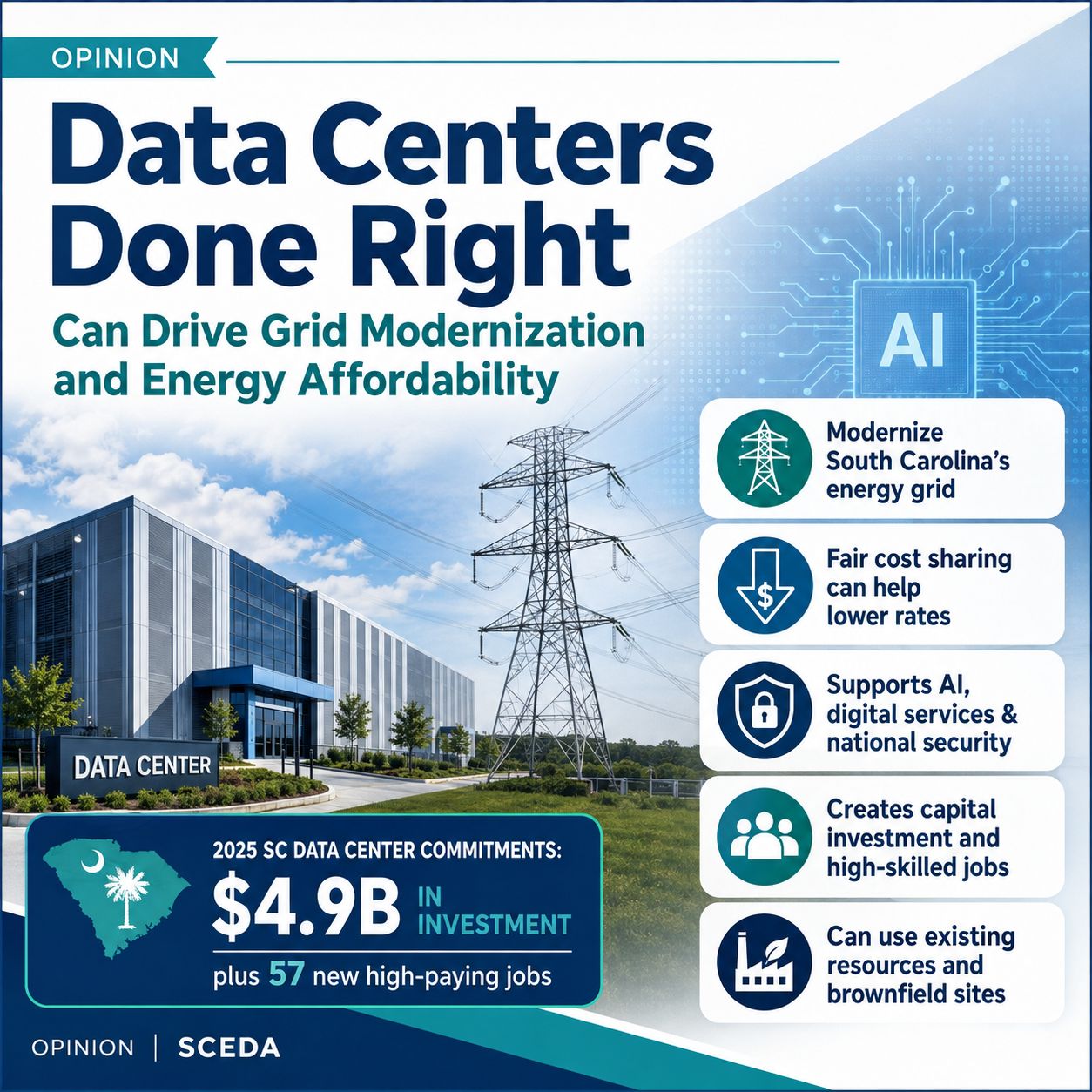
But the truth is data centers done right can share the costs of modernizing South Carolina’s energy infrastructure and help lower rates for all customers, tap into existing resources, play a critical role in our nation’s defense, place the state at the forefront of the modern technology revolution, and bring critical capital investments and high-skilled, well-paid jobs without causing additional traffic or strains on our roadways.
In reality, South Carolina’s economic growth is multi-layered. The U.S. Bureau of Economic Analysis (BEA) ranked South Carolina number one in the nation in economic growth and among the highest in personal income growth, with a Gross Domestic Product (GDP) annual increase of 1.7%. Indeed, Governor McMaster and the South Carolina Department of Commerce released the 2025 industry recruitment results on January 14, 2026, and from January to December 2025, South Carolina announced a total capital investment of $9.12 billion, representing the third-highest year for industry recruitment on record and more than 8,100 new jobs. Nearly half of that investment ($4.9 billion) and 57 new high-paying jobs were commitments by two data centers who did not receive any state discretionary incentives.
But, we don’t need the BEA study to tell us what we know to be true. We all see the growth in our state every day. When we drive on the highways and roads, we see major manufacturing facilities that are the backbone of our economy like BMW, Mercedes-Benz Vans, Volvo; new industries like Scout Motors, e-VAC Magnetics, Isuzu North America Corporation; and many new housing developments. Simply put, the Palmetto State has more people and businesses locating to our beautiful state.
This economic growth in turn requires electric and gas utilities to meet the demand for power. Meeting this demand means building new generation and transmission facilities, which are expensive.
Data centers, if properly located, can bring much needed grid modernization and energy infrastructure to areas in the State that need it. Everyone benefits from grid modernization. Locating data centers on brownfield sites (unused or abandoned properties) should also be encouraged.
With appropriate and fair safeguards, a data center that locates in an economically disadvantaged area of the state and pays for the transmission lines and associated facilities used to serve it, can be a net positive. The existing energy infrastructure is modernized and financially supported by the data center, paving the way for other businesses offering employment opportunities to locate in the area. Tax revenues increase. And, with proper cost allocation, the energy burden is lowered across all customers, driving rates down.
Additionally, Artificial Intelligence (AI), which is essential to the nation’s National Security, can be a tool to make the grid smarter and more efficient. For example, AI can identify and unlock unused capacity on existing power lines and thereby more efficiently use existing energy infrastructure.
Some nevertheless argue against data centers of any kind and refuse to acknowledge the daily functions that data centers support. Data centers serve as the backbone powering our digital life. Without these facilities, online features like social media apps, AI algorithms, GPS navigation, cloud banking, and smart personal assistants/smart home assistants such as Siri and Alexa could not function.
These projects are critical to our national security, which is often a positive that has been overlooked. With President Trump’s “Winning the AI Race: America’s AI Action Plan” released in July of 2025, our country has placed an emphasis on growing this critical industry by accelerating innovation, removing regulatory barriers, investing in key infrastructure for these sites, and protecting U.S. tech from theft, reducing risks, and promoting American AI standard globally.
South Carolina is uniquely positioned to take advantage of the Transco pipeline, subsea cables from Myrtle Beach and Portugal, and high-capacity fiber routes connecting Washington, DC and Atlanta. South Carolina should take advantage of the current infrastructure to tap into these existing resources. As Governor Henry McMaster has said, South Carolina is “pound for pound the most patriotic state in America.” South Carolina has a role in winning the AI race by leading the way in establishing this critical infrastructure.
Finally, there are ways to address the increased demand for energy and the costs of the energy infrastructure. For example, the South Carolina Energy Security Act encourages shared bulk power resources between large customers and electric utilities subject to appropriate protections for existing customers and approval by the Public Service Commission of South Carolina. Also, large customers such as data centers can build their own generation.
Data centers can reduce rates to our residential and commercial customers, help build our State’s energy infrastructure, play a critical role in National Security, support and expand the conveniences they provide in our daily digital lives, place South Carolina at the forefront of AI and the modern technology revolution, and create capital investment without draining our infrastructure, like roads and schools.
About SCEDA
The South Carolina Economic Developers’ Association (SCEDA) is the leading professional organization for economic developers in the state, committed to enhancing the professional development of its membership and advocating for economic development to benefit the citizens of South Carolina. For more information, visit sceda.org.

Sign up for our Sunday Spectator. Delivered to your inbox every Sunday, with all the news from the week.

Thomas Hyslip lives in Tega Cay with his wife and daughter. After 27 years in the U.S. Army and Federal Law Enforcement, he retired to pursue his passion for teaching. Tom is now an Assistant Professor of Instruction at the University of South Florida. In 2 short years he has won 10 awards from the South Carolina Press Association, including first place in column writing, education beat reporting and best podcast.