
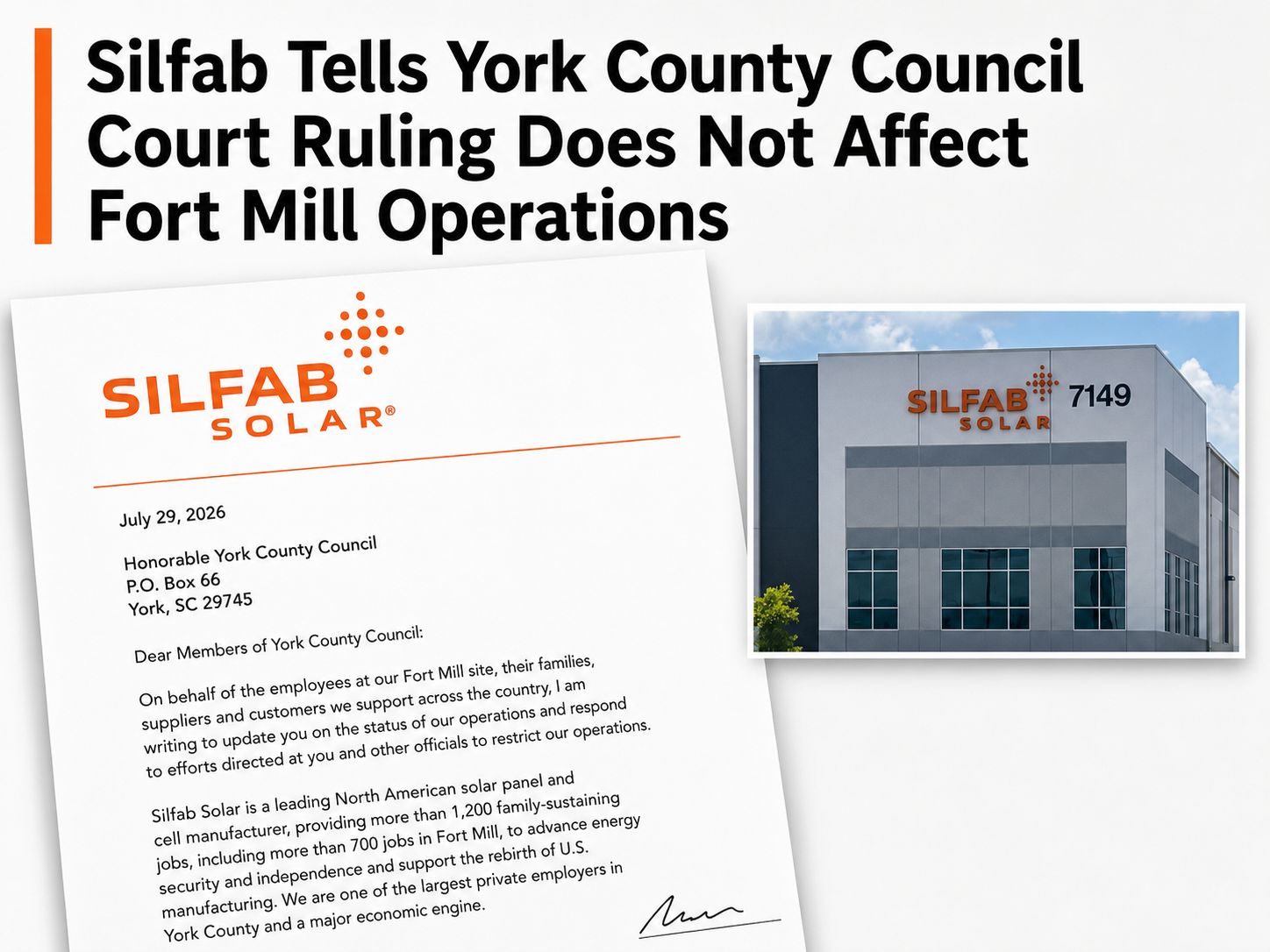
Silfab Solar President and CEO Paolo Maccario wrote to York County Council on July 29 to say that a recent circuit court zoning ruling does not affect operations at the company’s Fort Mill plant and that, in his words, “there is no legal or public safety basis for any action that would limit our ability to operate.”
The four page letter, sent to the council at its York post office box, is the company’s most detailed public response to the pressure it has faced since Circuit Judge William A. McKinnon issued his July 21 order affirming the York County Board of Zoning Appeals decision that solar panel manufacturing is not a permitted use at 7149 Logistics Lane under the site’s Light Industrial classification. The plant sits near Flint Hill Elementary and Flint Hill Middle schools, and both the Fort Mill School District Board of Trustees and state Sen. Mike Johnson have written to state and county officials in recent weeks urging regulators to act.
Maccario opened by telling council members he was writing on behalf of employees at the Fort Mill site, their families, suppliers and customers, and that his purpose was to update the council and “respond to efforts directed at you and other officials to restrict our operations.” He said Silfab employs more than 1,200 people companywide, including more than 700 in Fort Mill, and called the company one of the largest private employers in York County.
What the letter says about the court ruling
Maccario wrote that “the Circuit Court recently issued an order in an ongoing zoning case that has led to confusion.” He said Silfab brought the case itself, “to protect our ability to fully utilize our property,” and to strengthen operations beyond the uses listed in the plant’s current certificate of occupancy.
The letter’s only passage set in bold type states the company’s reading of the outcome. “The decision involved a zoning interpretation and did not address the safety, quality or regulatory compliance of our existing operations, nor does it affect ongoing operations at the facility,” Maccario wrote.
Safety and emissions claims
Maccario wrote that the plant operates consistently with state, federal and local requirements, that its operations have never caused injuries beyond the property line and that no regulatory body, including the federal Occupational Safety and Health Administration, has cited the company for violations stemming from workplace injuries. He said the company’s rate of workplace incidents falls below industry standards and that Silfab pursued voluntary certification under ISO 9001:2025 quality management standards.
An appendix attached to the letter answers eight claims the company says have been raised about its operations, each one laid out as a claim followed by the company’s response.
Responding to calls for officials to revoke permits, the appendix says: “There is no legal or community safety reason for any action that would limit Silfab’s ability to operate or otherwise impact our operations.” It adds that “County, state and federal agencies have found the facility does not present a threat to public health or safety.”
On emissions, the appendix says the plant uses advanced emissions control equipment and operates under permits issued by SCDES, and asserts that “There has never been evidence of emissions exceeding regulatory standards.” The company says it voluntarily installed air monitoring equipment between the plant and the two Flint Hill schools and gave the school district access to the data.
On the March evacuations, the appendix says the district “evacuated its facilities after unplanned releases from the Silfab site in March that, according to emergency responders, did not pose a risk to health and safety.” The company says the decision to evacuate came after responders had already notified the district that the releases posed no threat.
Addressing the plant’s 50 foot exhaust stack, the appendix says the structure “was reviewed and approved as part of the facility’s comprehensive air permit following the required public notice and comment process,” and that environmental regulators and the state administrative law court defended that decision during litigation. The company argues SCDES is bound by the Pollution Control Act to ensure “maximum employment [and] industrial development of the State.”
The appendix closes by returning to the question of closure, saying agency findings “do not provide a factual basis for suspension or revocation of operating approvals.”
A warning about precedent
The sharpest language in the letter comes near the end of the second page.
“As we follow through on our commitments, we respectfully ask our partners to follow through on the commitments they made to us, as well,” Maccario wrote, referring to the recruitment process that brought the plant to Fort Mill.
He then set out what he said would follow from action against the facility. Restricting operations would harm the company, its customers and its employees, he wrote, and would force litigation over what he characterized as a taking of Silfab’s property rights, put at risk the public investment made to recruit the company to South Carolina and “have a chilling effect as other companies weigh business opportunities here.” It would also, he wrote, “establish a concerning precedent that could allow zoning boards in other communities to reverse course and terminate business operations after businesses have been built and began operations.”
Maccario closed by saying the company welcomes “the opportunity to continue working collaboratively with you and other partners” and looks forward to constructive dialogue.
Who received the copies
The letter was copied to Gov. Henry McMaster, SCDES Director Myra Reece, Attorney General Alan Wilson, the Fort Mill School District Board, Superintendent Grey Young, Sen. Mike Johnson and Rep. David Martin.
A spokesperson for Silfab Solar said the letter “was sent to provide an update on the status of our operations and respond to efforts directed at County Council and other officials to restrict our operations.” The spokesperson said the company remains committed to open and transparent communications grounded in facts, to stronger community partnerships and to safe operations.
York County Council has a special called meeting tonight, Thursday July 30th, and the only agenda item is:
- Receipt of Legal Advice: Silfab Solar Litigation, Circuit Court Order in Case No. 2024-CP-46-02641,
and other matters related thereto
Source: Letter from Paolo Maccario, president and chief executive officer of Silfab Solar Inc., to the York County Council, dated July 29, 2026, including the attached appendix; statement provided by a Silfab Solar spokesperson.



Sign up for our Sunday Spectator. Delivered to your inbox every Sunday, with all the news from the week.

Thomas Hyslip lives in Tega Cay with his wife and daughter. After 27 years in the U.S. Army and Federal Law Enforcement, he retired to pursue his passion for teaching. Tom is now an Assistant Professor of Instruction at the University of South Florida. In 2 short years he has won 10 awards from the South Carolina Press Association, including first place in column writing, education beat reporting and best podcast.