

A Global Movement Reaches Its Tipping Point
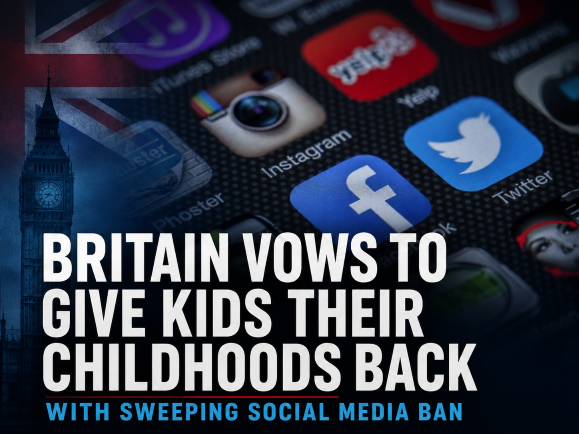
This morning, British Prime Minister Keir Starmer stood outside 10 Downing Street and made a sweeping announcement that sent shockwaves through Silicon Valley. Britain will ban children under 16 from using a range of social media apps including Snapchat, TikTok, YouTube, Instagram, Facebook, and X, to protect young people from harmful content and excessive screen time.
“We’re going further than any country in the world by banning social media for under-16s and putting wider protections in place to give kids their childhood back,” Starmer said.
It is a bold statement. And for millions of parents around the world who have watched their children disappear into glowing screens, it may be exactly what they have been waiting to hear.
What Britain Is Doing
The UK plans to model its approach on Australia’s landmark legislation passed late last year, but will go further by introducing additional restrictions on features deemed particularly harmful to children, including blocking livestreaming and communication with strangers for users under 16, while similar protections will be enabled by default for 16 and 17 year olds. The government is also considering overnight curfews and measures to limit infinite scrolling for minors.
The landmark legislation, which the UK government says is backed by nine in ten parents, is expected to be brought before Parliament before Christmas and could come into force in spring 2027.
Platforms that fail to take reasonable steps to exclude children younger than 16 could be punished with multimillion-dollar fines. Starmer acknowledged some teens would try to find their way around the ban, but vowed to fight back if technology companies resist the move.
The specific features in the crosshairs are not accidental. Infinite scrolling, autoplay video, algorithmic feeds calibrated to maximize time on screen, and notification systems engineered to pull users back every few minutes were designed deliberately. They work on children’s developing brains in ways that adult brains are better equipped to resist. Britain’s legislation targets these mechanisms directly while going a step further by restricting platform access altogether for anyone under 16.
Britain Is Not Alone
Australia, Canada, Brazil, and Indonesia have introduced legislation or announced age-based restrictions or requirements for children’s access to social media. France, Spain, Denmark, Thailand, and South Korea are among others studying or developing similar approaches.
The common thread running through all of these efforts is frustration with an industry that spent years arguing self-regulation was sufficient while the mental health data on children told a different story. Governments around the world have reached the same conclusion at roughly the same time: waiting for Silicon Valley to fix this problem voluntarily is not a strategy.
Social media is making children unhappy and is designed to be addictive, Starmer said at his press conference. That framing, addictive by design, is now the dominant lens through which lawmakers in country after country are approaching the problem.
Closer to home, South Carolina is already moving in the same direction. Governor Henry McMaster signed the Stop Harm from Addictive Social Media Act into law on May 19, 2026, which will strip autoplay videos, infinite scrolling, push notifications, and like counts from social media accounts of users younger than 16 in our state, with the law scheduled to take effect January 1, 2027. Britain and South Carolina are reading from the same page.
South Carolina Bans Addictive Social Media Features for Users Under 16
What This Means for Families Right Now
The laws are coming, but they are not here yet. Britain’s ban may not arrive until spring 2027. In the meantime, the responsibility for managing children’s social media use still falls on families.
Have the conversation now. Ask your child which platforms they use, who they talk to, and how much time they spend on them each day. Most children underestimate their own usage significantly, and most parents underestimate it even more.
Use the tools that already exist. Every major platform has parental control and screen time features that most families never activate. Apple Screen Time and Google Family Link allow parents to set daily limits across all apps at the device level, not just the platform level. These tools are free, available today, and do not require waiting for any law to take effect.
Pay attention to mood and sleep. Sleep disruption is one of the most consistently documented effects of late-night social media use in adolescents. If your child is on their phone after 10 p.m., that is worth addressing regardless of what the law says.
Look at what they are actually seeing. The algorithmic feeds that run platforms like TikTok and Instagram are powerful enough to shift what a child thinks is normal within weeks of account creation. Periodic check-ins on the content your child is consuming are not an invasion of privacy. They are parenting.
No law, however, replaces the parent in the room. The world is finally moving in the right direction on this issue. But the most important protection your child has right now is a conversation at your kitchen table tonight.
Stay safe out there, and I will see you next week!
Feeling lost in the digital world? Dr. Tom is here to help!
References
- NPR. “Britain Will Ban Under-16s from Social Media Apps, Including TikTok and YouTube.” June 15, 2026. https://www.npr.org/2026/06/15/nx-s1-5858644/britain-social-media-ban
- CNBC. “UK to Ban Social Media for Under-16s to Give Kids Their Childhood Back.” June 15, 2026. https://www.cnbc.com/2026/06/15/uk-social-media-ban-under-16s.html
- TechRadar. “UK Bans Social Media for Under-16s.” June 15, 2026. https://www.techradar.com/news/live/uk-social-media-ban-june-2026
- House of Commons Library. “Proposals to Ban Social Media for Children.” June 2026. https://commonslibrary.parliament.uk/research-briefings/cbp-10468/
- Tega Cay Sun. “South Carolina Bans Addictive Social Media Features for Users Under 16.” June 8, 2026. https://tegacaysun.com/2026/06/08/south-carolina-bans-addictive-social-media-features-for-users-under-16/

Sign up for our Sunday Spectator. Delivered to your inbox every Sunday, with all the news from the week.

Thomas Hyslip lives in Tega Cay with his wife and daughter. After 27 years in the U.S. Army and Federal Law Enforcement, he retired to pursue his passion for teaching. Tom is now an Assistant Professor of Instruction at the University of South Florida. In 2 short years he has won 10 awards from the South Carolina Press Association, including first place in column writing, education beat reporting and best podcast.