
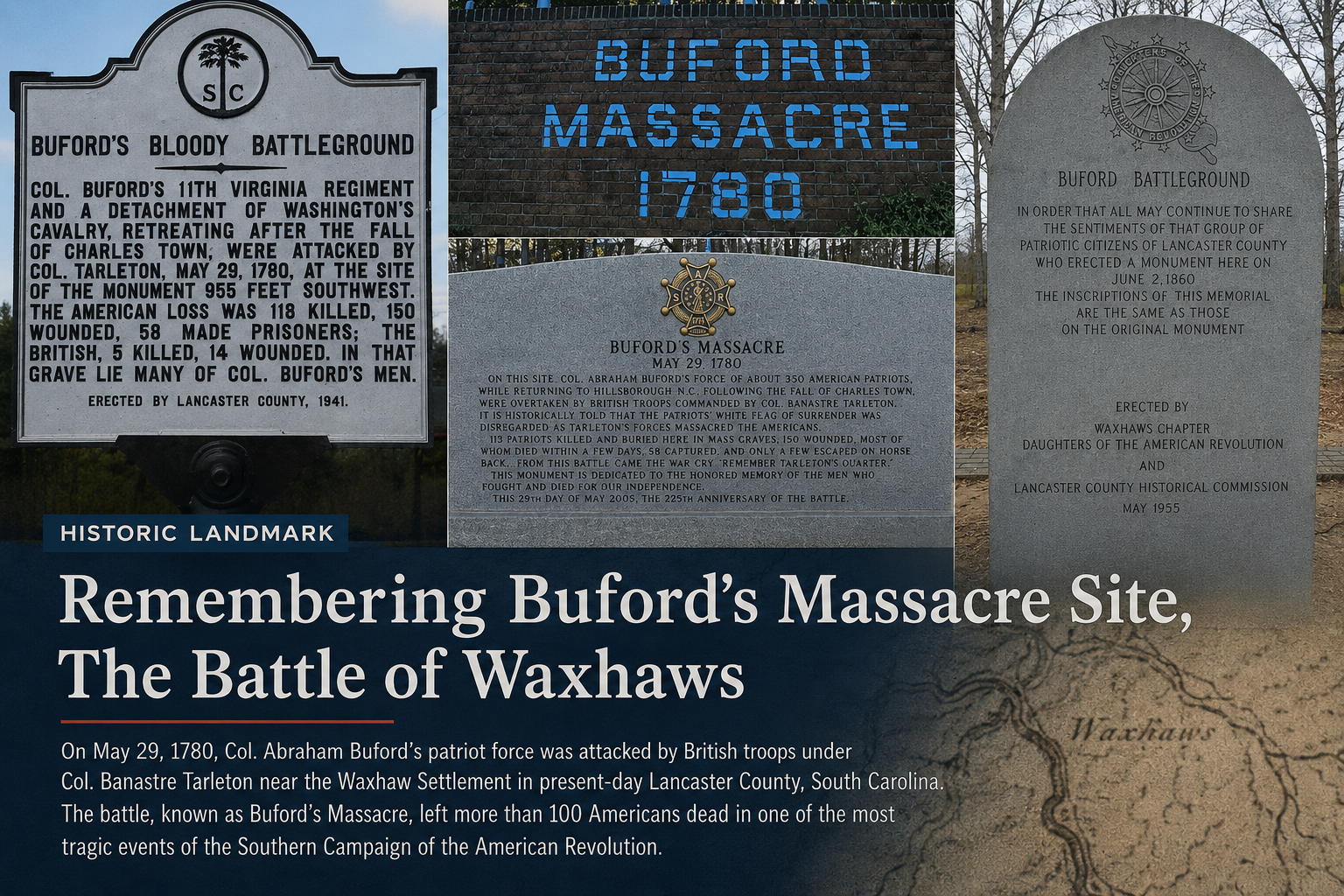

On May 29, 1780, in the rolling farmland of what is now eastern Lancaster County, a short and brutal clash between Continental soldiers and British led cavalry left more than a hundred Americans dead and gave the Revolution one of its most enduring rallying cries. Friday marks the 246th anniversary of the Battle of Waxhaws, remembered by many simply as Buford’s Massacre.
For readers in Tega Cay and Fort Mill, the battlefield is closer than many realize. The Buford Memorial site sits about nine miles east of the city of Lancaster on South Carolina Highway 522, roughly ten miles south of the North Carolina line, an easy drive from the northern York and Lancaster county communities. It is one of the most significant Revolutionary War sites in the region, and it carries new weight as South Carolina observes the 250th anniversary of American independence.
What happened on the ground
The fight came late in the spring of 1780, weeks after the British captured Charleston and pushed into the South Carolina backcountry. Colonel Abraham Buford was leading a force of roughly 350 Virginia Continentals north toward North Carolina when British Lieutenant Colonel Banastre Tarleton, commanding a mounted force of cavalry and infantry, overtook the column near Waxhaw Creek.
Tarleton sent forward a demand for surrender, overstating the size of his force in an effort to force Buford’s hand. Buford refused and formed a battle line. The engagement that followed was over quickly. Tarleton’s cavalry overwhelmed the Continentals, and accounts of the day describe attackers continuing to cut down soldiers after resistance had collapsed. American losses ran to about 113 killed, 150 wounded and 53 taken prisoner. Tarleton reported only five men killed and a dozen wounded on his side.
A war cry born in defeat
What set the Battle of Waxhaws apart was not its size, which was modest, but the fury it provoked. Patriots across the Carolinas seized on the killing as proof of British cruelty, and the phrase “Tarleton’s Quarter,” meaning no mercy at all, became a rallying cry that stiffened backcountry resistance in the months that followed. Historians have long debated exactly how the violence unfolded, but the political effect was clear. The bitterness fed a partisan war that would help turn the tide toward American victory in the South.
Many of the wounded were carried to Waxhaw Presbyterian Church, where they were cared for before their deaths. Others were buried in mass graves at the battlefield itself.
Two monuments and a preserved field
The site has been a place of remembrance for more than a century and a half. Lancaster County residents erected a white stone monument over the graves on June 2, 1860. After decades of damage from souvenir hunters chipping away pieces, the Waxhaws Chapter of the Daughters of the American Revolution placed a new monument bearing the same inscription on May 1, 1955. Buford’s Massacre Site was added to the National Register of Historic Places in 1990.
In recent years the grounds have grown well beyond the original two acre county park. The South Carolina Battleground Preservation Trust has preserved about 51 acres surrounding the memorial, and the American Battlefield Trust and its partners have installed interpretive kiosks along a short walking trail as part of the Liberty Trail, a network of Revolutionary War sites across the state. Visitors can scan codes at the kiosks to hear audio presentations on the chase, the demand for surrender and the defeat itself.
A local group keeps watch
Much of the day to day care falls to Friends of the Buford Massacre Battlefield, a nonprofit foundation that has worked since 2011 to preserve and interpret the grounds. The group added a brick walkway, landscaping and additional kiosks in recent years to tie the memorials and the fenced mass grave together. In May 2024 the Daughters of the American Revolution unveiled a marker at the site as part of the America 250 Patriots Marker project, marking the approaching anniversary of the nation’s founding. A battle reenactment drew visitors to the nearby Buford Recreation Complex in June 2025.
The battlefield is open to the public as a county park and picnic ground at 262 Rocky River Road in Lancaster. With the state deep into its 250th anniversary observances, the anniversary of the Battle of Waxhaws offers area residents a quiet chance to walk the field, read the markers and remember the men buried where they fell.
Sources: American Battlefield Trust; Friends of the Buford Massacre Battlefield; South Carolina National Register of Historic Places nomination, South Carolina Department of Archives and History; South Carolina 250th Anniversary of the American Revolution.

Sign up for our Sunday Spectator. Delivered to your inbox every Sunday, with all the news from the week.

Thomas Hyslip lives in Tega Cay with his wife and daughter. After 27 years in the U.S. Army and Federal Law Enforcement, he retired to pursue his passion for teaching. Tom is now an Assistant Professor of Instruction at the University of South Florida. In 2 short years he has won 10 awards from the South Carolina Press Association, including first place in column writing, education beat reporting and best podcast.