

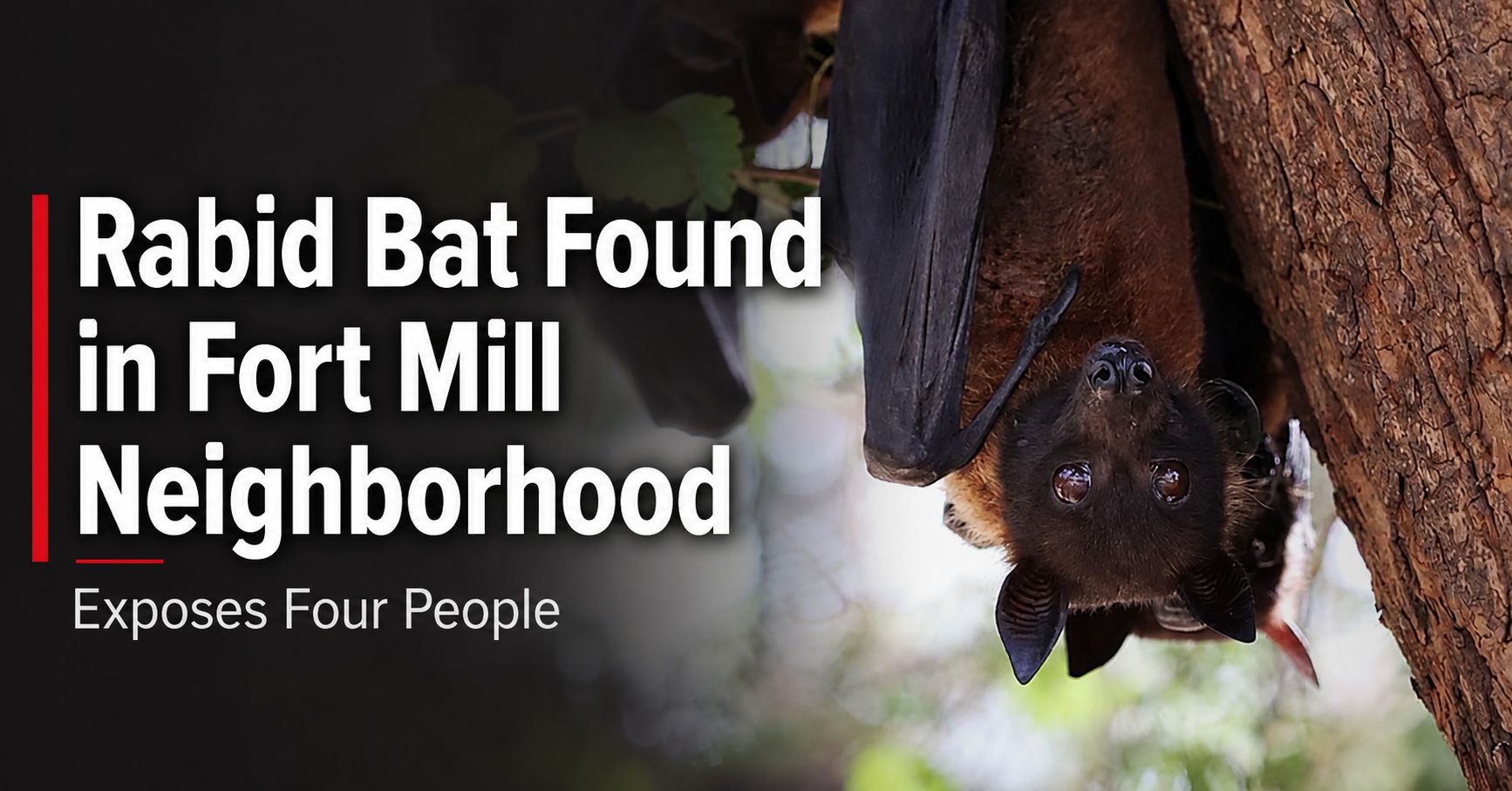

A bat found in a Fort Mill neighborhood has tested positive for rabies, and four people who came in contact with it have been referred to their healthcare providers, the South Carolina Department of Public Health confirmed Monday.
The bat was found near Bailiwyck Green Boulevard and Cranborne Chase, a residential area in Fort Mill. No pets are known to have been exposed, according to the agency. It marks the fourth animal to test positive for rabies in York County this year.
The case is one of three the state announced together. Raccoons in Charleston County and Saluda County also tested positive. All three animals were submitted to the department’s laboratory July 17 and confirmed to have rabies July 20.
Anyone who believes they, someone they know, or their pets may have come in contact with the bat or another animal that could carry rabies is asked to call the department’s 24 hour rabies reporting line at 888.847.0902 and select option two.
Why bat exposures are easy to miss
Terri McCollister, the department’s Rabies Program manager, said bats are known carriers of the virus and that bites often go unnoticed.
“People don’t always realize they or a pet have been bitten since bat teeth are tiny and bites are easy to overlook,” McCollister said.
Because of that, health officials say people should assume a bite may have occurred any time someone wakes to find a bat in a room or tent, when a bat turns up where children, pets, or someone with impaired mental capacity has been left unattended, or after any direct contact with a bat.
A rabies exposure is defined as direct contact through broken skin or through the eyes, nose, or mouth with saliva or with brain or nervous system tissue from an infected animal. Anyone who may have had such contact should wash the area thoroughly with soap and water and seek medical attention right away.
McCollister cautioned that a healthy appearance means little. Rabies can be confirmed only in a laboratory, though daytime activity, an inability to fly, and turning up in unusual places such as a home or lawn can signal a problem.
“Although bats can carry rabies, not every bat is infected with the virus,” McCollister said. “Bats are an important part of South Carolina’s ecosystems and deserve a healthy degree of respect just like all wild animals.”
Handling a bat safely
Officials warn against ever handling a bat or any wild or stray animal, alive or dead, with bare hands. A bat that may have had contact with people, pets, or livestock should be trapped in a sealed container and left untouched. A bat that has potentially exposed a person or pet should never be released, because once it is gone it can no longer be tested.
Keeping pets current on their rabies vaccinations remains one of the simplest and most effective safeguards against the disease, the department said.
The York County bat is the fourth rabies case in the county this year. Statewide, there have been 62 confirmed cases in 2026. South Carolina has averaged about 136 positive cases a year since 2002. Of the 101 cases confirmed across the state in 2025, nine were in York County.
Local public health office contacts are listed at dph.sc.gov/RabiesContacts. More information on rabies is available at dph.sc.gov/rabies or cdc.gov/rabies.
Source: South Carolina Department of Public Health news release, July 20, 2026.

Sign up for our Sunday Spectator. Delivered to your inbox every Sunday, with all the news from the week.

Thomas Hyslip lives in Tega Cay with his wife and daughter. After 27 years in the U.S. Army and Federal Law Enforcement, he retired to pursue his passion for teaching. Tom is now an Assistant Professor of Instruction at the University of South Florida. In 2 short years he has won 10 awards from the South Carolina Press Association, including first place in column writing, education beat reporting and best podcast.