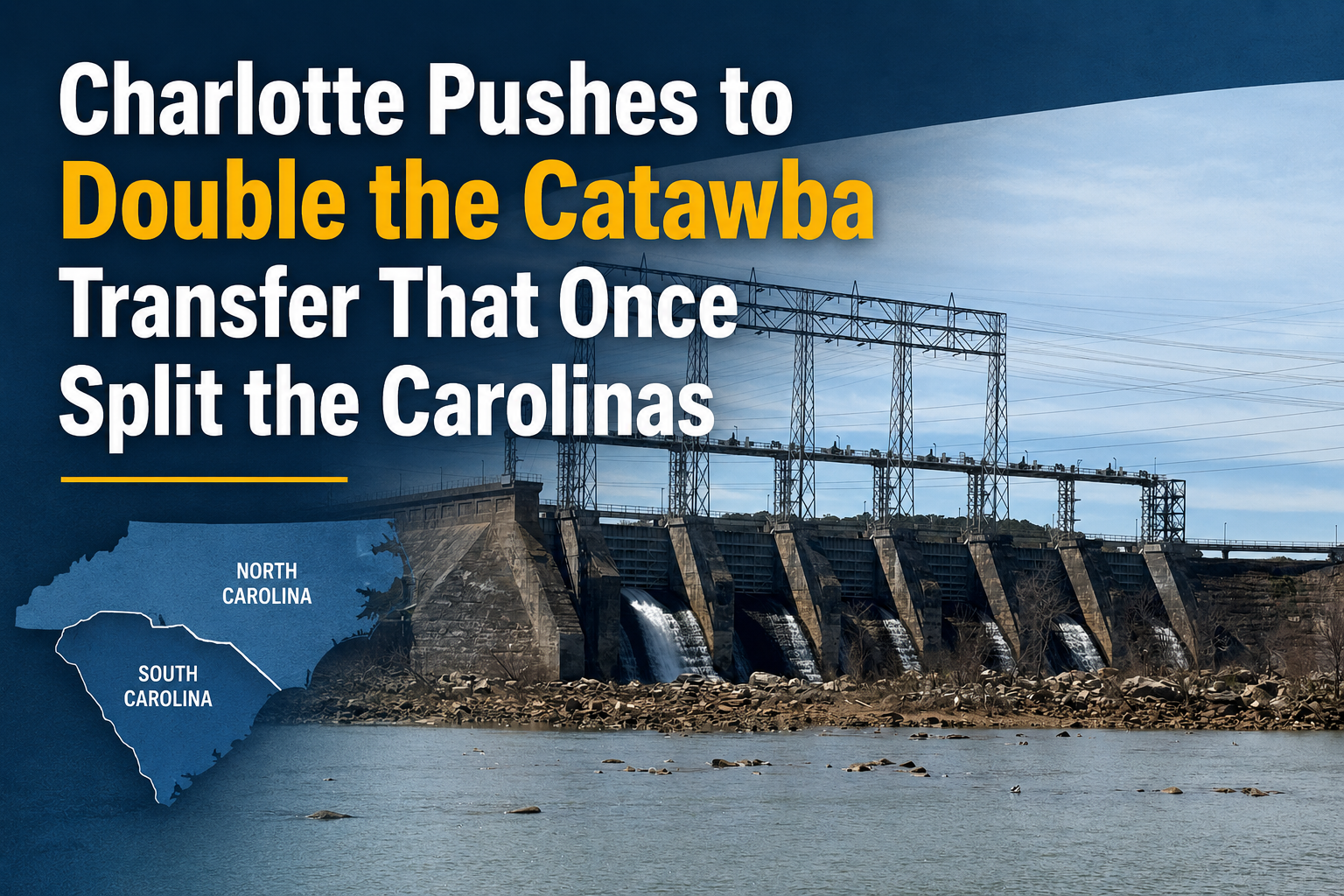

Charlotte Water’s plan to nearly double the water it permanently moves out of the Catawba River is facing organized opposition from South Carolina, including the Rock Hill based regional agency that represents York County, and under a North Carolina law the request cannot even be approved before 2027.
The Catawba is the primary drinking water source for much of this region, including Tega Cay, Fort Mill and Rock Hill, all of which draw from Lake Wylie or the wider river system. How much water leaves the river for good is not an abstract question here. It affects how much remains in local reservoirs during a drought, which is why water systems and elected officials on both sides of the state line are paying close attention.
What Charlotte is asking for
Charlotte is certified to transfer up to 33 million gallons of water a day from the Catawba into the neighboring Rocky River basin, part of the larger Yadkin Pee Dee system, under a certificate it received in 2002. The city wants to raise that ceiling to about 63 million gallons a day to keep pace with growth on the eastern side of Mecklenburg County.
Charlotte Water Director Angela Charles has said the city does not believe the larger transfer would harm smaller communities, pointing to the planning that accounts for upstream and downstream users. Deputy Director David Czerr has said the city is studying alternatives as part of its environmental review but that the cost and scale of new infrastructure make those options impractical without straining affordability for customers.
South Carolina officials push back
Three South Carolina regional planning agencies registered formal opposition to the plan well before it reached this stage. In an August 20, 2024 letter, the Catawba Regional Council of Governments in Rock Hill, together with the Central Midlands Council of Governments in Columbia and the Santee Lynches Council of Governments in Sumter, told Charlotte Water and North Carolina regulators they opposed raising the certificate from 33 million to 63 million gallons a day.
The Catawba Regional Council represents York, Chester, Lancaster and Union counties, putting Tega Cay, Fort Mill and Rock Hill squarely within the agency that signed the letter. Together the three regions cover twelve counties and nearly 1.5 million residents, much of that population dependent on the Catawba Wateree Basin while facing rapid growth of their own.
The councils argued that a transfer of this size would subsidize development outside the basin while drawing down a shared and finite resource, and that lower river flows could concentrate pollutants and harm aquatic life, recreation and public health. They urged Charlotte to wait until the regional water supply master plan is finished before pressing ahead, noting that the 2015 master plan projected Charlotte’s current transfer would be sufficient through 2065. Any increase, they wrote, should be considered only as an emergency and very temporary measure, and only after Charlotte addresses the water it loses to leaks. The councils also pointed to the 2010 settlement between the Carolinas over interbasin transfers.
The letter went to Charlotte Water, the North Carolina Environmental Management Commission and the North Carolina Department of Environmental Quality, with a copy to the South Carolina Department of Environmental Services. The Catawba Regional Council’s executive committee, chaired by Charlene McGriff, approved sending it in a vote recorded at a special meeting, with seven of nine members voting yes.
Upstream communities organize too
The opposition is not limited to South Carolina. At a Morganton City Council meeting on January 5, 2026, Anthony Starr, executive director of the Western Piedmont Council of Governments, said local governments across his four county region in western North Carolina, joined by McDowell County, have formed their own coalition to resist large transfers out of the basin.
Starr told the council the Catawba is already stressed, citing the severe droughts of 1998 to 2002 and 2007 to 2009, when portions of the basin fell 8 to 10 feet and Lake Norman dropped to just over three feet above the cooling water intake for a nuclear plant on the lake. He described Lake James, near the headwaters, as the region’s final reserve. “Lake James is our last line of defense when it comes to drought,” he said.
He also questioned Charlotte’s numbers, saying the city loses more than 19 percent of every gallon it withdraws, about 23 million gallons a day, to leaks, and that the expansion would move far more water than Charlotte aims to conserve during an extreme drought. “We’re not opposed to Charlotte growing,” Starr said. “We just don’t want it to occur at our expense.”
A state moratorium freezes the request
North Carolina State law has paused the question for now. The General Assembly passed House Bill 850 in 2025, enacted as Session Law 2025-74, which bars the Environmental Management Commission from issuing a certificate for any significant new or increased transfer above 15 million gallons a day until March 1, 2027. Charlotte’s proposed increase of 30 million gallons a day sits well above that line.
The law, sponsored by Rep. Jay Adams, a Republican from Catawba County, also directs the North Carolina Collaboratory at the University of North Carolina at Chapel Hill to study the state’s transfer approval process, including how impacts on upstream and downstream communities are weighed, and to report to the General Assembly when it convenes in 2027.
A draft plan at the center of the dispute
To support its case, Charlotte Water has pointed to a draft study from the Catawba Wateree Water Management Group, the regional body that manages the shared river. Charlotte officials say the modeling examined a severe drought and found no impacts upstream and minimal effects downstream.
That study is part of the group’s Integrated Water Resources Plan, a final draft dated December 31, 2025, and the update the South Carolina councils urged Charlotte to wait for. The plan draws on more than 40 years of daily simulations to evaluate supply and quality across the basin and its 11 reservoirs and forecasts water demand through 2075.
Opponents say they cannot verify the work. The Western Piedmont Council of Governments wrote to the management group saying it had requested the underlying data repeatedly without success, and Starr has said it would be unwise to base the future of an entire region on a draft study the authors will not let outsiders check.
Why Lake Wylie matters here
The draft plan itself singles out Lake Wylie, the reservoir that borders Tega Cay and much of the Fort Mill area. In a hypothetical scenario in which water now sent out of the basin was instead returned, modeling showed Lake Wylie was the most sensitive point in the system, gaining about 38 additional days of accessible water during the drought that ran from 2006 to 2009.
The same analysis identified a Decision Point Year for Lake Wylie, the point at which water accessibility could be challenged, within the 2025 to 2035 window. Tega Cay, Rock Hill, York County, the Chester Metropolitan District and the Lancaster County Water and Sewer District are among the 21 public utilities that belong to the management group alongside Charlotte and Duke Energy, giving South Carolina communities a seat at the table.
A fight that already reached the Supreme Court
This is not the first time Charlotte’s transfers have set the two states against each other. The Catawba originates in the mountains of North Carolina and crosses into South Carolina at Lake Wylie, and that shared border has produced more than a decade of legal history.
In June 2007, South Carolina filed an original action against North Carolina in the U.S. Supreme Court, asking the justices to set an equitable share of the river. The complaint argued that North Carolina had authorized upstream transfers beyond its fair share under a 1991 law requiring a permit to move more than 2 million gallons a day out of certain basins. At the center of that case was the same 33 million gallon a day permit Charlotte now seeks to expand, which the city described in its filings as the single largest transfer named in the complaint.
The Court appointed a Special Master and, in a decision issued January 20, 2010, allowed Duke Energy and the Catawba River Water Supply Project to join the case while keeping the City of Charlotte out. The two states later reached the 2010 settlement the South Carolina councils referenced, which still shapes how transfers are handled, including a requirement that water users in both states receive notice of proposed transfers.
What comes next
Charlotte’s proposal remains early in a process expected to take years, and the state moratorium means no certificate can issue before March 1, 2027 at the earliest. After that, a transfer of this size would still require an interbasin transfer certificate from the Environmental Management Commission, including technical review, environmental documentation and public engagement.
Starr urged residents to weigh in with their legislators, telling the Morganton council the stakes reach well beyond the current drought. “The next 50 years of growth in our region will be determined by this issue,” he said. The full draft plan is posted for public review on the Catawba Wateree Water Management Group website.
Sources for this report include the August 21, 2024 special meeting minutes and August 20, 2024 joint comment letter of the Catawba Regional, Central Midlands and Santee Lynches Councils of Governments, the January 5, 2026 presentation by Anthony Starr of the Western Piedmont Council of Governments to the Morganton City Council, WBTV reporting by Naomi Kowles published May 21, 2026, the Catawba Wateree Water Management Group Integrated Water Resources Plan final draft dated December 31, 2025, North Carolina Session Law 2025-74, and the U.S. Supreme Court decision in South Carolina v. North Carolina, 558 U.S. 256 (2010).
Sign up for our Sunday Spectator. Delivered to your inbox every Sunday, with all the news from the week.

Thomas Hyslip lives in Tega Cay with his wife and daughter. After 27 years in the U.S. Army and Federal Law Enforcement, he retired to pursue his passion for teaching. Tom is now an Assistant Professor of Instruction at the University of South Florida. In 2 short years he has won 10 awards from the South Carolina Press Association, including first place in column writing, education beat reporting and best podcast.