
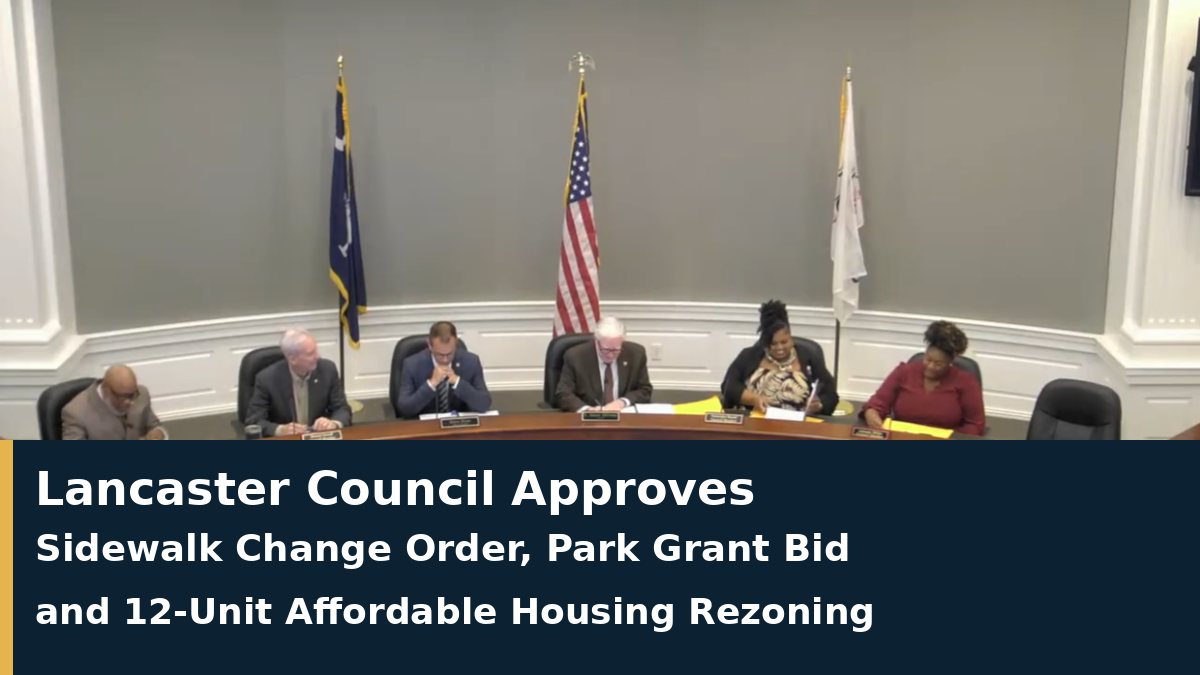

Lancaster City Council on Tuesday, Oct. 27, approved a $24,295 change order for the East Arch Street sidewalk project, authorized a $487,750 state grant application for new playgrounds and a picnic shelter at Municipal Justice Center Park, and gave final approval to a rezoning that clears the way for a 12-unit affordable apartment building on Dixon Road. Council also completed the annexation of two small residential parcels, gave first-reading approval to a third annexation and to a Duke Energy easement downtown, and heard a year-to-date report on the Lancaster Municipal Court. Every vote was unanimous.
The decisions touch several neighborhoods east and south of downtown, where the city is pairing a federally funded sidewalk project with a multiphase rebuild of MJC Park. The Dixon Road rezoning adds a rare piece of new affordable rental housing, and the Duke Energy easement is part of a broader rebuild of the downtown power grid.
Municipal court reports caseload, collections
The meeting opened with the annual State of the Municipal Court briefing, listed on the agenda under Judge Heath. A court representative delivered the prepared report.
From January through mid-October, the court handled 401 bond hearings, 383 prisoner releases, 225 arrest warrants and 70 search warrants, and disposed of about 791 cases ranging from speeding and reckless driving to DUI, shoplifting, assault and battery, and domestic violence. Those cases produced about $78,600 in fines, of which the court has collected about $54,832, a figure that includes older outstanding fines.
The report said collecting fines is a challenge nationwide and cited a 2025 Fines and Fees Justice Center report finding that collections in 24 states fell 33% between 2018 and 2022 even as amounts imposed rose. Court administration advises municipalities not to jail people on bench warrants for unpaid fines, the report said, because arresting and housing a defendant at the Lancaster County Detention Center costs the city more than it recovers. Instead, the court notifies the S.C. Department of Motor Vehicles to suspend licenses and refers debts to the state Setoff Debt Program to intercept tax refunds. About 87 cases have qualified for license suspension notices, and the court has submitted $45,891.50 to the setoff program for the coming tax season.
The court is staffed by a chief trial judge, three full-time and two part-time associate judges, a floater, a part-time clerk and a newly hired full-time associate judge who, after training, will work a 2 p.m. to 10 p.m. weekday shift. The court is also moving from its LawTrak software, used for more than 15 years and no longer supported after the vendor closed, to a new system called ARMS that will allow 24-hour service.
One council member asked whether the new evening judge would reduce the number of arrestees sent to the county jail, noting figures from the police chief showing 60% to 70% are transferred because they cannot get a bond hearing. The court representative said the evening shift will allow more bond hearings and that after-hours calls are rare. The council member said he would share his figures with the court for comparison.
Engineering firm marks 25 years with city
During citizen comments, a representative of engineering firm Ardurra, formerly WK Dickson, thanked council for a 25-year working relationship. He said the firm has helped the city secure roughly $30 million in grants and loans over that time, much of it for the wastewater treatment plant and collection system. Mayor DeVenny thanked the firm for its long service.
Finance report delayed, audit about half done
The city’s finance director told council the September financial report was not ready because staff was still tracking down credit card receipts from departments citywide, which kept the month from closing on time. He said the report will be ready at the next meeting and that he cannot recommend raising department card limits while receipts remain a problem. The annual audit is about 50% complete, he said, with no firm completion date.
He also credited the utility billing staff, who have worked most weekends during the second half of each month to get bills out on time while the city runs two billing systems during its water meter replacement project.
Council members said department heads are responsible for signing and submitting receipts and that City Administrator Flip Hutfles should hold them to it.
Monthly reports note water loss decline
In reviewing the September monthly reports, council members praised the public works staff for quick repairs on Plantation Road and Briarwood. Deputy Police Chief Steven Rice said most police IT tickets with contractor VC3 involve passwords, email and software issues and that response has been timely.
Mayor DeVenny noted the city’s water loss rate has fallen to about 6% to 7% as new meters come online. Staff said the new meters provide hour-by-hour usage data that helps customers pinpoint leaks, and that the replacement project is about 75% complete.
Sidewalk change order adds rail, drainage work
Council approved Change Order No. 2 for the CDBG-funded East Arch Street sidewalk project at a cost of $24,295, paid from the general fund reserve and contingent on state approval.
Street and Sanitation Supervisor Carnes said the change adds safety railing atop the retaining wall in front of the Municipal Justice Center, replaces an open storm grate at East Arch and South Hughes streets with an accessible lid, replaces about 60 feet of failing 18-inch storm pipe along the MJC Park frontage, and adds driveway concrete and curb at Sumpter and Harris streets so runoff from Harris Street no longer flows toward a home’s front door. The cost was partly offset by removing about 175 feet of railing elsewhere after the sidewalk was regraded.
The change raises the contract with Little Mountain Builders of Catawba County to $1,116,426.50. The total project budget is now $1,355,595, with $750,000 from the CDBG grant and $605,595 from the city. Engineering firm Keck & Wood recommended approval.
Carnes said the project has a substantial completion date of mid-April and final inspection in mid to late May, and that work is slightly ahead of schedule. A preconstruction meeting for the separate MJC Park project is set for Thursday, Oct. 29.
Council Member Miller moved to approve, and Council Member Marsh seconded.
City seeks state grant for MJC Park playgrounds
Council adopted Resolution R26-19, authorizing an application to the S.C. Department of Commerce Rural Development Initiative for $487,750 for Phase 2 of the MJC Park improvement project. The phase would add two playgrounds and a picnic shelter.
City Clerk Kelli Stevens said the city will commit $48,789 in local matching funds, plus any additional money needed to finish the project, for a total of $536,539. The match will be budgeted in the fiscal 2027-28 capital improvement plan. The Catawba Regional Council of Governments will provide administrative support.
Stevens said the city’s earlier CDBG grant for the park was approved about two years ago, but bids came in over budget even after the playground equipment and picnic shelter were moved to bid alternates. The new grant would fund those items. With an existing park grant for one playground, the park could eventually have three playgrounds, a picnic shelter, a walking trail and a new parking lot.
The state’s application window closes Oct. 30, with awards expected by Jan. 8, 2027.
Council Member Koss moved to approve, and Council Member Hood seconded.
Two annexations finalized
Council gave second and final reading to two annexations presented by Louis Streater, director of building, planning, zoning and licensing. Neither drew new discussion.
Ordinance O26-16 annexes 0.44 acres at 1004 Roberts Drive, owned by Eduardo Torres Sanchez. Utility service to the rental property was cut off in June 2025, and city code requires annexation before water and sewer can be restored to a structure outside city limits that has been disconnected for more than six months. The parcel is expected to generate about $1,444 a year in property tax. Council Member Sowell moved to approve, and Council Member Miller seconded.
Ordinance O26-17 annexes 0.15 acres at 1147 Sixth St., where Mango Builders LLC built a new single-family home. The lot had not had city water and sewer since 2013, when the previous house was demolished. Staff estimates about $903 a year in property tax. Council Member Hood moved to approve, and Council Member Marsh seconded.
“Lot by lot, the city is growing in these areas, and every time they come in, it makes that entire area better,” Mayor DeVenny said.
Dixon Road rezoning cleared for apartments
Council gave second reading to Ordinance O26-18, confirming multifamily zoning on 1.032 acres at 273 Dixon Road owned by the Mace Green Trust. The parcel came into the city with interim multifamily zoning.
Streater said property owner Mace Green Jr. plans a $3 million multistory building with 12 affordable three-bedroom, two-bath units of about 1,200 square feet each. HUD’s 2026 fair market rent for a three-bedroom unit in the area is $1,382 a month. The project is expected to generate about $40,000 a year in property tax once built. The Planning Commission recommended approval after a June 2 public hearing.
Streater said the building would stand alone, not as part of a larger complex, and that no formal site plan has been filed, though the proposal fits what multifamily zoning allows.
Council Member Miller moved to approve, and Council Member Marsh seconded.
15th Street annexation advances
Council gave first reading to Ordinance O26-19, annexing 0.08 acres at 926 15th St. owned by Lora Massey. Service to the property, which holds a 2000 Clayton mobile home, was disconnected Dec. 31, 2025, and Massey petitioned for annexation to restore water, sewer and garbage service. The parcel adjoins city limits to the north and west, sits beside the railroad tracks south of the city’s 15th Street building, and is expected to generate about $180 a year in property tax.
Streater said adjoining state road and railroad rights of way are annexed along with the parcel. Council Member Marsh moved to approve, and Council Member Miller seconded.
Duke Energy easement for downtown grid work
Council gave first reading to Ordinance O26-20, granting Duke Energy Carolinas a permanent, nonexclusive easement on city property in the alley between South White Street and 521 BBQ, beside the Native American Studies Center. The easement runs about 143 feet and includes a 30-foot strip for overhead lines and a 20-foot strip for underground lines.
Carnes said the work is part of Duke Energy’s Lancaster Voltage Conversion Project, will not block vehicle access or city garbage trucks, and Duke will restore the area afterward. The city pays nothing and receives no compensation.
A Duke Energy right-of-way representative said the utility is replacing old poles and lines throughout downtown and adding underground service to prepare for growth. Four easements are needed on the block. Two are signed, the city’s is pending and a fourth owner, Watts Tax Service, has agreed verbally.
Council Member Sowell moved to approve, and Council Member Koss seconded.
Council adjourned after the easement vote. Second reading of the Duke Energy easement and the 15th Street annexation is expected at council’s Nov. 10 meeting.

Sign up for our Sunday Spectator. Delivered to your inbox every Sunday, with all the news from the week.

Thomas Hyslip lives in Tega Cay with his wife and daughter. After 27 years in the U.S. Army and Federal Law Enforcement, he retired to pursue his passion for teaching. Tom is now an Assistant Professor of Instruction at the University of South Florida. In 2 short years he has won 10 awards from the South Carolina Press Association, including first place in column writing, education beat reporting and best podcast.