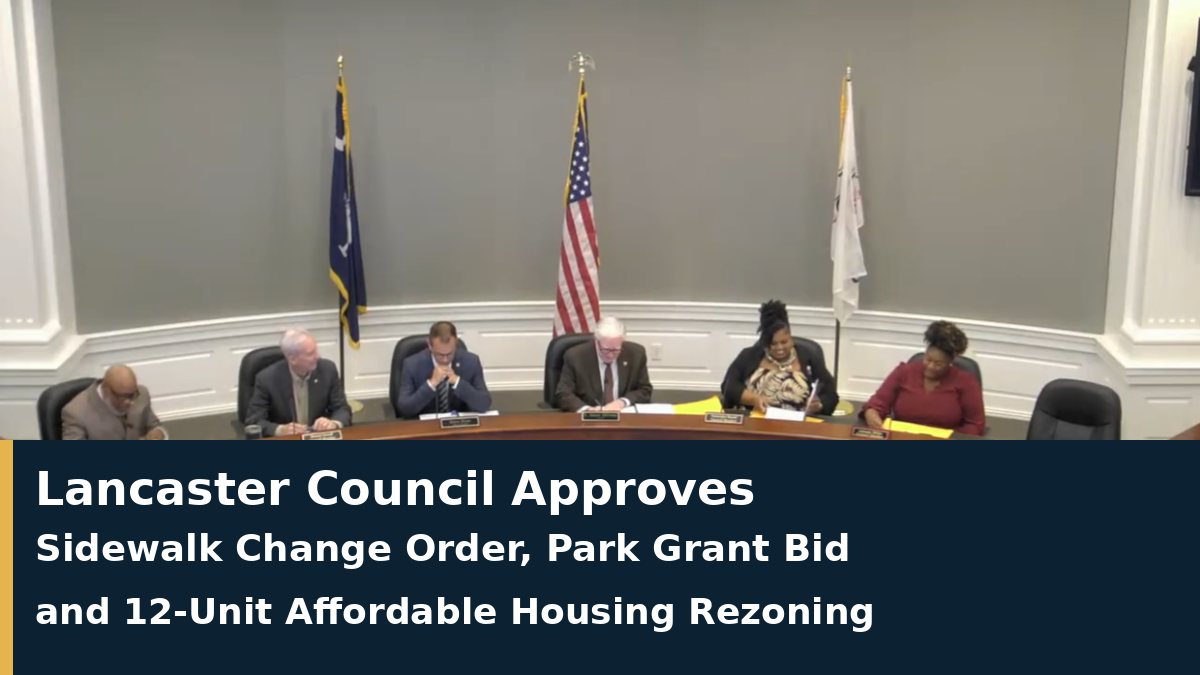

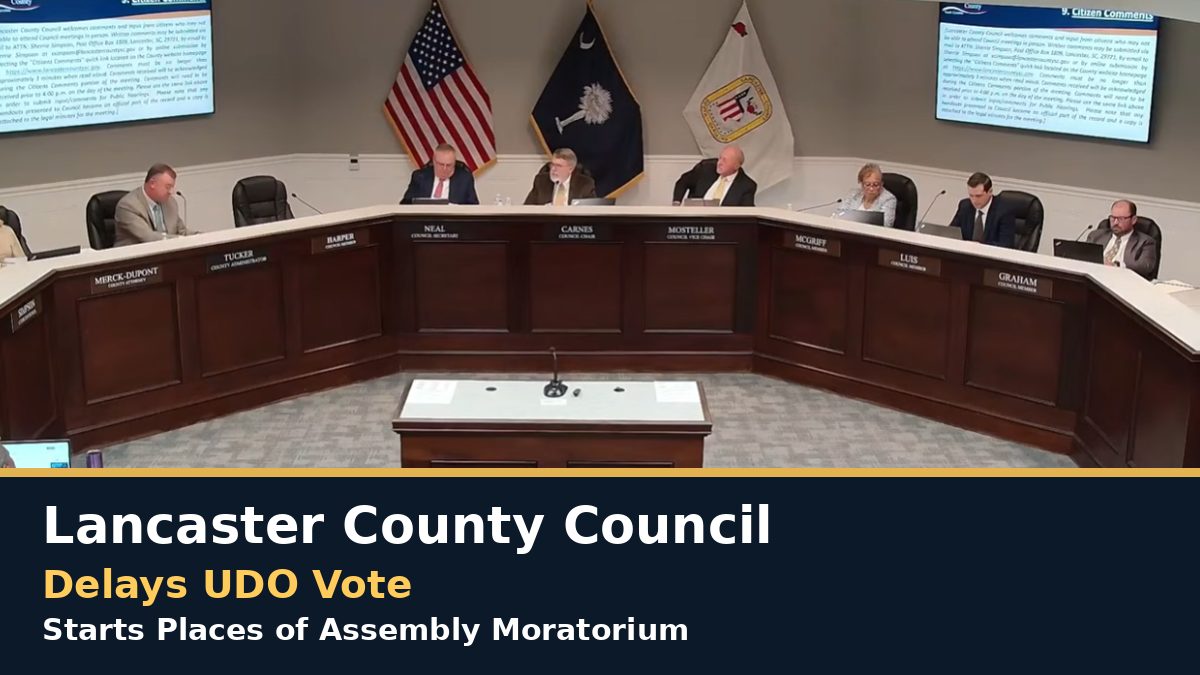

Lancaster County Council on Monday, Oct. 26, postponed the final vote on its rewritten Unified Development Ordinance until its next meeting, giving members more time to review the document before the county’s development moratorium expires Nov. 10. The 5-1 vote came after staff told council the draft had not changed since second reading.
Council also gave unanimous first reading to a 60-day moratorium on new places of assembly in residential zoning districts, a step County Administrator Brian Tucker said will give staff and the UDO ad hoc committee time to settle how large gathering places such as churches and event venues should fit into neighborhoods. Members unanimously advanced two ordinances tied to the Harris Mill Residential Improvement District, including authorization for up to $9 million in assessment revenue bonds, and gave first reading to updated state building codes that take effect Jan. 1, 2027. A fiscal 2026-27 budget amendment accepting state supplemental funding received final approval.
During public comment, residents of the Rosleyn active adult community in Indian Land raised traffic, noise and buffer concerns about the county’s regional sports complex being built beside their homes, and an Indian Land resident pressed council to keep its promise to fix a gas station provision in the new UDO. Two rezoning requests for property on Harrisburg Road were withdrawn by the applicant.
Executive session
Council opened at 5 p.m. and went into closed session to receive legal advice on the status of pending litigation involving the Planning Commission and Planning Department, and on possible requirements for places of assembly. Interim Planning Director Shannon Catoe was invited into the session for both items. County Attorney Ginny Merck-Dupont reported afterward that no motions were made and no votes were taken.
Rosleyn residents raise sports complex concerns
Three residents of Morning Song Way in Roselyn told council the Lancaster County regional sports complex sits in the middle of an age-restricted community whose residents were not fully told of its scope. One speaker said the project was first described as a park, then a sports park, then a regional complex, and that each label carried a different sense of size and impact.
Speakers listed four main concerns: traffic, safety and security, noise and the tree buffer. They asked the county to strengthen thin sections of the buffer once the park nears completion, to bar air horns and other noise makers, to rule out concerts and fireworks and to move the complex’s closing time to 9 p.m. to match the community’s covenant quiet hours.
Traffic drew the most attention. Residents said the current plan sends all complex traffic onto Rosleyn Avenue off U.S. 521 and around a traffic circle that fronts the community clubhouse and pool, where residents walk, bike and drive golf carts. One speaker estimated more than 750 cars could turn over every two to three hours on event days, on top of traffic from roughly 1,800 homes under construction. He asked the county to build a separate road through an undeveloped, commercially zoned parcel to connect the complex directly to U.S. 521. Another resident asked for a county or state traffic study on whether a signal is needed at Rosleyn Avenue and U.S. 521.
Gas station provision in the UDO
An Indian Land resident who has spoken repeatedly on the UDO told council that item 32 of the draft UDO change matrix incorrectly describes the current code. Staff had said minor vehicle services, which include gas stations, should be permitted with review in the Neighborhood Business district to stay consistent with the existing UDO. She said the current UDO allows gas stations in those districts only as a conditional use and that the new language would let them proceed without a public hearing. She reminded council that members acknowledged the issue at first reading and committed to correcting it by text amendment after adoption. She also said a development near her neighborhood on Barberville Road has begun advertising a future gas station.
Electronic comment on manufactured homes
Clerk to Council Sherrie Simpson read a written comment from a research coordinator with the Manufactured Housing Institute of South Carolina regarding the UDO. The institute asked council to expand the residential districts where HUD-code manufactured homes are allowed, to distinguish manufactured home subdivisions from manufactured home parks and land lease communities, and to further consider replacement homes, foundation and installation requirements and model year restrictions.
Solicitor’s office recognized
Randy E. Newman Jr., solicitor for the Sixth Judicial Circuit, recognized two staff members who won state awards at the 2026 South Carolina Solicitors Conference.
Assistant Solicitor Julian Cuthbertson received the John R. Justice Award, named for the former Sixth Circuit solicitor who served from 1978 to 2006. The award includes $1,500 toward student loans. Newman said it is the circuit’s fourth John R. Justice Award since 2018. Cuthbertson joined the office in 2023, is a graduate of the North Carolina Central University School of Law and now leads the office’s drug prosecution team and serves on drug court. Newman said he also volunteers with Lancaster County Parks and Recreation and coaches his daughter’s soccer team.
Victim Services Specialist Madison Shaw was named South Carolina Victim Advocate of the Year by the South Carolina Victim Advocates Forum. Shaw, a University of South Carolina graduate who joined the office in 2022, works as a paralegal and victim services specialist in the violent crimes unit. Newman said most circuits assign one paralegal per prosecutor, while Shaw handles the caseloads of three. The circuit last won the award in 2017.
Newman also reported that the state Supreme Court recognized the circuit for cutting its case backlog by more than 30%, compared with a statewide average of 27%, and reducing total pending cases by 10% against a state average of 7%. In Lancaster County, pending warrants fell from 5,975 on July 1, 2025, to 4,831 on July 1, 2026, even as 2,377 new warrants came in. Newman said the county disposed of 167% of its incoming cases, ranking fourth among the state’s 46 counties.
Consent agenda
Council unanimously approved the minutes of its Oct. 12 regular meeting.
Harris Mill improvement district
Council gave unanimous first reading to two ordinances involving the Harris Mill Residential Improvement District, which council created in 2020. Michael Seezen, a partner with Burr & Forman and the county’s bond counsel, presented both.
The district originally covered about 320 acres and 381 lots planned in five phases. Seezen said the developer has spent about three years installing roads, water, sewer and stormwater infrastructure and expects to finish public infrastructure by this time next year. Homes in Phase 1 are already being sold.
The first ordinance, 2026-2062, removes Phase 1, about 60 lots, from the district. Seezen said state law requires notice to be recorded so future buyers know their property is subject to assessments, and lot sales in Phase 1 began before that notice was filed. He said the developer did not tell Phase 1 buyers their lots would be assessed, so those homeowners will not be. The district would shrink to about 250 acres covering Phases 2 through 5, and assessments on those lots would remain at the maximum.
The second ordinance, 2026-2063, authorizes up to $9 million in assessment revenue bonds to buy public infrastructure, fund capitalized interest and a debt service reserve and cover issuance costs. Seezen said the original improvement plan caps bond proceeds for improvements at $7 million and caps annual assessments at $1,850 per property. Based on those limits, the county’s assessment consultant, MuniCap, expects the bonds to sell for between $7 million and $8 million. He said the developer has already put about $27 million in improvements into Phases 2 through 5.
The bonds would be sold through underwriter FMS Bonds only to accredited investors in blocks of $25,000 or more, the same structure the county used earlier this year for Rosleyn . State law also requires the property owner to pay the county a fee equal to 4% of the bond amount, which Seezen said would go toward additional road infrastructure. If council approves both ordinances at its next two meetings, closing is expected in December.
Charlene McGriff made the motion on 2026-2062 and Billy Mosteller seconded. Bryant Neal moved approval of 2026-2063 with a second from McGriff. Both passed unanimously.
UDO final vote postponed
Ordinance 2026-2059, which repeals and replaces Appendix B of the county code with the rewritten UDO and new zoning and overlay maps, came up for third reading. McGriff moved approval and Mosteller seconded. Staff said nothing had changed since second reading.
A council member asked when the development moratorium expires. Staff said it would end as soon as council adopts the UDO, or on Nov. 10 if council does not act, leaving one more meeting before the deadline. The council member then moved to postpone the vote to the next meeting to allow more time to review the documents. Jose Luis and Stuart Graham seconded. Tucker said the delay still fits the timeline. The motion to postpone passed 5-1.
Places of assembly moratorium
Council unanimously gave first reading to Ordinance 2026-2065, a 60-day moratorium on development approvals for new places of assembly, both small and large, and material expansions of existing ones in unincorporated Lancaster County. Luis made the motion and Neal seconded.
Tucker said the current UDO treats places of assembly as one category, while the new UDO splits them into small and large at 200 attendees. He said there has been debate over whether 200 is the right threshold and which zoning districts should allow them. The moratorium applies only to residential districts, not commercial ones. Tucker said staff wants to weigh traffic and infrastructure impacts on existing neighborhoods and avoid unintended consequences, and he expects the work can be finished in 60 days, though the moratorium could be extended. The UDO ad hoc committee will continue meeting to work through this and other text amendments after the UDO is adopted.
Budget amendment adopted
After a public hearing with no speakers, council unanimously gave third and final reading to Ordinance 2026-2060, amending the fiscal 2026-27 budget to receive supplemental appropriations from the state and spend them on state-approved projects. Finance Director Paul Rodrigues said the ordinance also creates a special revenue fund to track the money separately from the general fund. McGriff made the motion and Mosteller seconded.
Building codes updated
Council unanimously gave first reading to Ordinance 2026-2064, adopting updated building codes mandated by the South Carolina Building Codes Council, effective Jan. 1, 2027. Darin Robinson told council the county adopts new codes on a three-year cycle, last done in 2022, and the state added a year this time. He said the update includes hundreds of code changes, with 149 South Carolina modifications, and that county staff have already held training sessions. Luis made the motion and Neal seconded.
Harrisburg Road rezoning withdrawn
Two ordinances on the agenda for third reading, 2026-2050 and 2026-2052, were withdrawn by the applicant. They would have rezoned about 32.89 acres at 11632 Harrisburg Road from Light Industrial to Institutional and changed its future land use designation from Economic Development to Growth Area. The Planning Commission and planning staff had recommended denial of both. Tucker said the items were left on the agenda because of public interest and that the applicant has withdrawn its interest in the property, not just the project, so they will not return. No action was required.
Board appointment
Council unanimously appointed John Greene to the Van Wyck Fire Protection Fee District Board to fill an unexpired term ending June 30, 2027. Graham made the motion and Luis seconded. Current board vacancies and upcoming expirations were presented for information only.
Items still on hold
Two requests for 159.64 acres off Old Hickory Road, a rezoning from Rural Neighborhood to Medium Density Residential and a related comprehensive plan amendment, remain postponed at the applicant’s request. Both received unanimous recommendations of denial from the Planning Commission.
Council’s next regular meeting is scheduled for Nov. 9, when the UDO is expected to return for third reading, along with second readings of the Harris Mill ordinances, the places of assembly moratorium and the building codes update.

Sign up for our Sunday Spectator. Delivered to your inbox every Sunday, with all the news from the week.

Thomas Hyslip lives in Tega Cay with his wife and daughter. After 27 years in the U.S. Army and Federal Law Enforcement, he retired to pursue his passion for teaching. Tom is now an Assistant Professor of Instruction at the University of South Florida. In 2 short years he has won 10 awards from the South Carolina Press Association, including first place in column writing, education beat reporting and best podcast.