
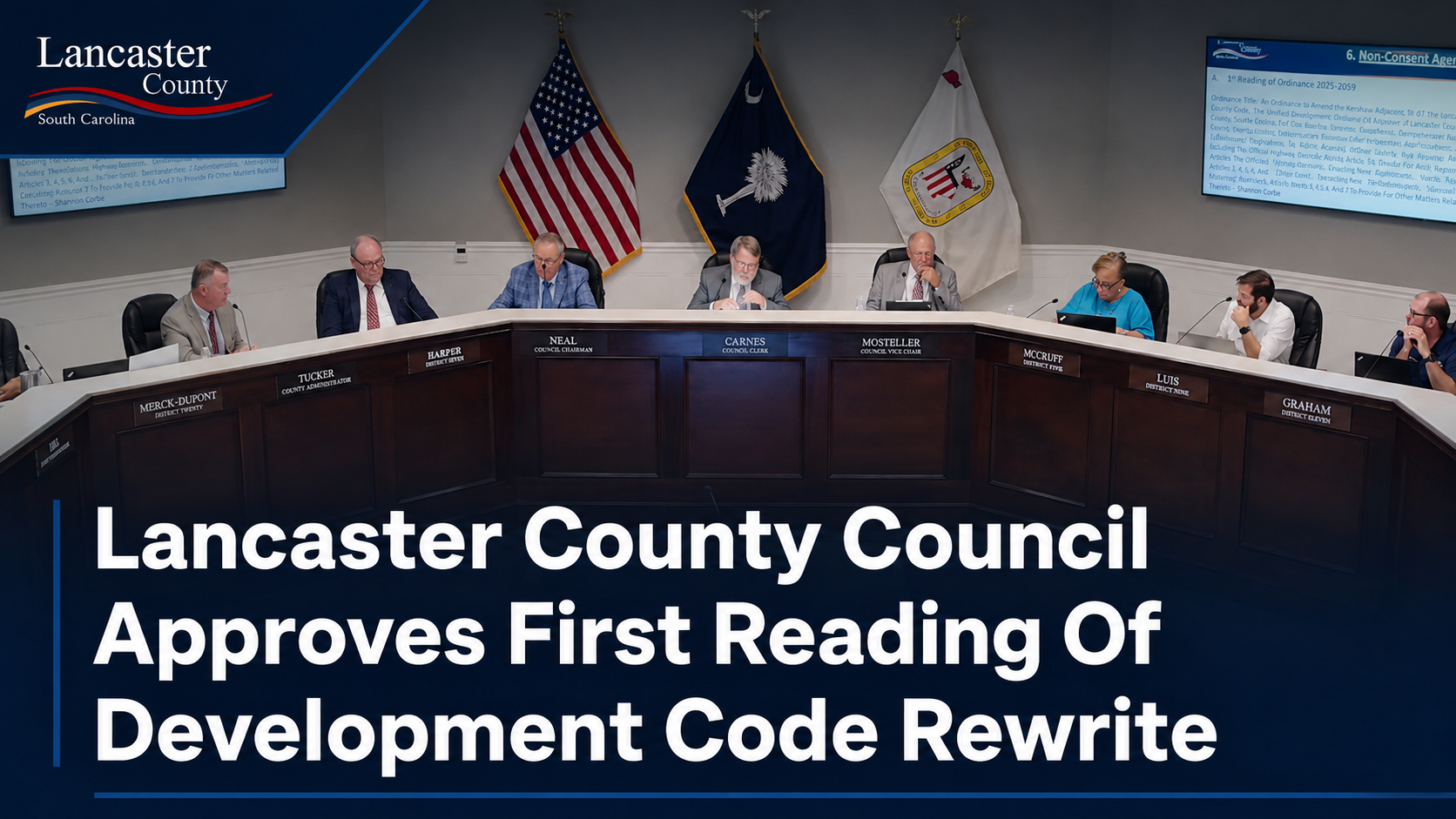

Lancaster County Council voted unanimously Tuesday to approve first reading of a comprehensive rewrite of the county’s development rules, attaching more than two dozen changes before sending the document back to the Planning Commission.
Ordinance 2026-2059 would repeal and replace Appendix B of the Lancaster County Code, the Unified Development Ordinance, rewriting the county’s zoning, subdivision, development review, design, transportation, infrastructure and environmental protection regulations and adopting revised zoning and overlay maps.
The special called meeting at the County Administration Building on North Main Street ran about two hours, nearly all of it spent working line by line through a matrix of Planning Commission and staff recommendations. No citizens comments were received.
County Administrator Brian Tucker told council the schedule is tight. The Planning Commission meets in special session next week to take up the changes, with second and third readings to follow. Third reading is targeted for Oct. 12, before the county’s development moratorium expires.
Council agreed to allow individual septic systems on lots of at least three-quarters of an acre in the rural neighborhood and low density residential districts where public water is available. Shared and community septic remain prohibited, and systems cannot sit in common open space.
Members dropped the requirement for mast arm traffic signals in the Highway Corridor Overlay, citing replacement cost, and added Highway 5 to that overlay because of its connection to Rock Hill and York County. Pylon signs will be prohibited. Parking for single family homes, which the draft set at the greater of two spaces per unit or one per bedroom, was capped at four.
The Carolina heelsplitter overlay stays in place for now. Council was told the county has been out of mitigation credits for some time while continuing to collect payments, and directed that the standards and a new banking process be handled by text amendment after adoption.
A stormwater staff proposal to cap active mass clearing and grading at 30 contiguous acres was not added. Councilman Steve Harper said the limit could push construction traffic through occupied sections of a subdivision and complicate water and sewer phasing. It will be studied and brought back later.
Council also agreed to let the county require development agreements in accordance with state law rather than mandate them for certain projects, and directed the development agreement ad hoc committee to draft a policy so similar projects are treated consistently.
Second reading is expected after the Planning Commission acts next week.

Sign up for our Sunday Spectator. Delivered to your inbox every Sunday, with all the news from the week.

Thomas Hyslip lives in Tega Cay with his wife and daughter. After 27 years in the U.S. Army and Federal Law Enforcement, he retired to pursue his passion for teaching. Tom is now an Assistant Professor of Instruction at the University of South Florida. In 2 short years he has won 10 awards from the South Carolina Press Association, including first place in column writing, education beat reporting and best podcast.