


Money Did Not Win Every York County Primary Race
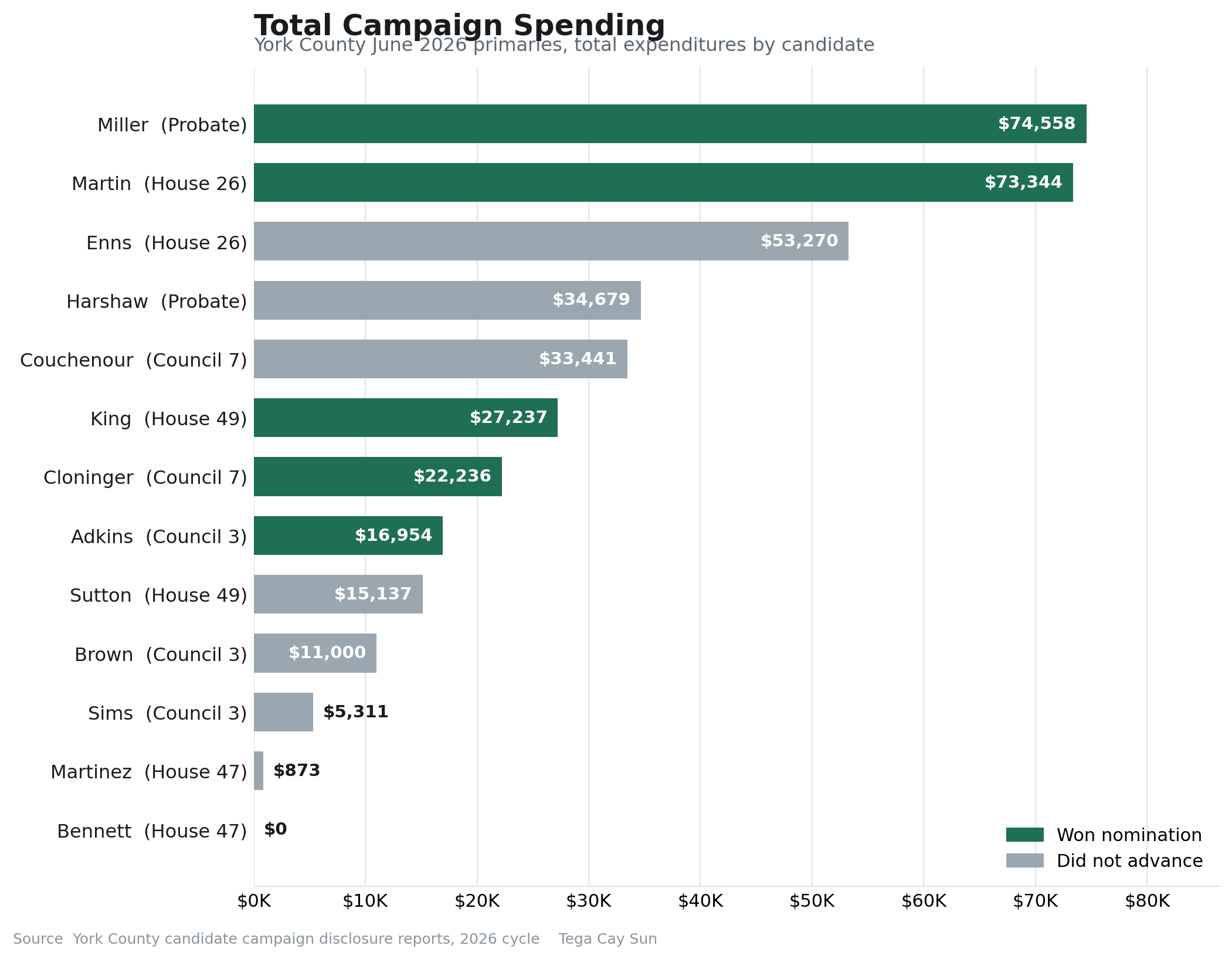
Justin Bennett won the Democratic nomination for South Carolina House District 47 on June 9 without raising or spending a single dollar through his campaign account. In the same election, incumbent Rep. David W. Martin reported spending more than $73,000 to hold his District 26 House seat, the most any York County primary candidate spent this cycle.
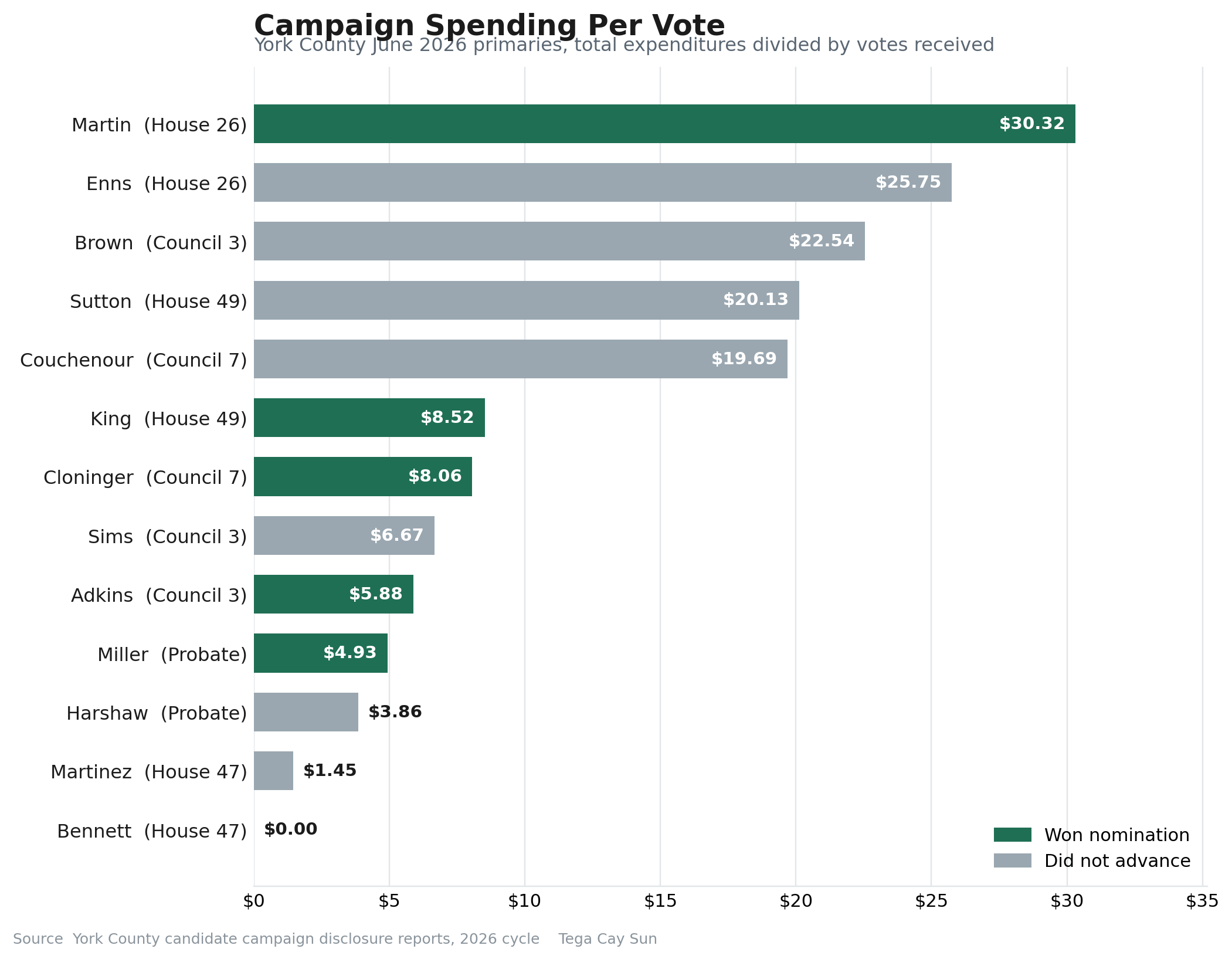
The gap between those two campaigns frames a wider picture drawn from the candidates’ latest campaign disclosure reports. Across the six local and legislative primaries decided June 9, the 13 candidates on the ballot reported raising a combined $441,804.97 and spending $368,039.34. That works out to an average of $33,985 raised and $28,311 spent for each campaign, or roughly $10.37 raised and $8.64 spent for every one of the 42,587 votes cast in these races.
Those totals come from the Quarter 2, 2026 reports the candidates filed in early and mid July, after the primary.
Here is how the money broke down, race by race.
Probate Judge
The countywide Republican primary for York County Probate Judge drew far more voters than any other local race, and both candidates spent accordingly. Anna Miller, who won the nomination with 15,117 votes, reported raising $78,807.01 and spending $74,557.86. Her total included $52,940 in cash contributions and $23,720 in loans to the campaign. Because turnout was so high, her spending came to $4.93 per vote, one of the lowest figures among the winners despite the large dollar amounts. Her single largest vendor was LimeLight Marketing, which received about $52,293 for printed materials, including one $50,000 payment in early May.
Daniel H. Harshaw raised and spent $34,679.20, the two figures matching because he filed a final report that closed out his account. That included $8,520.05 of his own money. His spending came to $3.86 per vote, the lowest of anyone in the field who raised money at all. His largest vendor was the consulting firm First Tuesday Strategies, which received about $21,780.
Miller faces no Democrat in November and is positioned to take the seat.
County Council District 3
Tommy Adkins won the three way Republican primary with 2,882 votes while running one of the leaner campaigns relative to his return. He reported raising $17,125 and spending $16,954.27, all of it from contributions rather than his own pocket, for $5.88 per vote. His largest identified vendor was Diversified Signs at $4,173 for yard signs and banners, though his reports also show about $5,483 spent on campaign hats with no vendor named.
Bradley C. Sims, who finished second with 796 votes, raised $5,949.53 and spent $5,310.57, or $6.67 per vote. About $3,800 of that came from his own funds, and his largest vendor was UZ Marketing at $1,544. Stephanie Brown, third with 488 votes, financed her entire $11,000 campaign herself through a $10,000 loan and a $1,000 personal contribution. She spent the full $11,000, which came to $22.54 per vote, the highest cost per vote of any candidate who did not spend into six figures. Her largest expenditure was a single $6,450 payment to Red Truck Media.
Adkins is unopposed in the general election.
County Council District 7
District 7 produced the clearest case of the cycle in which the bigger checkbook lost. Scott W. Couchenour raised $34,000, nearly all of it, $33,000, from his own money, and spent $33,440.62. Debi Cloninger, who won the nomination with 2,758 votes to Couchenour’s 1,698, raised $22,690.26 and spent $22,236.35, a total that leaned on outside contributions and a $4,000 loan.
Couchenour outspent the winner by more than $11,000 and still lost. His spending came to $19.69 per vote, and his largest expenditure was a single $14,278 payment to LimeLight Marketing for mailers. Cloninger’s spending came to $8.06 per vote, spread across many smaller vendors, the largest of which was the printer Got Print at about $3,485. She is unopposed in November.
State House District 26
The District 26 Republican primary was a rematch of 2024, and the result held. Martin again defeated Elizabeth Enns, this time 2,419 votes to 2,069, after winning the 2024 primary 2,117 to 1,777.
The money grew sharply between the two contests. Martin reported raising $131,658 this cycle, more than double the $63,511 the Tega Cay Sun recorded for him in 2024. He spent $73,344.41 through the primary, or $30.32 per vote, the most of any candidate. His report listed $121,658 in cash contributions and a $10,000 loan. His single largest expenditure was a $33,268 consulting payment to Starboard Communications in January, nearly half of everything he spent.
Enns raised $48,902.75 and spent $53,269.61, meaning she spent more than she took in and drew down a reserve to do it. Her spending came to $25.75 per vote. Her largest vendor was The Cierge Group, which received about $28,996 across several consulting and campaign payments. Martin advances to a three way general election against Democrat Jenny Desch and Workers Party candidate Kiral Mace.
State House District 47
Bennett’s win stands apart. His campaign account reported no cash contributions and no expenditures across both his pre election and second quarter filings. The $208 filing fee he paid to enter the race came from personal funds, the only cost his reports reflect. He won the Democratic nomination with 835 votes, a cost per vote of zero.
Peter A. Martinez, III, who finished with 601 votes, ran a modest campaign of his own, raising $1,531 and spending $872.98, or $1.45 per vote. His largest expenditure was $640 to Office Depot. Of the two Democrats, Bennett is the one moving forward. He faces Republican incumbent Tommy Pope, the Speaker Pro Tempore of the South Carolina House, in the fall, a race that will test how far a no cost primary strategy can carry.
State House District 49
Incumbent Rep. John R. King won the Democratic nomination with 3,196 votes to Perry L. Sutton’s 752. King raised $38,841.80 and spent $27,236.90, all from contributions and account credits rather than personal money, for $8.52 per vote. His largest vendor was Momentum National, which received $14,907 for mailers and voter contact.
Sutton raised $16,620.42 and spent $15,136.57, most of it self financed through nearly $12,000 in loans. His spending came to $20.13 per vote, and his largest vendor was TCC Political Service at $7,526 for canvassing and phone banking. No Republican filed in the district, so King is positioned to keep the seat.
What the numbers show
Read together, the reports tell a mixed story about whether money buys York County votes. In four of the six races, the candidate who spent the most won. But the two exceptions were striking. Couchenour outspent Cloninger and lost District 7, and Bennett won District 47 while spending nothing at all. The spread ran from Martin’s $30.32 per vote down to Bennett’s zero, with Martinez the next lowest at $1.45.
The biggest checks in these races went to consultants, marketing firms and mail houses rather than to signs or events. LimeLight Marketing was the top vendor for both Miller and Couchenour and a significant one for Martin, while Starboard Communications did work for both Martin and Miller. In several races a single consulting or mail payment accounted for a large share of a candidate’s entire budget.
Self funding was common. Couchenour, Brown and Sutton covered most or all of their campaigns with their own money, and none of the three won. Miller and Martin also carried loans, though both won by wide margins on the strength of large outside contributions as well.
The figures for Martin and Bennett will keep moving, since both advance to contested November elections and will continue to file. Their next quarterly reports, along with those of the unopposed nominees who keep their accounts open, are due to the state in October. All of the reports are public and searchable through the South Carolina State Ethics Commission.
Source: Candidate campaign disclosure reports filed with the South Carolina State Ethics Commission for the 2026 election cycle, and the Tega Cay Sun’s June 16, 2024 campaign finance analysis for the 2024 comparison figures.

Sign up for our Sunday Spectator. Delivered to your inbox every Sunday, with all the news from the week.

Thomas Hyslip lives in Tega Cay with his wife and daughter. After 27 years in the U.S. Army and Federal Law Enforcement, he retired to pursue his passion for teaching. Tom is now an Assistant Professor of Instruction at the University of South Florida. In 2 short years he has won 10 awards from the South Carolina Press Association, including first place in column writing, education beat reporting and best podcast.