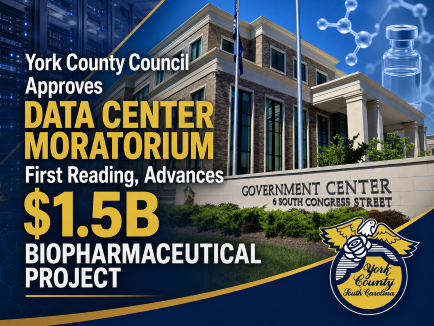

York County Council passed first reading of a nine-month moratorium on new data center approvals, took the opening step toward a $1.5 billion biopharmaceutical development at the former Panthers site in Rock Hill, denied a rezoning request that had drawn strong neighborhood opposition in Fort Mill, and referred up to $1 million in preservation funding for a 120-acre historic agricultural property in the city of York during its June 15 regular meeting at the York County Government Center.
The meeting drew a standing-room crowd, with much of the public comment focused on the QTS data center under construction off Hans Mill Highway and on a pair of economic development items the council addressed later in the evening.
Public forum
Nine residents signed up to speak during the public forum session, addressing three overlapping topics: the Silfab solar panel manufacturing plant near Flint Hill Road, the QTS data center project, and rezoning case 26-06 on Highway 160 west of Fort Mill.
Amanda Lane, who said she lives less than a mile from the Silfab facility on Laura Mont Court, told the council she sold her home and pulled her daughter from school after a series of chemical incidents at the plant. “You lost nothing. We lost everything,” she said, calling on council to treat the facility as a legal nuisance and require its relocation.
Several speakers addressed the data center, asking council to approve the proposed moratorium and to provide public answers about projected tax revenue from the QTS agreement, which was approved in September 2023 under the code name Project Cobra. Chris Thompson of York said she had submitted questions to council six months earlier without receiving a response. “No one goes into a business deal without having a number,” she said.
Julie Ferrell of Vanderlakes asked council to ensure that any moratorium apply not only to future data center permits but also to the five remaining buildings at the QTS site that have not yet entered the permit process. She also asked council to extend public comment time from two minutes to at least three.
Two residents spoke in opposition to rezoning case 26-06, a request to rezone 1.776 acres on Highway 160 from planned development to general commercial. Jacqueline Albby of Fort Mill cited traffic concerns and said a pedestrian was struck by a car near the site on June 2. Kaylee McLerty, also of the Fieldstone at Waterstone community, said the 2008 planned development zoning contained protections against gas stations, fast food establishments, and late-night operations that general commercial would eliminate.
County Manager Josh Edwards briefly addressed public questions about code names and data center revenue figures following the consent agenda vote, noting that code names are standard practice statewide when recruiting businesses. He said tax revenue projections for the data center had been sent to council staff and were public.
Consent agenda
Council approved the consent agenda with one item removed. Council member A. Watts Huckabee Sr. pulled item 33, the purchase of a mobile command vehicle, for separate discussion. The remaining items, which included software renewals, road materials contracts, and three rezoning cases on second reading, passed without discussion.
Old business
Rezoning case 26-03, Blessed Hope Road, York (GC to RMX-20, 12.80 acres, District 3)
Council approved third reading of a rezoning request by applicants Joyce and Daniel Baker to reclassify 12.80 acres on Blessed Hope Road from general commercial to RMX-20, allowing the property to be subdivided into three large residential lots. Council member Tommy Adkins, whose district includes the parcel, moved to approve contingent on the property owner recording a deed restriction within 90 days limiting further subdivision. County attorney staff confirmed no legal barrier to conditioning the approval on that timeline. Motion carried.
Rezoning case 26-06, Highway 160 West, Fort Mill (PD to GC, 1.776 acres, District 1)
Council denied on third reading a request by TWP Ft Mill Retail, LLC to rezone 1.776 acres on Highway 160 west of Fort Mill from planned development to general commercial. The motion to deny carried without objection.
Planning staff noted after the vote that the property remains developable under its existing 2008 planned development zoning, which permits uses such as coffee shops and drive-through businesses, though the developer would not be required to meet current standards on items such as lighting direction and drive-through escape lanes that the county has added to its newer zoning code. Huckabee suggested staff informally encourage the developer to voluntarily incorporate updated standards. Vice Chairman Tom Audette, whose District 1 includes the parcel, said the process “worked” to surface the conflict before a final decision.
New business
Water meter ratification, $267,874
Council ratified a previously unpaid bill of $267,874 to Fortiline Inc. of Concord, North Carolina, for water meter installations completed in a prior fiscal year. Edwards said the new utility director identified the outstanding obligation and brought it forward for payment. Motion carried unanimously.
Stockbridge Trunk Sewer project, $5,880,543
Council approved awarding bid 3035 for the Stockbridge Trunk Sanitary Sewer Improvements project in Tega Cay to State Utility Contractors Inc. of Monroe, North Carolina, for $5,880,543. The project is the final phase of a multi-year effort to replace aging infrastructure and eliminate four lift stations by connecting to a regional gravity sewer system.
Council member Andy Litten raised questions about whether the county could fund the project’s second-year costs, approximately $1.4 million in fiscal year 2028, given declining utility fund balances and unresolved rate study findings. Utilities staff said the project was too far advanced to pause and that reprioritization had already occurred within the fiscal year 2027 budget. Edwards said a rate study consultant would present findings to council in late fall or early winter. Motion carried unanimously.
Project Palmetto Rock, first reading of FILOT agreement
Council passed 7-0 on first reading an ordinance authorizing a fee-in-lieu of ad valorem tax agreement for Project Palmetto Rock, a proposal by a global biopharmaceutical company to build a corporate headquarters and advanced manufacturing facility at Palmetto Research Park, the former Carolina Panthers site adjacent to Interstate 77 in Rock Hill.
Economic Development Director Mitch Miller told council the project represents approximately $1.5 billion in capital investment and is projected to create more than 1,200 direct jobs, with average manufacturing salaries above $100,000 and office positions averaging $142,000. An independent analysis estimates the project could support an additional 2,200 indirect jobs.
Miller explained that the fee-in-lieu structure reduces the company’s effective assessment ratio from South Carolina’s standard 10.5 percent down to 4 percent over a 40-year term, making the project competitive with neighboring states. Over the life of the incentive agreement, the project is projected to generate approximately $362 million in new tax revenue split roughly 62 percent to Rock Hill Schools, 24 percent to the city of Rock Hill, and 14 percent to York County. The site currently generates no tax revenue as it is owned by Rock Hill.
Miller also said the company’s manufacturing process does not involve diseases or viruses, describing it as producing pharmaceutical products that are “life-saving” and “minimal” in environmental footprint. The company will publicly identify itself at a special-called second reading scheduled for June 29, which will include a public hearing.
Several council members used the vote to address public questions about the county’s use of project code names and fee-in-lieu agreements more broadly. Council member William “Bump” Roddey cautioned that eliminating Act 388, which shifted much of the property tax burden from residential to commercial properties, would likely increase residential tax bills by roughly 80 percent.
State economic development grant authorization for Project Palmetto Rock, $65 million
Immediately following, council approved 7-0 a resolution authorizing staff to apply for a $65 million South Carolina Coordinating Council for Economic Development set-aside grant on behalf of Project Palmetto Rock. No local match is required. Council members clarified for the public that York County is not providing the funds but acts as a pass-through conduit for state money designated for site preparation, building construction, and road improvements.
Data center moratorium, first reading
Council passed first reading of an ordinance establishing a nine-month moratorium on new special exceptions, conditional use approvals, site plan acceptances, and other land use approvals for data centers in unincorporated York County. The vote was not unanimous. Roddey abstained, saying he did not have enough information about whether the moratorium would apply to the existing QTS data center and said he wanted legal advice in executive session before voting. His motion to enter executive session on that question failed for lack of a second. The motion on first reading carried.
Discussion was at times contentious. Roddey said council was voting on something it could not explain to the public and that the ordinance originated as a different referral from what eventually reached the agenda. Huckabee argued the county should develop capacity standards that apply to any future high-demand industry, not only data centers, so it is not in a similar position when the next large-scale energy or water consumer arrives. County attorney staff said the moratorium would be drafted to comply with South Carolina’s vested property rights act, though a more specific legal opinion on its effect on the current QTS approvals was not given in open session.
The interim county attorney said studies to be undertaken during the moratorium period fall into four categories: rate-making impacts on residential utility customers, generator use limitations, geothermal and heat impacts on adjacent properties, and noise beyond what existing county ordinances already measure.
York Place preservation referral, up to $1 million
Council voted 4-2 to refer up to $1 million from the York County Forever Fund to the York County Forever Commission for its consideration of purchasing development rights on approximately 120 acres of land known as York Place at 234 Kings Mountain Street in the city of York. The site includes a historic agricultural property and is being pursued by the Yorkville Agricultural and Education Society with support from Nation Ford Land Trust.
Edwards said the state conservation bank and state leaders including Sen. Harvey Peeler have committed approximately $2 million toward the project, and that York County Forever funds, which exist specifically for land preservation, cannot legally be used for other purposes.
Litten voted against, arguing the county was paying for development rights on a property already being purchased by a conservation nonprofit, that the value was disproportionately high because the land is zoned industrial and institutional rather than farmland, and that a million-dollar expenditure required more defined terms. Roddey also opposed, calling it a large cash outlay for what he described as a feel-good project. Other council members countered that the preservation fund exists precisely for this purpose and that the project carries wide support from city and state partners.
The referral goes to the York County Forever Commission for evaluation. The commission’s recommendation will return to council before any funds are disbursed.
Mobile command vehicle, $1.4 million
Council approved unanimously the purchase of a new 40-foot custom mobile command vehicle and associated equipment from LDV Custom Specialty Vehicles of Burlington, Wisconsin, for a total not to exceed $1.4 million.
The purchase replaces a 2002 federal surplus unit that Emergency Management Director Chuck Haynes said has structural integrity problems stemming from the slide-out design used by the original manufacturer, which is no longer in business. The vehicle is included in the fiscal year 2027 budget.
Huckabee and Roddey both raised questions about the frequency of use, noting the unit was dispatched to incidents roughly three to four times per year in recent years, and asked whether shared purchasing arrangements with other jurisdictions such as Rock Hill, Clover, or Fort Mill might reduce the county’s cost. Staff said the county’s unit differs from Rock Hill’s in that it is designed for broad multi-agency coordination rather than law enforcement-specific use, and that Duke Energy funding from the county’s nuclear station emergency planning contributed to the purchase cost.
Committee reports
Litten, chairman of the Health and Environmental Protection Committee, reported that he and Huckabee met June 4 to discuss creation of a parks foundation to generate external funds for parks improvements. Staff is researching whether other county parks foundations in South Carolina were established as special purpose districts or special tax districts. The committee also received updates on ongoing park construction projects.
Non-agenda comments
Adkins announced that the fall livestock show at TK Ranch on 728 South Shallow Road in York will celebrate its 25th anniversary Sept. 11-12, with dairy goats, dairy cows, and beef cattle shown Friday and poultry and meat goats on Saturday.
Roddey suggested council revisit its public comment procedures at a future workshop, including potentially extending individual speaking time from two minutes to three and developing a process for council or staff to respond to factual claims made during public forum. Chairwoman Christi Cox said she would ask management to add the topic to the next workshop agenda.
Cox also mentioned that she and Edwards had been approached about creating an agricultural advisory board modeled on one in Abbeville County, and said she would share information with the full council.
Council then entered executive session for a litigation update, legal advice on Project Palmetto Rock, and review of county attorney applications. No action was taken in executive session.
The next regular meeting of York County Council is scheduled for July 13 at the York County Government Center, 6 S. Congress Street in York. A special-called second reading for Project Palmetto Rock, which will include a public hearing and the company’s public identification, is set for June 29.

Sign up for our Sunday Spectator. Delivered to your inbox every Sunday, with all the news from the week.

Thomas Hyslip lives in Tega Cay with his wife and daughter. After 27 years in the U.S. Army and Federal Law Enforcement, he retired to pursue his passion for teaching. Tom is now an Assistant Professor of Instruction at the University of South Florida. In 2 short years he has won 10 awards from the South Carolina Press Association, including first place in column writing, education beat reporting and best podcast.